Compared with going to the moon and back, the flight from San Diego to Houston was a small hop.
Yet for the four crew members of NASA’s Artemis II, who had traveled more than 700,000 miles on the first trip by humanity into deep space in more than half a century, flying to Texas was an emotional last leg of their journey as they reunited with friends and family on Saturday afternoon.
“I have absolutely no idea what to say,” Reid Wiseman, the mission’s commander, said, drawing laughter from the audience during a welcome-back ceremony.
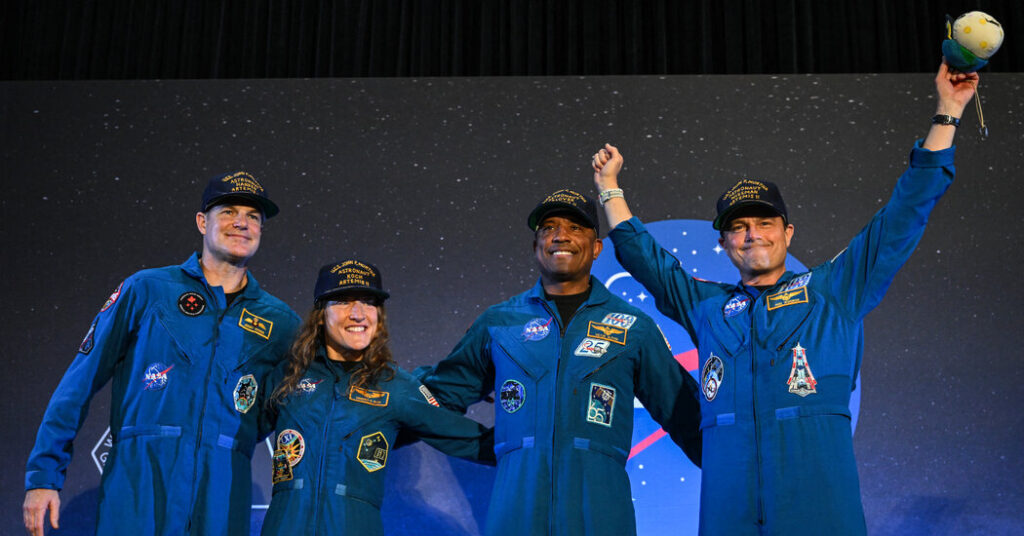
The Artemis II astronauts — Mr. Wiseman, along with Victor Glover and Christina Koch of NASA and Jeremy Hansen of the Canadian Space Agency — sat on a stage at Ellington Field, a small airport in Houston near NASA’s Johnson Space Center.
It was less than a day after they were plucked out of the Pacific Ocean at the end of a successful 10-day mission that zipped around the moon without landing and then returned to Earth.
“Twenty hours ago, the Earth was that big out the window,” Mr. Wiseman said, his hands indicating something about the size of a basketball, “and we were doing Mach 39. And here we are back at Ellington, at home.”
Space officials like Jared Isaacman, the NASA administrator, and Lisa Campbell, the president of the Canadian Space Agency, gave valedictory speeches, as did politicians like Brian Babin, the Republican representative whose congressional district contains the NASA Johnson Space Center.
Mr. Isaacman noted that, a couple of months ago, Mr. Wiseman had said in an interview that he hoped Artemis II would eventually be forgotten, overshadowed by much greater space achievements to come.
“But I’m very sorry to disappoint you all,” Mr. Isaacman said. “Artemis II will always be remembered.”
He thanked the astronauts. “Thank you for showing us the moon again,” Mr. Isaacman said. “Thank you for showing us planet Earth again.”
Each of the astronauts spoke. Each touched on the themes of unity and humanity sharing a planet.
Mr. Wiseman noted how difficult it was for the families back on Earth, including his two daughters.
”This was not easy, being 200,000 plus miles away from home,” he said. “Before you launch, it feels like it’s the greatest dream on Earth, and when you’re out there, you just want to get back to your families and your friends.”
He added that “It’s a special thing to be a human, and it’s a special thing to be on planet Earth.”
The four astronauts then gave each other a group hug, one of many.
Victor Glover, the pilot, spoke briefly. “I’m afraid to start talking,” he said. “I have not processed what we just did, and I’m afraid to start even trying.”
He thanked God, as he had eight days earlier from space. “Because of seeing what we saw, doing what we did, and being with who I was with, it’s too big to be in one body,” Mr. Glover said.
Ms. Koch talked about what the word “crew” meant to her now — “a group that is in it all the time, no matter what” — and about how, when she looked at Earth from the neighborhood of the moon, it “was just this lifeboat hanging undisturbingly in the universe.”
She concluded, “There’s one new thing I know, and that is: Planet Earth, you are a crew.”
Mr. Hansen said that, if people liked how the Artemis II astronauts worked together, that joy was something everyone could share.
“I would suggest to you that, when you look up here, you’re not looking at us,” he said. “We are a mirror reflecting you. And if you like what you see, then just look a little deeper.”
Kenneth Chang, a science reporter at The Times, covers NASA and the solar system, and research closer to Earth.
The post Artemis II Crew Reunites With Families and Fellow NASA Astronauts appeared first on New York Times.