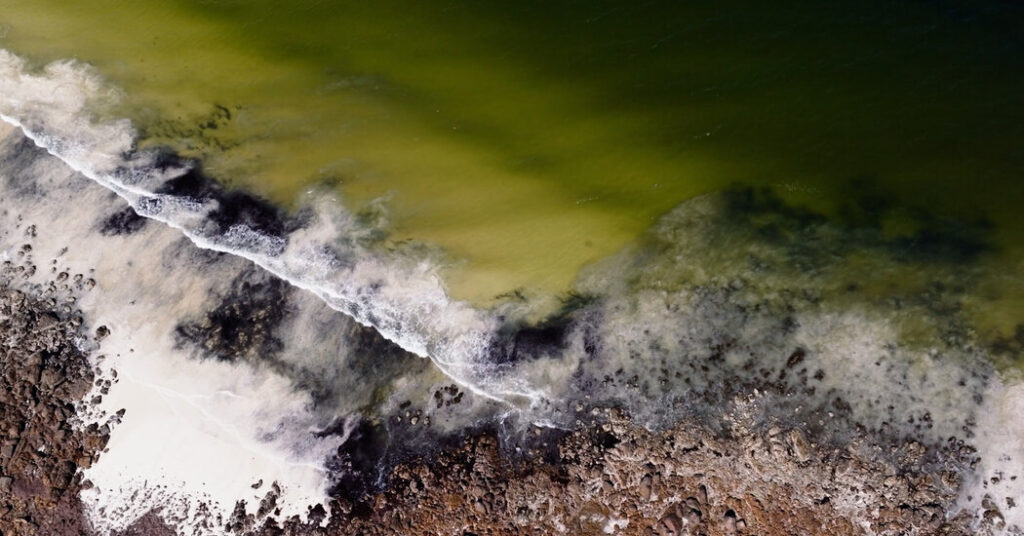
Wendy Parry, an ocean swimmer from Adelaide, Australia, has for decades relied on a local beach as a refuge for stress reduction and relaxation. But she stopped going last year when the water turned green and yellow, and a foul-smelling foam clung to the sand.
As dead fish, seadragons and other creatures began washing ashore along the South Australian coastline, the air irritated her lungs, leaving her coughing and suffering from itchy eyes.
“Being on the beach was just disgusting,” said Ms. Parry, 66, who typically swims at least three times a week, even through the winter. “It broke your heart.”
The culprit was a harmful algal bloom, a naturally occurring phenomenon in which toxin-producing algae rapidly grow and concentrate. Along the jagged coastline of South Australia, a state with nearly two million people, it has become an underwater phantom that has drifted along the shoreline for more than a year. Researchers say it has spanned more than 7,000 square miles of ocean, and they’re not entirely sure why.
The algal bloom has devastated marine life, disrupted the fishing industry, and threatened a cherished rite of Australian life: going to the beach. Surfers have reported irritated eyes and shortness of breath, and beachgoers have been horrified by the dead animals washing ashore, including stingrays, octopuses and sharks.
As scientists search for explanations, the bloom is taking a psychological toll on South Australians. In a survey last July, nearly 70 percent of respondents said that they could not stop thinking about the bloom, and about half reported feeling anxious or afraid. Some said they felt as though they’d lost a loved one.
It also removed an outlet for many who rely on ocean activities for stress-relief or socializing, said Brianna Le Busque, an environmental psychology scientist at Adelaide University, who led the survey.
“People realized how important it was when it was taken away from them,” Dr. Le Busque said.
The bloom in South Australia first appeared in March last year, when surfers on two beaches reported sore throats, eye irritation and other symptoms. By July, it had moved northeast to the coastline near Adelaide, the state’s capital city, and later reached the Yorke Peninsula.
Several local species of fish declined last year as the bloom emerged, according to a government report. “It was literally just like an underwater bushfire,” said Nathan Barbiero, a recreational fisherman.
Only some species of algal blooms produce toxins. They have appeared in South Africa, Europe and parts of coastal United States, including Florida’s Red Tide.
Scientists say the bloom off southern Australia stands out for how long it has persisted, how large it has grown and what kind of toxins it is producing.
Some species of algae produce a type of neurotoxin known as brevetoxins. But Shauna Murray, a marine biologist at the University of Technology Sydney who studies harmful algal blooms, said that she has identified a rare species off South Australia, Karenia cristata, that had not been previously been known to produce brevetoxins.
“We’ve never had this before,” said Dr. Murray, referring to brevetoxins in Australia. Their sudden appearance in this algal bloom “rang alarm bells,” she added.
The exact origins of this bloom are unknown, but scientists are looking at a few working theories.
Officials have pointed to several recent events as possible drivers, including a marine heat wave and a nutrient-heavy flood from the nearby Murray River. The intensity and frequency of harmful algal blooms have also generally been linked to climate change and agricultural runoffs.
Critics have accused state and federal officials of moving too slowly to warn the public. A parliamentary inquiry last year found officials were ill-prepared to monitor and track the crisis, and recommended more investment in marine research.
Murray Watt, Australia’s environment minister, pushed back against the criticism in an interview last month with the Australian broadcaster ABC.
“To this day, no one has been able to produce an answer on what could have been done differently to prevent the bloom,” he said, adding that the country would now have a “roadmap” for similar events in the future.
The state government of South Australia said in a statement that it has a comprehensive testing and monitoring program for algal blooms that covers 240 sites, and that the state and federal governments are investing more than 60 million Australian dollars, or about $41 million, into protective measures that include offshore monitoring buoys and reef restoration projects.
The crisis has pushed some residents to document its potential toll. The precise impact of the bloom on marine life is still being determined, but since February 2025, a crowdsourced platform has recorded more than 100,000 instances of dead marine life.
Lochie Cameron, a resident of Corny Point, said he was crushed when the beaches last year around Foul Bay filled with dead animals. “That was like the entire ocean had spat all of its fish and all of its creatures onto the shore,” he said.
A lifelong fisherman, he has not cast a line since. “I can’t kill another fish after seeing so much on the beach,” he said.
Mr. Cameron and others in the community have collected water samples and photographed the dead sealife, acting as self-described “citizen scientists.”
There are signs the bloom may be receding in some areas.
The vast majority of South Australia’s coastline has recorded low or undetectable levels of Karenia for the past three months, a spokesman for a state government unit monitoring the bloom said in an email. But in late March, some people reported signs that the bloom may have shifted west toward Port Hughes, northwest of Adelaide on the Yorke Peninsula.
Stefan Andrews, a marine biologist and diver who has been tracking the bloom, said that on a recent dive at Port Hughes, he saw neon-green water and many dead octopuses.
“That was one of the last spots that I was holding onto on the whole Yorke Peninsula,” said Mr. Andrews, a co-founder of a nonprofit focused on marine habitats along southern Australia. “I’ve kept this little bit of hope in me that maybe — somehow — it’s able to dodge it.”
In Adelaide, Ms. Parry said she had noticed signs of recovery, such as stingray tracks in the sand. She has even returned to ocean swimming after a seven-month break.
But when she notices discoloration, foam, or strange smells, she stays on land.
“I don’t think it’s totally gone,” she said.
Isabella Kwai is a Times reporter based in London, covering breaking news and other trends.
The post An Underwater Phantom Is Killing Fish and Breaking Hearts appeared first on New York Times.