It was another Friday at Latitude Margaritaville, a retirement community in South Carolina’s Lowcountry, and the pool party felt like a freshman-year mingle. Piña coladas sat half-finished under tiki huts. Residents rested belly-first on lounge chairs.
Near them was a movie theater room with a greeting splashed across the screen that may as well have been the slogan for the community’s home, Jasper County: “Welcome to Paradise.”
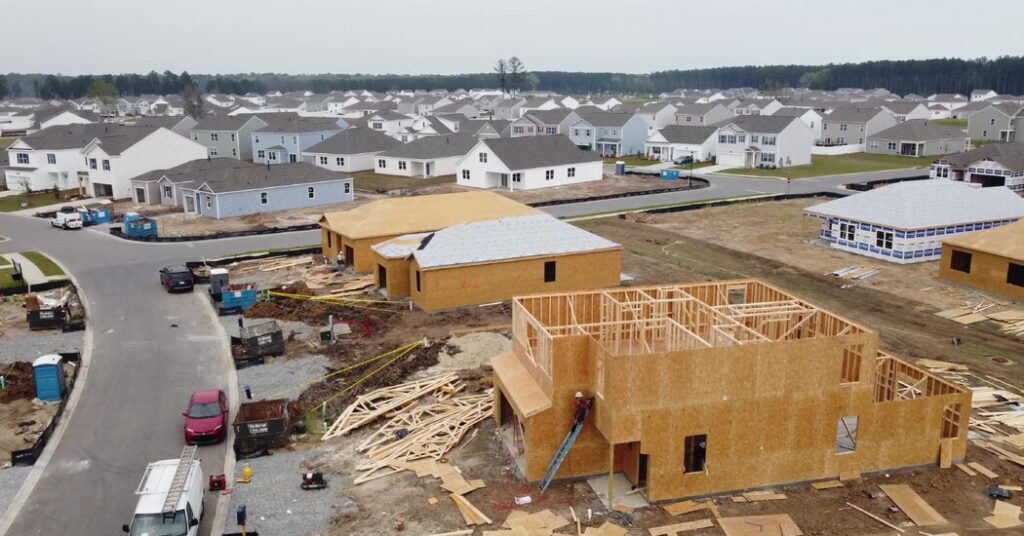
With its proximity to the water, consistently sunny weather and low taxes, Jasper County has seen a crush of newcomers in recent years, many of them retirees who have moved into communities like Latitude Margaritaville, which is building thousands of new homes soon. New estimates released by the Census Bureau show that the county’s population has grown to about 38,000 this year from roughly 29,000 in 2020, making it the fastest-growing county in the United States. (Across much of the rest of the country, however, population growth has either slowed or turned negative.)
Jasper County is about a half-hour drive to Hilton Head Island, the popular tourist spot to its east, and Savannah, Ga., the charming arts hub to its southwest. Charleston, S.C., is just a day’s trip away. Other islands with golf courses are right next door, in Beaufort County, S.C.
All of those destinations have become increasingly expensive and crowded, making Jasper County even more desirable. But where some see paradise, others see profound growing pains. Traffic issues abound. Some health care services are strained. And the growth shows no sign of slowing, much to the alarm of conservationists.
“The development threats are imminent,” said Grant McClure, the south coast office director for the Coastal Conservation League, as he steered a boat along the sprawling Euhaw Creek.
Jasper County is awash in wetlands and teeming with wildlife. Turkeys amble near piers and marshes. Locals take small boats and traverse through salty estuaries that nurture oysters and spotted sea trout. The land also serves as a natural buffer during storms, which have intensified in recent years because of climate change, said Jessie White, a lawyer with the South Carolina Environmental Law Project.
But there are small signs of the county becoming a suburban nest for transplants: a golf cart with a New York Yankees banner; the newly built home with Ohio’s state flag against a window; a mailbox made to look like a Dallas Cowboys helmet.
Many of those new residents, now in the twilight of their lives, say they relish the idea of being closer to the beaches they had visited as tourists, ideally at a cheaper price. Barbie Henderson, 70, said she and her husband moved to Latitude Margaritaville from Newark, Ohio, in 2018, intrigued by the idea of living close to Hilton Head Island, where her family loved to vacation.
There was still not much to do in Jasper County, she said, but she was hopeful it would soon flourish with businesses.
That possibility troubles some locals.
“The serenity is gone,” said Reginald White, 58, who was born and raised in Jasper County, and whose family owns about 200 acres. Some of his cousin’s goats chewed on grass nearby.
Many knew this population explosion was coming. Decades after Hilton Head Island buzzed with tourism in the 1980s, largely because of a bridge that connected the island to the mainland, Jasper County officials started working on a plan to retain as much natural land as possible while accounting for the inevitable growth.
The county sits at the southern tip of the state. Near the southern half is Hardeeville, the county’s largest city. In the central part of the county is Ridgeland, the next-largest city. Andrew Fulghum, who has been Jasper County’s administrator since 2002, said that he and county leaders at the time had planned to concentrate growth around those two areas and preserve the rest as rural. So far, he said, nearly all of the population growth has stemmed from Hardeeville.
But some longtime residents have expressed concern that the political will to protect land may diminish as more people move in and the makeup of the county council changes. Past council meetings turned contentious when yet another developer asked to clear land.
Mr. Fulghum, who is retiring this year, has become used to it. In his office, he dropped a thick stack of papers on his desk. It was a lawsuit that the South Carolina Environmental Law Project recently filed against the county and other defendants regarding the rezoning of roughly 200 acres to allow for the operation of a sand mine, which is needed for construction material.
“It’s sort of a necessary evil,” Mr. Fulghum said, though he empathized with concerns about bringing truck traffic to quiet areas. “If you have growth, you’re going to have those resources extracted from other areas.”
Officials have had some success balancing competing needs. In 2024, county voters approved a 1 percent sales tax that will generate $376 million for transportation infrastructure and $94 million for land and water protection.
To many in the county, of course, growth is not necessarily a bad word. Hardeeville’s mayor, Harry Williams, said it also presented an opportunity for the work force to expand beyond the service industry, which props up the wealthy islands nearby. The city has also had an influx of Hispanic residents tied to the construction industry.
Hardeeville is well positioned to become a major hub for business, he said. It is about 10 miles from the Port of Savannah, the fastest-growing port on the East Coast. Hardeeville has built more than four million square feet of warehousing in the last six years. And an energy equipment manufacturer has set up shop in the city and will employ hundreds of people with an average salary of $60,000, above the statewide average.
“Our goal is not to get to 100,000 people, although that may happen someday,” Mr. Williams said. “Our goal is to bring job opportunities to our young people.”
Still, officials acknowledge that many are feeling crunched by the lack of affordable housing and the rising costs associated with the arrival of wealthier residents. Some have been priced out of Hardeeville and forced to move into mobile homes and campers.
In one such mobile home near Hardeeville, Guillermina Romero, 47, was preparing to rest before her early morning shift at a laundromat. Born in Mexico, she immigrated to the United States decades ago and has lived in Jasper County for five years. At first, her rent was $350. Now it is $650.
She lives there with her two teenage sons and has been eager for summer to start. That would mean more tourists and more money. But it would also mean she could catch crabs on Hilton Head Island, which would lower her grocery bills.
“All this growth, but the pay is the same and the rent is higher, and it feels like you can’t do anything about it,” she said.
It was a sentiment shared by Mr. White, who was resting outside on his porch on a recent afternoon, underneath Spanish moss and chirping sparrows. He tried to focus his senses on the land.
Then a truck carrying construction equipment rushed by. Birds fluttered off. Mr. White brushed dust from his eyes and sighed. In the distance, he thought he heard a woodpecker. But on this afternoon, it sounded more like thuds from a hammer.
Eduardo Medina is a Times reporter covering the South. An Alabama native, he is now based in Durham, N.C.
The post America’s Fastest-Growing County Wonders if ‘Paradise’ Is Growing Too Fast appeared first on New York Times.