LIMA, Peru — If one thing unites Peruvians, it’s their visceral disdain for the political class.
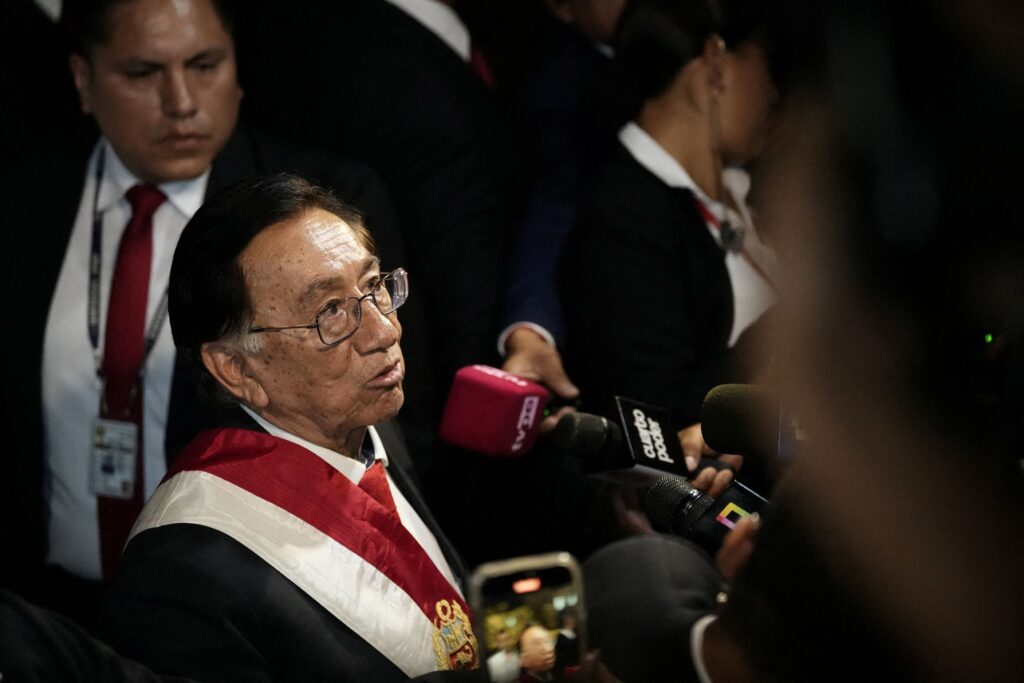
Interim President José Balcázar’s approval ratings are stuck in the mid-teens — but that’s enough to put him ahead of Congress, which is flirting with single digits.
The country is mired in a decade-long political crisis: A revolving door of presidents kept spinning by a fire hose of Dickensian corruption, a botched auto-coup, security forces massacring protesters, and new laws that enable organized crime and political graft.
In an election Sunday, Peruvians will choose a president who upon inauguration in July will become its 10th leader in 10 years. The last to complete a full term was Ollanta Humala in 2016. The stretch since then has included three resignations, three impeachments and a removal by censure. Six presidents this century have been charged with corruption; three so far have been convicted.
As a result, a country blessed with rich history, culture and material wealth is also beset by challenges — including, lately, an extortion epidemic in which criminals have targeted schools with grenades, leaving Peruvians less safe, healthy and prosperous.
Sunday’s election offers another once-in-five-years chance to set this perennially troubled Andean nation on a new path. Yet all the signs suggest Peruvians will end up returning many of the same politicians to power.
“Peruvians suck at voting,” says Lima voter Beto Vizarreta, 43, expressing a common sentiment here. “We always end up electing candidates who betray us. It’s what we do. Every five years, we screw up.”
The observation has merit, says Eduardo Dargent, a political scientist at the Pontifical Catholic University of Peru. “It’s a reflection of a depoliticized, disinterested society that is not paying attention,” Dargent said.
Equally, he says, in a country where an estimated 70 percent of the labor force works informally, typically living hand-to-mouth, many prefer lawless politicians who, they hope, will block attempts to regulate their ways of getting by — a phenomenon he describes as “representation for no taxation.”
Many here blame the political dysfunction on Keiko Fujimori, the polarizing daughter of former president Alberto Fujimori, the kleptocratic strongman who was convicted of human rights abuses and corruption. Her hard-right Popular Force party has dominated Congress for the last decade.
Yet polls show Keiko Fujimori leading, narrowly, the record field of 35 presidential candidates, with the support of about 10 percent of the electorate, though the figure might represent her electoral ceiling. Her party is poised to again form the biggest bloc of lawmakers in Peru’s single-chamber Congress.
There are also structural reasons Peruvians, who are required to vote or pay a fine, are repeatedly presented a menu of largely unpalatable options. Some of them, analysts say, have been built intentionally.
The most obvious is the proliferation of parties, which effectively turns the contest into a lottery, giving even deeply unpopular politicians such as Fujimori a good chance at making the inevitable second round in June, when the top two finishers go head-to-head.
Many of the parties lack clear ideologies beyond the personal interests of their bosses.
Those interests frequently include Peru’s low-quality but lucrative private universities, catering to the emerging middle classes. Congress recently reversed strict new regulations that would have gutted the profits of various party leaders who are also university tycoons.
Many lawmakers have also been linked to illegal gold mining, a $12 billion sector that’s larger by an order of magnitude here than cocaine production.
Congress just reversed a much-heralded reform that required parties to hold primaries. That means that most candidates have been chosen personally by party bosses, often based on donations, some of them under the table, rather than political ability or popularity.
Congressional candidate Mirtha Vásquez, a former prime minister and one of the few seen as being genuinely committed to democracy and the rule of law, describes these parties as “businesses, interest groups and even criminal gangs, pseudo-parties.”
The upshot is that Fujimori, the only politician who a majority of Peruvians say they would never vote for, is expected to make it to the runoff for a fourth time in a row. Polls indicate she would then lose it, also for a fourth consecutive time, no matter which candidate she faced.
Which highlights another barrier to stable governance: Congress is elected in the first round, not the second round.
In 2016 and 2021, the success of Fujimori’s party in the first round and her failure in the runoff left successive presidents Pedro Pablo Kuczynski and Pedro Castillo facing hostile legislatures dominated by members engaging in what critics said were bad-faith opposition tactics.
Compounding the problem, Peru’s electoral system redistributes congressional votes from the smallest parties to the largest.
The system was intended to avoid a balkanized legislature and promote stability, but in practice, it has distorted election results. In 2016, for example, Keiko’s party received 36 percent of the popular vote, a plurality, but was given 56 percent of the seats, a majority.
The Fujimoristas forced out Kuczynski in 2018 and his successor, Martín Vizcarra, in 2020, each on dubious grounds, setting in motion the presidential merry-go-round.
Trailing Fujimori in polls is a cluster of a half-dozen candidates, separated by just a few percentage points, any of whom might join her in the runoff.
They include Rafael López Aliaga, a right-wing former mayor of Lima sometimes described as the “Peruvian Trump.” He’s already making claims without evidence of electoral “fraud” and has been accused of making death threats to the head of the electoral agency.
Others include leftist Roberto Sánchez, running on the contentious legacy of Castillo, now in prison for attempting to avoid impeachment by dissolving Congress and ruling by decree; comedian and Fujimori fellow traveler Carlos Álvarez, a political newbie famous here for his impersonations of other politicians; and Ricardo Belmont, an octogenarian left-wing populist known for graphic sexist, homophobic and xenophobic outbursts.
The post 10 years, 10 presidents. Peru’s leaders don’t last. Voters will try again. appeared first on Washington Post.