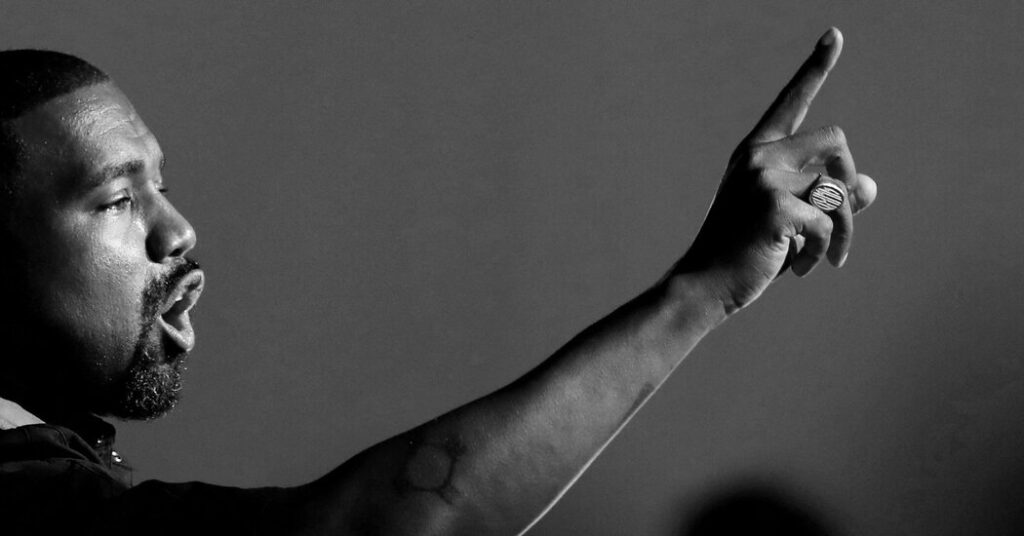
Over the past 15 years, I’ve watched Ye, the artist formerly known as Kanye West, alienate many of his longtime fans, including me, with one incident of performative ignorance after another. He transformed himself from the high-strung yet endearing artist we knew from “The College Dropout” into a red-pilled megalomaniac with a lust for hateful antagonism.
And yet, he continues selling concert tickets, releasing music and getting streams. It speaks to the fact that in today’s pick-a-side culture, when one group blackballs you for offending them with your antics, another group might not care. In Ye’s case, this can be true even as your new music loses the soulfulness that made it so good in the first place.
Wearing Confederate flag patches in 2013 was the first stupid move by Ye to raise my eyebrow. Two years later, he declared that “racism is a dated concept.” In 2016, many Black women called out his “multiracial women only” Yeezy Season 4 casting call, hearkening back to when he called biracial women “mutts” in 2006. And by 2018, he became one of the world’s most famous MAGA endorsers, while asserting that slavery was a choice. He became persona non grata with me and many of his other Black fans.
In 2022, it seemed as if he formally exiled himself from mainstream culture after his promise to go “def con 3 on Jewish people.”
He lost his Adidas deal, which would have earned him hundreds of millions of dollars. Cancellation did not deter him. He doubled down on his coarse antisemitism, on X and in interviews. He wore a “white lives matter” shirt alongside the podcaster and conspiracy theorist Candace Owens. And last May, after showing off a diamond-studded swastika chain, he made a song called “Heil Hitler,” complete with an Führer sample. (Not to mention the stench of a sexual assault lawsuit — whose claims he has denied — and a reported penchant for forcing employees to watch his sex tapes.)
And yet, his career survives in some form. He was set to headline a set of shows at the Wireless Festival, a summer music event in London until the British government refused to allow him into the country, asserting that “his presence in the U.K. would not be conducive to the public good.” His recent shows at SoFi Stadium in Los Angeles were packed, and reportedly grossed $33 million.
Who is still a Ye aficionado, and why?
This has been a debate for some time. One theory is that his supporters have a relationship to him that, to them, feels more authentic and personal than the Ye who appears in the media. In 2019, a 21-year-old Ye fan toldGQ that his view of the artist hadn’t changed post-MAGA turn, stating “as Kanye’s fans we all trust him, so whatever his decisions are, we back him 100 percent. I think he’s a great person.”
Another is that a younger generation of fans is either numb to calls for cancellation or more forgiving. A Seton Hall University communications professor, Antoine Hardy, told me, “My students in 2021-23 were more critical of Kanye and celebrity, but I have noticed a shift to defend him openly since 23-24.”
It’s notable that a clip of people moshing at one of his L.A. concerts shows a sea of young, overwhelmingly non-Black attendees. That audience might explain away his past comments and actions because they don’t directly strike at their identity.
The best artist-fan relationship is usually one of aging together and riding the good vibes of their classic era. But the 2013 release of “Yeezus” was a demarcation point in Ye’s career. The polarizing album eschewed soul samples and mastery of traditional hitmaking for a noxious soundscape of blaring synths and electronic drums. He alienated many fans who loved the “Old Kanye.” The “Yeezus” album cycle was defined by Ye angrily chafing against the establishment in interviews, clamoring for access to and acceptance by the European high-fashion scene while ideating himself as the new Walt Disney, pleading not to be marginalized and rapping about “New Slaves.”
It feels like Ye was corrupted by his greatest attribute: his ambition. As an artist, he had never met a barrier he couldn’t break, and he was usually declared a genius in the process. He had redefined Black cool for an industry not built to recognize his (and our) full humanity, and he realized, while rapping on “All Falls Down,” “you still a nigga in a Coupe.” For someone with such astronomical aspirations, one way to stay sane when you keep butting up against the confines of racism might be to assert that they didn’t exist. Maybe that’s why he declared race “dated.” Who knows?
Soapboxing about Kanye and his antics has become a national pastime. How much has mental illness been a factor in his actions? Or his admitted substance abuse? Is he just a troubled genius? Has all of this been calculated scheming for attention?
In any case, he ended up anticipating the anti-woke and manosphere shifts in our culture that coincided with Donald Trump coming to power in 2016 and 2024.
On “One Minute,” which was released with XXXTentacion, Ye rapped, “Now your name is tainted, by the claims they paintin’/ The defendant is guilty, no one blames the plaintiff,” apparently pushing back against the #MeToo movement as a rite of male solidarity.
Ye’s rage against the machine has seemingly come to epitomize badass for many young people. It’s no surprise that many in his fan base may not see the point of condemning their favorite musician for his hate speech in an age when few other public figures have decorum.
And there is still money to be made. Up-and-coming musicians still work with him. An icon like Lauryn Hill got onstage with him in L.A. Live Nation and Gamma, the label distributing his new album “Bully,” knows that. Ye announced his Gamma signing in January, shortly after taking out a public apology ad in The Wall Street Journal, asserting, “I am not a Nazi,” and referencing his battle with bipolar disorder as a catalyst for his troubling antics. The letter came two months after he publicly apologized to Rabbi Yoshiyahu Yosef Pinto for his past comments. He was in full image rehab mode.
Some former supporters have said that they need to see more atonement to take him seriously. I wouldn’t anticipate that. His letter wasn’t apologizing to his former fans. He already has enough current fans. He’s remained a top-selling, top-streamed artist throughout his various controversies. His apology was in a publication read by people in business, a transparent attempt to rehabilitate his reputation among potential sponsors.
Pepsi and Diageo nonetheless pulled out of the Wireless Festival. Then the British government stepped in with the entry denial and the show was called off. That intervention may just end up making him a free-speech martyr, intensifying his redemption arc for those who buy into it.
I still occasionally listen to some of Ye’s pre-2018 music, because it’s tied to some of my own life experiences. He’s too far gone for me to try to engage with his recent work, outside of the context of my job as a music critic. And I definitely won’t be attending any concerts. It’s OK though; I’m not needed there. He’s a different artist playing to a new core who will likely stick with him forever.
Andre Gee is a culture journalist and music critic who writes the Andre Gee Newsletter.
The Times is committed to publishing a diversity of letters to the editor. We’d like to hear what you think about this or any of our articles. Here are some tips. And here’s our email: [email protected].
Follow the New York Times Opinion section on Facebook, Instagram, TikTok, Bluesky, WhatsApp and Threads.
The post Who, Exactly, Still Likes Ye? appeared first on New York Times.