EMPIRE OF SKULLS: Phrenology, the Fowler Family and a New Nation’s Quest to Unlock the Secrets of the Mind, by Paul Stob
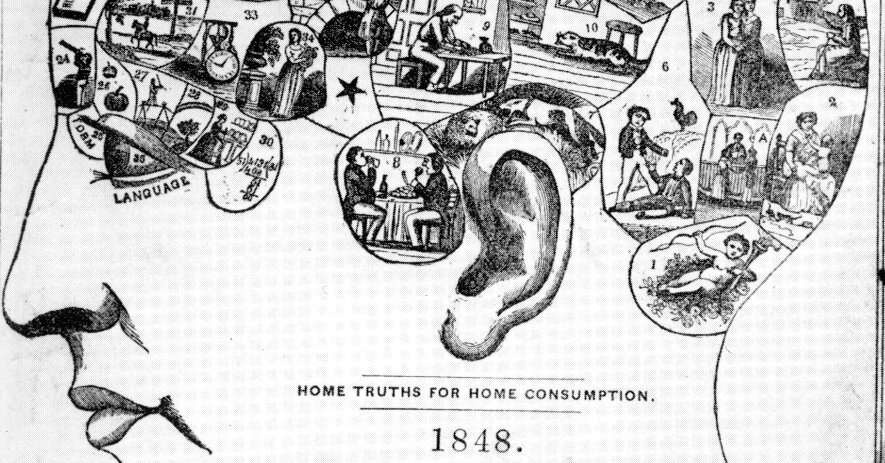
In studying mid-1800s America, one encounters a staggeringly long list of avowed phrenologists. Though correctly dismissed today, this “science” — which held that there are 37 portions of the brain, each responsible for a certain temperament — exerted surprising for a surprisingly long time. The women’s rights activist Susan B. Anthony bought into phrenology. So did the abolitionist John Brown and the writer Walt Whitman. Why did this theory appeal to so many?
The Vanderbilt University professor Paul Stob’s new book, “Empire of Skulls,” traces much of the allure back to the Fowler family of 19th-century New York. While the brothers, Lorenzo and Orson, did not originate the theory, they (along with Lorenzo’s wife, their sister and her husband) popularized it to a level never imagined. By measuring and palpating their patients’ skulls, the Fowlers claimed, they could determine subjects’ personality traits.
They had some notable “hits.” Lorenzo Fowler claimed a blacksmith’s assistant had a particularly developed “constructiveness” portion of the skull. By the time the two met again a few years later, the former apprentice had taken out 33 patents and had 500 employees, and he credited phrenology with making him realize he had the potential to be more than a day laborer.
As Stob notes, the self-help impulse spans generations (including our own), so it’s not surprising that “the people of pre-Civil War America were looking for one thing — improvement.” By marking which portions of their patients’ minds were underdeveloped, phrenologists might inspire the sitters to work on those characteristics — and phrenology told them such improvement was possible.
But perhaps another explanation for the widespread appeal is Stob’s observation that the Fowlers “tapped into the widespread, longstanding impulse to measure ourselves scientifically.”
That people would happily enlist the services of a phrenologist — discovering, perhaps, a predisposition to benevolence or secretiveness — may be analogous to how cheerfully people today will take a Myers-Briggs Type Indicator personality assessment. We enjoy seeing our personalities reflected back to us in concrete ways.
Everyone who met with the Fowlers came away “with a potentially life changing piece of paper — a chart that indicated what type of person they were.” These assessments were fascinating to share, particularly if they offered a flattering description. (For those eager to engage, Stob has included an amusing “do it yourself” phrenology section.)
There are moments where Stob, too, appears seduced by his subject. He notes early on that “applying the label ‘racist pseudoscience’ to phrenology encourages us to gloss over a complicated movement that was ultimately more progressive, even radical than we typically consider” and that “even using the world pseudoscience to discuss phrenology, as often happens, is misleading and ultimately unhelpful.”
Phrenology, which has been entirely discredited by reputable studies, supposed, according to the Fowlers, that African skulls were thicker than those of Caucasians because Black people had less brain activity.
While some people, abolitionists included, did not consider these findings detrimental — either because said populace might improve the weak portions of their minds, or become peaceful, useful citizens if freed from bondage — the bald truth is that the size and shape of skulls have no bearing on mental or behavioral attributes. It is not knee-jerk liberalism or white guilt to call phrenology “a racist pseudoscience”; it is a statement of fact.
That does not mean the theory did not have significant influence — nor that this history is unworthy of study. But if a reading of the skull of a blacksmith’s apprentice could inspire him to become an inventor, how might it affect a host of Black children to be told that they are, by nature, less intelligent than their white peers? Would they indeed all wholeheartedly welcome this news as a chance for improvement?
If such questions concern us now, they did not deter the theory’s popularity at the time. By 1841, there were 40 to 50 phrenological societies clamoring for replicas of the many casts the Fowlers had collected, which included those of Napoleon, Voltaire, a German murderer and a “good Negro.” The family began publishing The American Phrenological Journal and Miscellany. Orson happily remarked that phrenology “never before stood as high in public estimation as it now stands.” Its truth, he said “must prevail — is actually prevailing.”
In the years to come the Fowlers would delve with similar enthusiasm into spiritualism, magnetism and “water cure.” It is something of a shame that Stob, who has crafted a thoroughly researched and intriguing work, does not delve into any doubts the Fowlers must have had. When Orson Fowler endorsed water cure by declaring “the wet sheet HAS SAVED MY BOY … without it he would have died” — and when his sickly son did in fact die afterward — did the father question the method? And if he did not do so publicly, was his reticence due to genuine belief or, more cynically, because endorsing such fads had made the brothers celebrities?
Despite the criticism of contemporaries— including claims that Orson was a “professional scientific fraud and charlatan” — Stob never seems to doubt the purity of the Fowlers’ ideals. He notes of the siblings, “They were wrong about a lot of things (as are big thinkers of every age), but they dedicated their lives to progress across American society.”
The greatest flaw of the book is its refusal to consider that these men, who trafficked in their theories to great financial success, may not have always been as well intentioned as Stob charitably imagines.
But then, perhaps that reading depends entirely on how agreeable your lobes are.
EMPIRE OF SKULLS: Phrenology, the Fowler Family and a New Nation’s Quest to Unlock the Secrets of the Mind | By Paul Stob | Counterpoint | 322 pp. | $30
The post Was Phrenology Real? Ask the Lump on Your Forehead. appeared first on New York Times.