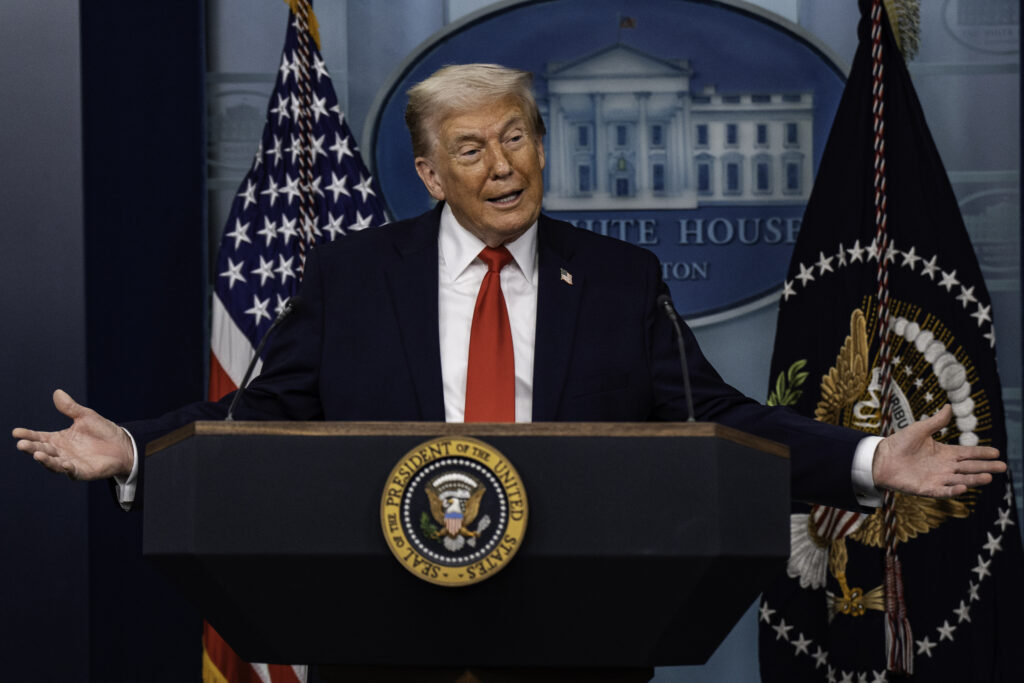
In full damage control mode after receiving the worst inflation report of his second term, President Donald Trump’s White House stressed that critics were looking too hard at the wrong things.
Instead, aides on Friday pointed to pockets of improvement — lower prices for some goods, tax cuts and falling drug costs — as evidence the broader picture was being missed.
The argument that the administration’s record is stronger than the public recognizes has become a familiar one. Former president Joe Biden made a similar case at the end of his term — a rare point of overlap between two leaders who have spent over a decade attacking each other’s policies and fitness for office.
In an increasingly polarized nation, presidential approval has hardened in ways that leave little room for persuasion, even with substantial policy outcomes. Major legislative or economic developments now more often lock in existing views rather than upend them, narrowing the space for presidents to translate action into broad public credit. For both Trump and Biden, that shift has quietly broken a core assumption of modern presidential politics: that results, once achieved, will be rewarded.
Trump and his aides have returned to the theme repeatedly this year, weaving it into campaign-style speeches and White House appearances. Trump has argued that the disconnect between strong economic indicators and voter discontent is a matter of misjudgment, insisting in recent speeches that the “roaring” economy is “better than people think” and downplaying concerns about affordability.
“In one year we’ve taken a dead and crippled country,” Trump said in an address to the nation last week. “I hate to say that, but we were a dead and crippled country after the last administration and made it the hottest country anywhere in the world by far.” During a January speech in Clive, Iowa, Trump said mainstream news organizations ignored his biggest accomplishments: “And you know the fake news. I can’t get them to talk about it. I got the biggest price reduction in history on drugs, pharmaceuticals. I can’t get these guys to talk about it.”
Those gripes mirror the closing stretch of Joe Biden’s presidency, when he and his aides voiced frustration after steering the country past the covid-19 pandemic. Biden spent the last full month of his presidency trying to brighten history’s view of his tenure. He stressed that the problem wasn’t with the policies, but with Americans’ ability to perceive the good he was doing on their behalf. He routinely argued that his party made good policies, but didn’t do a good enough job taking credit for them.
“I know it’s been hard for many Americans to see, and I understand it. They’re just trying to figure out how to put three squares on the table,” Biden said during a Dec. 4, 2024, economy-focused speech at the Brookings Institution. “But I believe it was the right thing to do, not only to lift Americans out of economic crisis caused by a pandemic, but set America on a stronger course for the future. And we did that.”
Tevi Troy, a presidential historian who served in the George W. Bush White House, said presidents across parties have long complained of being denied recognition for policies whose benefits unfold slowly or unevenly. What is new is how rarely public opinion now moves at all in response to policy results, leaving persuasion itself with diminishing returns.
“Every president enters office or campaigns for office with lofty goals about how they’re going to make the economy better, stave off inflation, how they’re going to create middle class jobs,” Troy said. “But the engine of the economy is not the government … whatever is happening on the ground is dictating what’s happening in the economy, and a president can’t control that and that frustrates them.”
Even sound economic decisions might not show results for months or years, Troy said, recalling how President George H.W. Bush’s aides routinely felt that President Bill Clinton received credit for an economic rebound that was initiated by tough decisions on the economy.
“They felt like they had done the hard work, they had taken the spinach to make the economy better, and then Clinton got credit for it,” Troy said.
Trump has similarly talked about the long-term benefit of crippling Iran’s nuclear ambitions. But the military action exacted a large toll. Iranian leaders blocked off the Strait of Hormuz. Tanker traffic diminished to a trickle, upending global energy markets and frustrating U.S. allies. A ceasefire was declared earlier this week, but even it shows signs of strain.
The economic impact has been dire. Inflation rose at its fastest monthly pace in four years, sparked by surging gas prices. It represents a potent political problem for a president who has vowed to bring costs down, and whose party faces headwinds in November’s midterms.
Both Trump and Biden have argued for what they believe should have counted, even as voters judge their records by entirely different metrics — an especially sharp collision for two leaders who each trust their own voice as the ultimate corrective.
Trump has repeatedly pointed to things he believes should command public credit: large drops in illegal immigration, lower prices in specific sectors and crime drops in places where he has increased a federal law enforcement presence.
His claims of an unappreciative public go far beyond America’s borders. He has criticized the Nobel Peace Prize committee for not awarding him the vaunted honor. He has said Canada “should be grateful” for the protection that comes from the country’s proximity to the United States and has long criticized other NATO members for not contributing their fair share to the alliance.
Biden sought more credit for steering the country out of the covid-19 pandemic, and sidestepping a recession many economists predicted as inevitable. Some of his biggest successes came with broad bipartisan support.
But by the end of his tenure, critics had a dimmer view: He was the President who wouldn’t concede that voters saw him as too feeble to lead the free world, which helped pave the way for Trump’s resurgence. Following a disastrous debate performance against Trump, Biden announced that he would not seek reelection, and threw his weight behind Vice President Kamala Harris 107 days before the election.
After she lost, Biden spent some of the remaining days of his presidency making the case for his place in history, moving preemptively to counter any effort by Trump to take credit for a strengthened economy.
The effort did little to alter public judgment. Biden’s approval rating never climbed out of the 50s, even after the passage of a pandemic relief package and a bipartisan infrastructure bill.
Trump’s approval ratings have also been low. According to a Washington Post average of polls since March, 37 of Americans approve of President Trump, while 60 percent disagree — a standing close to the lowest point of either his two terms.
The post Trump, sounding like Biden, says he deserves more credit appeared first on Washington Post.