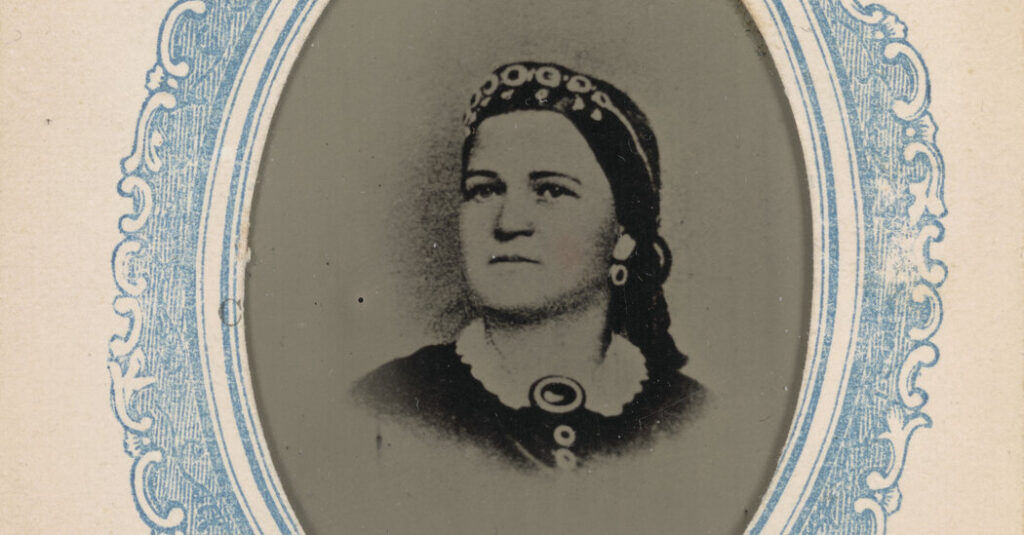
The Tony-winning Broadway show “Oh, Mary!,” which portrays Mary Todd Lincoln as a chaotic, resentful alcoholic former cabaret singer, has thrust America’s former first lady back into the public imagination over the past year. One might expect that a comedic character written (and originally played) by the playwright Cole Escola, who did, by their own admission, deliberately “less than no research” into Mary’s life, would be seen as hilariously preposterous. And yet, for audiences, the play’s burlesque can ring a little true, largely because it embodies a cultural image of Mary as crazy that has endured for 160 years and is familiar to them from decades of distorted scholarship.
She has existed in the historical record as largely a one-dimensional caricature created by men — biographers, political rivals, physicians — who failed to understand her. Early male writers often disparaged Mary as an intolerable shrew or filtered her through the prism of her husband’s greatness, turning her into a nuisance at best and a national embarrassment at worst. Some falsely suggested she was a spy for the Confederacy during the Civil War. Prime among those who distorted her legacy was William Herndon, Abraham Lincoln’s former law partner, who despised her for, among other reasons, refusing to invite him to dinner. Critics interpreted her anxiety over a war in which members of her immediate family were fighting for the enemy, and her unrelenting public grief over losing three children and her husband, as evidence that she was weak, rather than resilient.
It is true Mary suffered from mental illness and could have a temper. It is also true that her husband, who himself struggled with depression, may well have never become president without her. Even her harshest critics acknowledged that her ambition, political instincts and force of will helped propel him to the White House.
She was undoubtedly harmed by the era’s gender expectations. Even after women amassed greater liberty and power, few male historians made an effort to understand Mary’s pain or motives, choosing instead to typecast her as superficial and insane. One notable exception was a 1932 biography by a physician, William A. Evans, who uncovered a history of mental illness in Mary’s family and made an effort to understand her volatility.
By then, the die had been cast. And once a narrative takes hold, it can be repeated and embellished for generations before being dislodged.
Only in the past 60 years — thanks largely to the work of female historians such as Ruth Painter Randall, Jean Baker and Stacy Pratt McDermott — has a fuller picture emerged. In their works, Mary Lincoln appears not as a distortion but as a politically engaged partner who helped elevate her husband while navigating extraordinary personal loss in a patriarchal society. These historians viewed her battles with mental illness and her erratic personality in the context of her entire life. As the first lady, she made significant contributions: She used her position to support the Union effort, routinely visited encampments, tended to wounded soldiers at Washington hospitals, threw open the doors of the White House for large public receptions to lift morale and donated money and food to refugees from slavery. But her accomplishments were minimized in the historical telling of her story, leaving only a negative narrative that persists to this day.
Mary stands in good company. For centuries, the lives of some of the most formidable women in history — among them, Cleopatra, Marie Antoinette and Joan of Arc — were documented almost exclusively by men who believed that women were the passive, lesser sex. The men who chronicled these women in their lifetimes were hesitant to give them credit for greatness and quick to affix blame in times of conflict. The cultural narratives that endured consistently lack an understanding of social constraints, power dynamics and gender politics. In many cases, it was not until female historians began to write their own revisionist histories that these women’s stories were fully told.
Retelling the story of a woman today requires a motivation to correct the historical record. Too often, that comes only when the historian is a woman eager to do justice to a forgotten voice. There are barriers to correcting the historical record: Archives and research on accomplished women are often incomplete and scarce, simply because a woman’s contributions, undervalued or deemed unimportant when she lived, were often not comprehensively recorded. The records that were retained were routinely buried in the historical papers of women’s famous husbands or other male relatives.
In Mary Todd Lincoln’s case, she was so controversial in her own time that ample records are available to re-evaluate her story, including extensive (and often negative) media coverage. She was a prolific letter writer, openly sharing her joys, her grief and her anxieties. Remarkably, much of the correspondence was retained.
This year, Americans will celebrate our country’s 250th anniversary, and there will surely be endless testimonials to our founding fathers. We had founding mothers, too, yet there are far too few texts, or monuments, or attempts to popularize the roles played by women including Martha Washington, Martha Jefferson, Abigail Adams, Deborah Read Franklin and Dolley Madison in the founding of this nation. And it won’t become easier to honor these women anytime soon. In the wake of President Trump’s January 2025 executive order targeting diversity, equity and inclusion programs, officials have systematically removed or downplayed references to accomplished women and their achievements across federal agencies, including NASA and the Department of Defense, and at Arlington National Cemetery. When women’s achievements are purged, the story told about them becomes less accurate.
Historians, both male and female, must actively work to preserve and, when necessary, correct these records. Female historians, in particular, should prioritize examining what has been excluded and become the interpreters of women’s experiences. Male historians must also strive to delve into female lives through deeper contextual research to provide a fuller picture.
Perspective shapes narrative. Power shapes interpretation. Ultimately, who tells the story matters often as much as whose story is being told.
Lois Romano is the author of the forthcoming book “An Inconvenient Widow: The Torment, Trial, and Triumph of Mary Todd Lincoln.”
The Times is committed to publishing a diversity of letters to the editor. We’d like to hear what you think about this or any of our articles. Here are some tips. And here’s our email: [email protected].
Follow the New York Times Opinion section on Facebook, Instagram, TikTok, Bluesky, WhatsApp and Threads.
The post The Truth About Mary Todd Lincoln appeared first on New York Times.