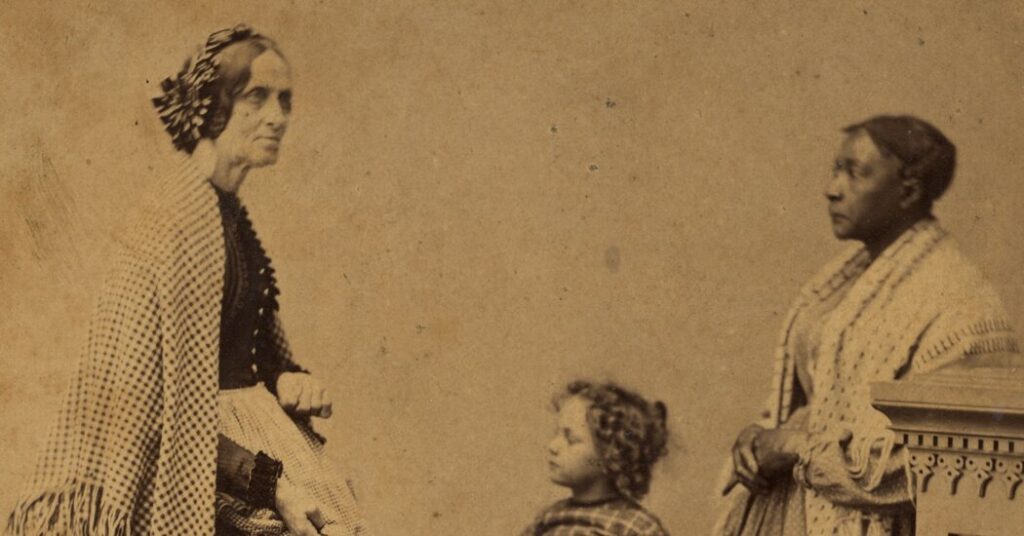
A TERRIBLE INTIMACY: Interracial Life in the Slaveholding South, by Melvin Patrick Ely
In a central Virginia courthouse in 1854, an enslaved man is prosecuted for raping a white woman. Black and white witnesses praise his character and attest that he could not have committed the crime because he was ill and incapacitated that day. He is ultimately exonerated.
In 1861, an enslaved man is on trial for murder after assaulting his owner with a blow to the knee that contributed to his death. Fellow slaves attest to the owner’s relentless abuse, including brutal whippings, beatings with heavy sticks and painful tooth extractions. One witness recalls that before the assault, the defendant, having recently been beaten, nevertheless declared his determination to work, telling his enslaver, “I intend to cut my row like a man.”
Melvin Patrick Ely’s “A Terrible Intimacy” brims with scenes like these as it unspools the complex lives of Black and white residents of Prince Edward County, Va., before the Civil War. Using records from six carefully selected criminal cases, each dissected in detail, Ely convincingly reveals how the antebellum social order was defined both by violent white supremacy and by a surprising variety of interracial relationships.
Ely, a historian at the College of William & Mary, has previously turned to local history to challenge our collective tendency to reduce the antebellum South to stereotypes and set pieces. In his Bancroft Prize-winning “Israel on the Appomattox” (2004), he investigated a longstanding free Black community in Prince Edward County. Now he examines slavery itself.
All manner of revealing testimony spilled out in these criminal prosecutions. Everyone seemed to know everyone else’s business. Trials elicited accounts of Black and white people whose families had intersected for decades: white men and enslaved men who drank whiskey together; white women and men who raised mixed-race children, the offspring of interracial relationships; and family members and neighbors of both races who visited, gossiped and nurtured grudges.
Ely is working with difficult sources. Witness testimony is shaped by many factors, including attorneys striving to elicit statements that support their clients’ cases. Court clerks produced not verbatim transcripts but summaries of what they heard. Ely is aware of the challenges and meets them admirably.
He does so in part by adopting an unorthodox format. Historians typically process their research behind the scenes and serve up a relatively smooth narrative, using citations or summaries of evidence to buttress their interpretations. By contrast, Ely gives us an X-ray view into how he works. He walks readers through each trial transcript as if reading the document for the first time. He quotes witnesses at length and explains what he thinks they’re saying, at times noting his own questions and confusion. Only toward the end of each chapter does he divulge the outcome of the trial.
He also narrates how he unearths information to supplement the court records. He recounts how he turns to tax records to reveal exactly where people lived and to discover the value of their land. He describes how he draws on the work of other historians. And he expertly translates his subjects’ vernacular, explaining that “two hours by sun” meant two hours before sunset, and that a “case bottle” may have been “a tall, squared-off glass container with tapered sides.” His conversational tone echoes the intimacy of the relationships he traces in the book, although in a few instances his affection for details ends up distracting from his larger points.
It is not easy to strike the balance that Ely achieves here. Writing about the close terms on which Black and white people often operated in a society like antebellum Virginia, one could easily slide into romanticization or minimize the structures of power that underwrote the social order. Ely resists that pull, circling back to the centrality of anti-Black violence and the threat of violence that hung over the entire system.
In one case, an enslaved man named Tom accidentally killed an overseer who assaulted him. Testimony revealed that the overseer had a violent temper, a drinking problem and a longstanding grudge against Tom’s owners, who were the overseer’s own sister and brother-in-law. But those details mattered little in court. The institution of slavery granted the white man “tyrannical authority” over Tom while placing “nearly absolute limits” on Tom’s “right to defend himself.”
Among the most telling figures Ely features are several prominent white lawyers who seemed to work hard on behalf of their enslaved clients. Those same men, Ely emphasizes, pushed Virginia to join the Confederacy and wage war for the preservation of slavery.
“The most appalling horror of American slavery,” he writes, “may well be that whites in any number of ways implicitly or even explicitly recognized the humanity of Black folk every day, yet they remained full, even avid participants in a system that exploited and abused those very people.” Although agents of oppression have sometimes deliberately “dehumanized” their victims to justify violence and exploitation, they often need no such excuse. They know full well that the people they abuse are human beings, and they do it anyway.
A TERRIBLE INTIMACY: Interracial Life in the Slaveholding South | By Melvin Patrick Ely | Henry Holt | 352 pp. | $31.99
The post The ‘Terrible Intimacy’ of Black and White Americans Amid Slavery’s Horror appeared first on New York Times.