Several years ago, in a burst of climate optimism, Democratic-led states across the Northeast adopted some of the world’s most ambitious policies to shift away from fossil fuels and cut planet-warming emissions.
But today, many of those states are scaling back or rethinking their climate plans as they miss emissions targets, struggle with soaring electricity bills and confront the Trump administration’s hostility to renewable energy.
In New York, Gov. Kathy Hochul recently said the state’s goal for deeply cutting emissions by 2030 was now “unattainable” and asked the legislature to rework its landmark climate law. Regulators had been discussing fees on polluters to help meet that goal, but Ms. Hochul said the costs passed onto consumers would be too high.
In Massachusetts, lawmakers are eyeing cuts to a program that adds charges to utility bills to fund heat pumps and efficiency upgrades, while Gov. Maura Healey has pursued a flurry of energy policy changes to address affordability.
In Rhode Island, Gov. Dan McKee has proposed delaying a legal deadline for the state to get all of its electricity from renewables, from 2033 to 2050, claiming that the current mandate would impose steep near-term costs.
“The biggest hardship I hear from Rhode Islanders right now is their growing energy bills,” Mr. McKee said after proposing to reduce state charges on utility bills that would have funded solar panels and other climate programs, in a move he estimated would save residents $1 billion over five years. “We need to provide relief now.”
Most Northeastern governors still say tackling global warming is a priority. And climate advocates have fought against rollbacks, arguing that cutting clean energy and efficiency programs might ease burdens on taxpayers today, but will cost more in the long run by leaving the region exposed to volatile oil and gas prices.
But the ambitious targets look increasingly out of reach. Various states had aimed to reduce emissions roughly in half by 2030 and nearly zero them out by midcentury. Yet New York’s emissions have barely budged since 2021, while carbon dioxide from New England’s power plants has increased the past two years.
Many Democrats blame President Trump. Northeastern states had planned to build giant wind farms in the Atlantic Ocean to produce clean power, but that has become exceedingly difficult with the White House’s attacks on offshore wind. Federal tax breaks for solar panels and electric cars have been eliminated.
Mr. Trump’s antagonism to renewable energy isn’t the only factor, though. The Northeast has for years had some of the nation’s highest electricity rates, partly driven by local policies. Some Democratic governors, worried about looming electricity shortages, now want to reconsider longstanding taboos against expanding nuclear power or natural gas pipelines.
It’s a sign of how the political landscape has shifted in the Trump era, as Democrats try to balance fears of a warming planet with immediate concerns about the cost of living.
“I think, generally speaking, if it’s affordable, New England governors are now willing to consider it,” said Gov. Ned Lamont, Democrat of Connecticut.
A struggle to meet clean energy goals
In 2019, New York passed a sweeping law requiring the state to cut emissions 40 percent below 1990 levels by 2030 and to essentially stop emitting greenhouse gases by 2050. Connecticut, Maine, Massachusetts, Rhode Island and Vermont adopted similar goals.
At the time, business groups and critics called the targets unrealistic and expensive. But supporters said that while the Northeast would need big upfront investments in clean energy, the region would ultimately benefit from weaning itself off fossil fuels.
“The argument at the time was that these targets were achievable with the right mix of technological progress and federal support,” said Noah Kaufman, a senior research scholar at Columbia University’s Center on Global Energy Policy.
“But,” he added, “a lot has happened between then and now.”
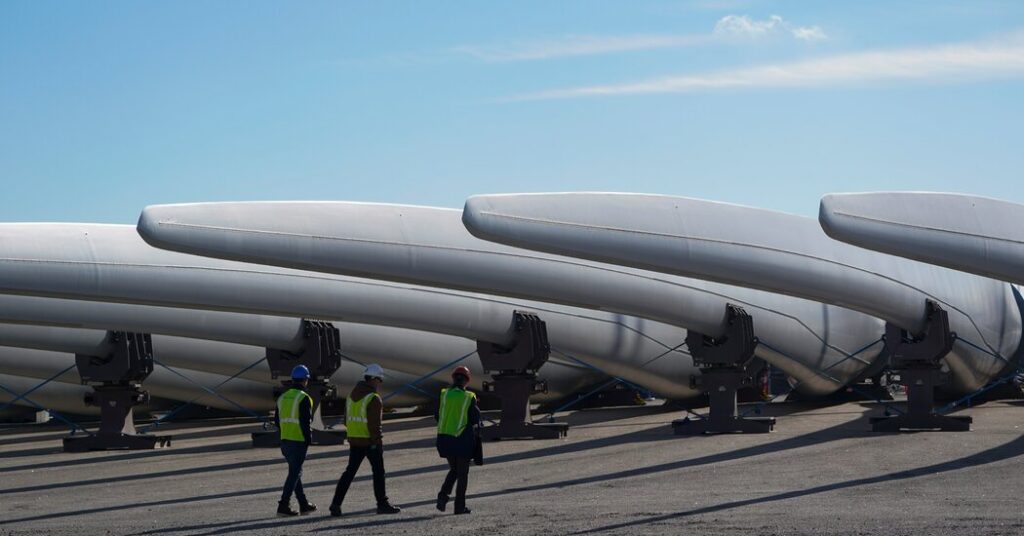
To meet their goals, Northeastern states planned to build more than a dozen wind farms in the ocean, since there is less room onshore for renewables. That meant creating an entire offshore wind industry from scratch. But the coronavirus pandemic wrecked supply chains and interest rates rose, which delayed projects and caused costs to skyrocket.
Then Mr. Trump returned to office and sought to block offshore wind, a technology he detests. While four offshore wind projects are still under construction, it is unclear if more can be built. New York’s climate plan calls for 9,000 megawatts of offshore wind by 2035, enough to power 6 million homes. Currently, only 1,800 megawatts are set to come online.
“That was a huge setback,” said Kyle Murray, the director of state program implementation at Acadia Center, a clean energy advocacy group. “Offshore wind was the primary strategy that states like Massachusetts were going to pursue for its electricity future, and now it’s shut down.”
Yet Mr. Trump wasn’t the only obstacle. Local hurdles also stymied projects.
In Maine, landowners fought a proposed transmission line to shuttle onshore wind power to the rest of New England. In western Massachusetts, residents have opposed large solar farms. In New York, 97 communities have enacted moratoriums on battery storage, often over fire concerns.
Massachusetts, New York and Vermont have also recently shut down nuclear plants after opposition from antinuclear activists. Those closures, including of Indian Point outside New York City, removed a large chunk of carbon-free power.
The slow build-out of clean energy means the Northeast still relies primarily on natural gas for power and heat — which is relatively expensive, since there are limited pipelines to bring in cheap gas from places like Pennsylvania. Over the past decade, Democrats and environmentalists have blocked several proposed pipelines.
Today, residential electricity rates in the Northeast are twice as high as those in the Midwest or South and climbing fast. High natural gas prices, weather disasters and rising transmission costs are major factors, but clean energy mandates also add costs, a study from Lawrence Berkeley National Laboratory found.
In New York, a state analysis found its climate law added $10 to $12 per month to residential electric bills in 2024, a figure expected to rise over time. While those costs don’t capture the law’s benefits, such as cleaner air, they have made politicians squeamish at a time of high inflation.
Expensive power can also make it harder to persuade people to switch to electric cars or heat pumps, two key climate strategies.
At the same time, some policymakers say that renewable energy isn’t enough to meet the region’s needs. During a ferocious storm this winter, New England produced little electricity from wind or solar at times and couldn’t import enough gas to cover demand. So power plants had to burn oil, a much dirtier fuel, instead. Meanwhile, a transmission line to bring hydropower from Quebec finally came online after years of delay — except Quebec had little power to spare, either.
The Trump administration piled on, citing the storm and the Northeast’s high prices as evidence of the follies of climate policy.
“The timing could not have been more cinematic,” said Dan Dolan, executive director of the New England Power Generators Association, a trade group. “It really encapsulated the consequences of where we sit.”
A pivot to ‘affordability’
Many Democratic governors are looking to revamp their climate plans.
In New York, Ms. Hochul said that because of offshore wind delays and other setbacks, meeting the state’s 2030 goals for reducing emissions would now require such drastic cuts and steep fees on industries that it could cost the typical household thousands of dollars per year. She has asked legislators to instead require more gradual emissions cuts over the next decade.
“Help us change the climate law,” she said last month. “We’re not saying no to it. We’re just saying give us a longer runway.”
In Rhode Island, Mr. McKee has proposed postponing deadlines to switch entirely to renewable energy, saying that the Trump administration’s actions have made existing targets “challenging.” In Massachusetts, Ms. Healey has delayed a state clean heat standard aimed at transitioning homes away from fossil-fuel heating, citing concerns about costs. A similar standard in Vermont died amid industry backlash.
Environmentalists have opposed many of these changes, arguing that expensive natural gas is the biggest reason for high energy prices in the region, and the quicker utilities can get off gas, the better. That means doubling down on efficiency and conservation measures, solar power and batteries while investing less in extending gas pipelines to new homes, they say.
“We could cut all these clean energy programs now and save a little on bills, but we’re still going to be in a constant cycle of natural gas costs going up unless we figure out how to break the cycle,” said Mr. Murray of Acadia Center.
Because New England still relies heavily on heating oil for homes, the region has been hit hard by price spikes stemming from the Iran conflict.
Some governors, desperate to rein in costs, are exploring new ways to speed up clean energy deployment while lowering bills. Ms. Healey in Massachusetts has moved to streamline permitting for solar projects, reduce electricity rates for heat pump owners and make the grid more flexible to reduce the need to build additional power plants.
“We can bring more energy in to lower people’s bills and bring more clean energy in to reduce emissions all at the same time,” Ms. Healey said.
More contentiously, Ms. Hochul, Mr. Lamont and Ms. Healey have also expressed openness to new natural gas pipelines, which studies suggest could save the region money on gas costs — though they could also slow the shift to low-carbon energy. A few smaller pipeline expansions have begun moving forward.
All six New England governors also recently voiced support for expanding nuclear power — a stark turnaround for a region with a history of opposing the technology. Ms. Healey has asked Massachusetts legislators to lift a 1980s-era moratorium on new nuclear plants, an energy source supported by the Trump administration.
“We need to make sure we’re getting all types of energy supply into the region to meet our growing needs,” said Ms. Healey. “We can’t just put our eggs in one basket.”
New York and New England together make up less than 1 percent of global carbon dioxide emissions, so they have only a small direct influence over rising temperatures. But as blue states hope to fill the gap after the federal government’s retreat on climate, many hope the Northeast can show that boosting clean energy can be popular and beneficial.
“We’ve spent years building up climate laws and economic development models around clean energy,” J. Timmons Roberts, an environmental studies professor at Brown, said of Rhode Island’s proposed rollbacks. “Are we really just going to give that up in a moment of panic?”
Brad Plumer is a Times reporter who covers technology and policy efforts to address global warming.
The post Northeast States Set Big Climate Goals. Now Those Plans Are in Trouble. appeared first on New York Times.