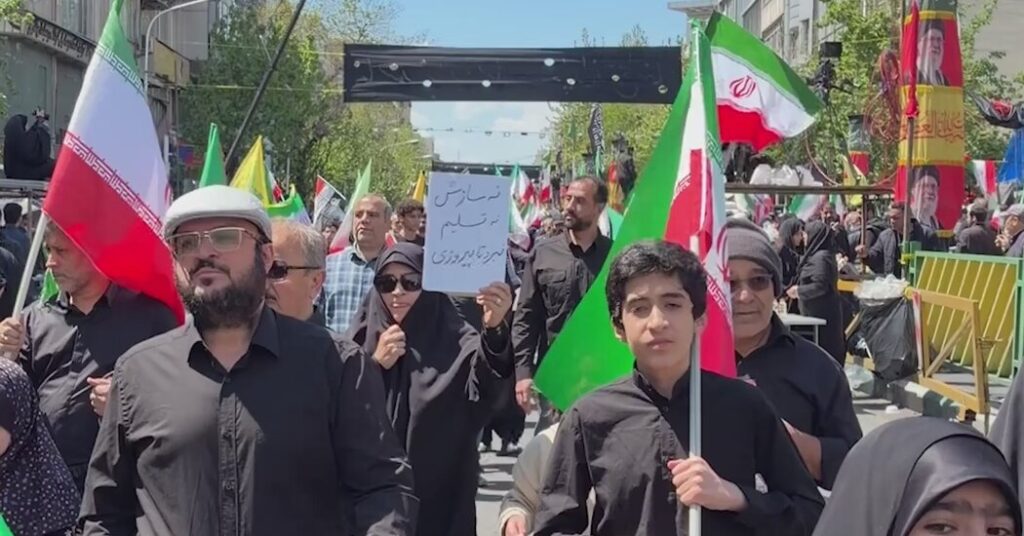
When the United States and Iran agreed to a cease-fire this week, many Iranians welcomed the reprieve from a devastating war that had stretched for over five weeks. But some hard-line supporters of the government were left deeply unhappy.
At a march held on Thursday in Tehran to commemorate the death of Ayatollah Ali Khamenei, the supreme leader who was killed at the outset of the U.S.-Israeli campaign, some demonstrators held signs that read: “Cease-fire is prohibited. It’s time for revenge” and “No compromise, no surrender. Fight until victory.”
The hard-liners’ distaste for negotiations with the United States is adding to the pressure on Iranian officials as they engage with their American counterparts on Saturday in Pakistan to discuss terms for an end to the war.
Conservative Iranians opposed to the cease-fire argue that the United States and its ally Israel have proven that they cannot be trusted. They point to the last two rounds of negotiations between Iran and the United States, which were interrupted by military attacks on Iran.
They are furious that Israel has continued to strike Lebanon in the days after the cease-fire was agreed. And they believe that Iran was winning the war, and now risks squandering that advantage.
“What happened was #diplomatic_sabotage in the midst of battlefield success,” wrote Seyed Ehsan Hosseini, an energy journalist who previously worked at a news outlet affiliated with Iran’s Revolutionary Guards, in an X post on the second day of the cease-fire. “Abandon Lebanon, and God will abandon us.”
After President Trump wrote on social media that Iran could not enrich uranium, something it has claimed as an inherent right, Ebrahim Rezaei, a member of Iran’s parliament and spokesman for the legislature’s national security and foreign policy committee, called for Iranian officials to “cancel negotiations with the defeated devil so they know that we are not in a position of weakness.”
Hard-liners within Iran generally have more freedom to harshly criticize the government, especially the conduct and policy decisions of elected figures who come from more moderate camps.
Some of those conservative figures have been upset for years over what they see as inadequate deterrence against attacks by the United States and Israel, believing this has emboldened Iran’s enemies to act more aggressively against the country.
Much of the Iranian population is opposed to the current government, and the country has seen round after round of nationwide protests demanding an end to the Islamic republic.
Given that limited popular support, ensuring the backing of its base is especially important for the government.
If this round of negotiations were to again be cut short by strikes on Iran, or if Iranian officials were seen to be conceding too much, the support of those hard-liners could be at risk.
Yeganeh Torbati is the Iran correspondent for The Times.
The post Many Iranians Are Glad the Fighting Has Paused. Some Hard-liners Aren’t. appeared first on New York Times.