From the moment the United States and Israel ignited their war against Iran, Tehran has maintained a markedly consistent set of demands, built around a permanent peace, economic relief and the right to pursue nuclear enrichment.
In contrast, President Trump frequently has recast the war’s aims — fluctuating among denying Iran nuclear weapons, inflicting devastating destruction, imposing regime change and achieving total victory — sometimes several times in one day.
Iran’s unwavering demands helped the regime to survive a war inspired at least partly by the hope that it would collapse, analysts said. The question is whether the two-week cease-fire that was announced Tuesday can endure should Iran maintain the same line during negotiations due to start Saturday in Pakistan. The maximalist demands put forth publicly in its 10-point plan for the talks appear both unrealistic and unworkable, not least because Mr. Trump has already been dismissive.
The United States is seeking major concessions, including Iran surrendering its highly enriched uranium and committing to no nuclear weapons as well as other limits on its military capabilities; restoring unfettered transit through the Strait of Hormuz; and ending support for its regional proxies like Hezbollah. In posts on his Truth Social app, Mr. Trump described Iran’s published demands as a “hoax,” while suggesting that Iran’s proposals behind closed doors are more reasonable.
Iran says that its goal from the talks is to establish “new security and political equations” in the Middle East that recognize the country’s “power and leadership,” according to a statement posted online Tuesday evening from the Supreme National Security Council, the powerful body that formulates defense and foreign policy.
The regime wants more than to merely survive, noted Dr. Sanam Vakil, the director of the Middle East and North Africa program at Chatham House, an international relations think tank in London. Iran has repeatedly demanded a deal that blocks any similar attack in the future and speeds recovery from this war, she said. But if it can stick to those demands in Pakistan remains to be seen.
“Consistency has been important to hold the regime together at a time of crisis, but under negotiation pressure, where Iran is forced to make compromises, unity and consistency could unravel,” Ms. Vakil said.
Mr. Trump has claimed victory, and believes the United States has the upper hand. The war hit Iran hard, inflicting billions of dollars in damage, seriously degrading its military and killing almost 2,000 civilians, according to a count by the Human Rights Activists News Agency.
Yet it has also emerged from the conflict with new leverage, having impaired the global economy by closing the Strait of Hormuz while damaging both energy infrastructure crucial to its Gulf Arab neighbors and U.S. bases in the region. It wants to avoid a repeat of the events last June, when the 12-day U.S. and Israeli attack on Iran just petered out without any formal agreement to end hostilities, which resumed on Feb. 28.
Mr. Trump initially set a high bar for the war, demanding Iran’s “unconditional surrender,” which he later defined as Iran losing the ability to fight.
He often vacillated between demands. Last Monday alone, for example, on the eve of the truce, the president started the day calling the prospects for a cease-fire “a significant step,” while in the afternoon he was demanding that Iran “cry uncle” and in the evening stated that “the entire country can be taken out in one night.”
In the decades since its revolution, Iran acceded to compromises on significant foreign policy issues just twice, noted Karim Sadjadpour, an Iran expert at the Carnegie Endowment for International Peace in Washington. Iran accepted a cease-fire in the Iran-Iraq war in 1988, after an estimated 250,000 of its soldiers had been killed. And in 2015, under the Obama administration, it signed a nuclear agreement that included outside inspections and exporting most of its highly enriched uranium.
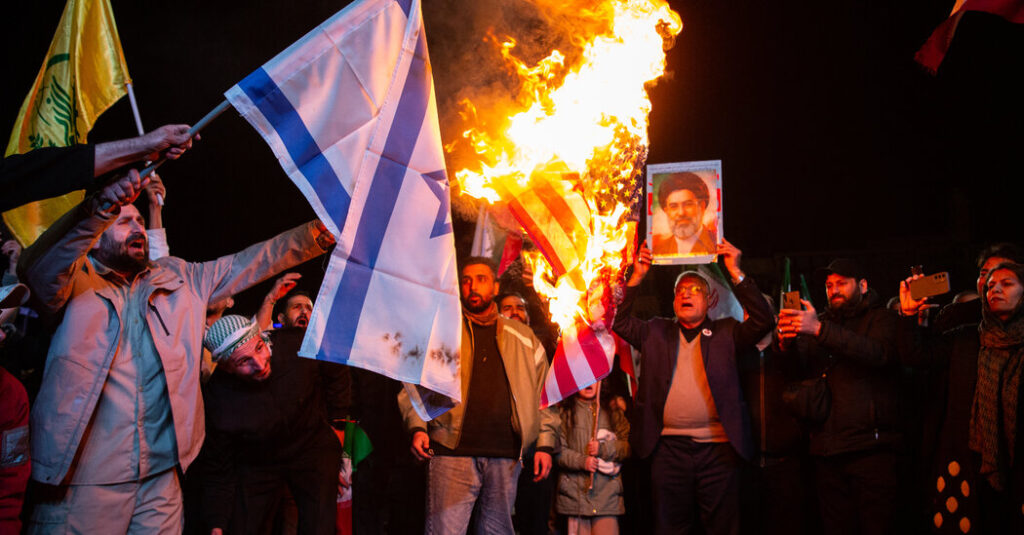
Neither forced Iran to abandon what Mr. Sadjadpour called the two fundamental principals that have served as the regime’s lodestar since it first took power in 1979: undermining American influence and rejecting Israel.
That revolutionary ideology feeds hostility in Washington, as Mr. Trump made clear in announcing the war on Feb. 28.
“For 47 years, the Iranian regime has chanted ‘Death to America’ and waged an unending campaign of bloodshed and mass murder, targeting the United States, our troops and the innocent people in many, many countries,” he said, returning to that theme repeatedly throughout the fighting.
Ayatollah Ali Khamenei, the supreme leader for almost 40 years before he was assassinated on the first day of the war and succeeded by his son, always refused to abandon that ideology.
“They believe their ideology is their identity, and their identify is inextricable to their survival,” Mr. Sadjadpour said. “Once you start to dilute or abandon your principles, that’s like taking a sledgehammer to the pillars of a building, it’s going to collapse.”
For the talks set to begin Saturday, the 10 points that Iran released publicly include a series of far-reaching demands that the Trump administration has suggested are implausible.
Aside from the guarantees that it will never be attacked again, they include maintaining its nuclear development program, the withdrawal of U.S. forces from the region and an end to attacks against its proxy forces, in particular Israel’s war against Hezbollah in Lebanon.
Perhaps most important, Iran wants to impose tolls on what had been the free passage of ships through Hormuz. About 20 percent of the world’s oil supply transits the Strait. On the economic front, it seeks war reparations and the lifting of decades of sanctions.
Echoing Mr. Trump, his press secretary, Karoline Leavitt, said at a White House briefing on Wednesday that Iran had modified its initial proposal, privately submitting a condensed, more reasonable plan that prompted the U.S. to accept the cease-fire.
Yet the statement on Tuesday from the Supreme National Security Council suggested that “resistance” — Iran’s shorthand for its hostility toward the United States and Israel — would continue.
“Iran wants major concessions from the U.S., but at the same time wants to maintain it as its primary adversary,” Mr. Sadjadpour said, “The two positions cannot be reconciled.” The public demands made by the United States and Iran “are not in the same universe,” he said.
The fact that the regime has been largely decapitated, with its most senior leaders killed, will likely compound the difficulty of already thorny negotiations, analysts said. While the replacements have long-established political and military credentials, they have yet to amass the power or the legitimacy needed to start tinkering with the fundamentals of the revolution, even if they wanted to, they said.
Issues like Hormuz or Israel’s attacks on Lebanon could also undo the cease-fire. This was the first time that Hezbollah attacked Israel specifically to help defend Iran, noted Ali Vaez, the Iran project director at the International Crisis Group, so not defending the organization would set a bad precedent for other proxy forces in Yemen and elsewhere. “If the Iranians betray Hezbollah, how can they count on the Houthis?” he said.
At the same time, while Mr. Trump has expressed readiness to resume fighting, the calendar will work against him, analysts noted. In quick succession he faces an already delayed summit meeting with President Xi Jinping of China, the United States hosting of the World Cup soccer championship and the U.S. midterm election season. An ongoing war would cast a shadow over all of them.
Despite its bluster, Iran might be ready for compromise given the huge costs of the war, leaving it with daunting problems, analysts noted.
First, the bombing shattered crucial economic infrastructure, deepening the government’s already troubled finances. Popular discontent with the regime, veiled while the country was at war, will likely re-emerge with the cease-fire. From the other end of the spectrum, hard-liners are attacking the government for accepting a truce before winning key demands, particularly guarantees against future attacks.
Still, leaders of the Islamic Republic have a history since the 1979 revolution of putting the survival of the regime well ahead of the interests of the country as a whole. That suggests they might be reluctant to retreat from the demands that saw them through the war, analysts said.
“They feel triumphant that they have been able to survive,” Mr. Sadjadpour said. “They will continue to prioritize revolutionary ideology over national interests.”
Sanam Mahoozi and Shirin Hakim contributed reporting.
Neil MacFarquhar has been a Times reporter since 1995, writing about a range of topics from war to politics to the arts, both internationally and in the United States.
The post Iran Has Been Consistent in War. Will It Be Consistent in Peace Talks? appeared first on New York Times.