One of the big surprises of the war now engulfing the Middle East has been the intensity of attacks by the Lebanese militant group Hezbollah on neighboring Israel after it held its fire for more than a year.
A nominal cease-fire in late 2024 ended the last Israeli-Hezbollah war, but Israel kept up near-daily strikes on Lebanon in an effort to dismantle the Iran-backed militia and diminish its ability to operate. When Hezbollah did not retaliate, many assumed that was because it had been weakened and much of its arsenal had been destroyed.
Hezbollah has defied that notion by managing to launch consistent rocket barrages into Israel for more than a month now. Officials and experts say the attacks demonstrate that Hezbollah has adapted to its new circumstances, becoming more agile, operating in smaller units and mounting surprise assaults.
The United States and Israel said this past week that Lebanon was not in the cease-fire agreement that was announced with Iran. Prime Minister Benjamin Netanyahu said Israel would continue hitting Hezbollah even as it opens talks with the Lebanese government on how to disarm the militant group.
The war has also made clear that Hezbollah retained a sizable arsenal of rockets, missiles and drones and carried on producing weapons locally. Hezbollah’s operations suggest that it saw the 15-month cease-fire not as an end to its conflict with Israel, but as a crucial window to prepare for another round of fighting, according to Israeli, Western and Arab officials and analysts who spoke to The New York Times.
“There was a very wrong widespread assumption that Hezbollah was finished,” said Heiko Wimmen, a Lebanon expert at the research organization International Crisis Group. “But it now appears that was not the case. They did prepare. They did rebuild. They did regroup.”
Here is what we know about the current state of Hezbollah’s arsenal.
Hezbollah was down, but not out.
In the past two years, Hezbollah was weakened by a series of attacks. Israel targeted its fighters by blowing up the pagers they used to communicate, and then killed the group’s secretary general, Hassan Nasrallah.
The militant group’s power was further eroded by the blows to its allies. Hezbollah’s Syrian ally, Bashar al-Assad, was ousted from power in late 2024. And last June, Israel waged a brief war against Iran, supported by U.S. airstrikes on Iranian nuclear facilities.
After the Israel-Hezbollah war paused in late 2024, Israel kept up targeted killings of the group’s fighters and senior commanders. Israel said it struck weapons depots, training camps and smuggling routes to prevent Hezbollah from regrouping.
At the same time, pressure mounted on Hezbollah both domestically and internationally to disarm. When the Lebanese army began to deploy in the south — Hezbollah’s decades-long stronghold — many wondered whether the group’s collapse was just a matter of time.
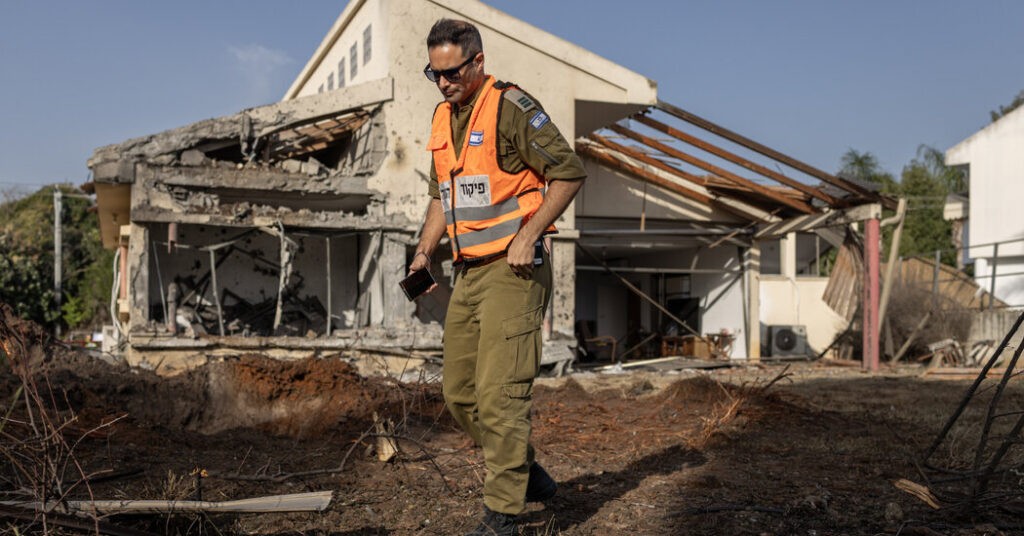
Then, in early March, just after the U.S.-Israeli war with Iran began, Hezbollah began attacking Israel in solidarity with Tehran. Since then, its fighters have fired hundreds of rockets and drones, fought Israeli troops along the border and displaced communities in northern Israel. The Israeli military says 11 of its soldiers have been killed in southern Lebanon since the latest conflict started.
Israel responded to Hezbollah’s attacks by intensifying a ground invasion of southern Lebanon, displacing hundreds of thousands of people. Israeli officials recently said that their country was preparing to occupy much of southern Lebanon even after the ground invasion ends.
There is little doubt that Hezbollah’s arsenal is smaller than it was before the regional wars that erupted after Hamas-led attacks on Israel on Oct. 7, 2023, according to an Israeli military intelligence official and Lebanese military experts. Still, the group has demonstrated that it remains a force to be reckoned with.
Hezbollah relies on missiles, rockets and drones.
Last year, Lebanon’s national armed forces began seizing Hezbollah weapons in the south and asserting state authority in the area. The U.S. military said last October that the Lebanese army had removed nearly 10,000 rockets and about 400 missiles.
Israeli officials, however, maintained that the group’s arsenal was being replenished faster than it was being stripped.
“We never thought Hezbollah had the capabilities to enter this war, let alone this capability to throw this many rockets,” said Hassan Jouni, a retired Lebanese general and military expert.
Before the current war, Hezbollah’s stockpile of rockets and missiles was estimated to number 15,000 to 25,000, according to Israeli security experts and Lebanese military officials. Most of those weapons are short-range artillery rockets, according to Janes, the defense intelligence firm based in London, and an Israeli military intelligence official.
Both Janes and Israeli security experts said they believed that Hezbollah also retained missiles that could reach longer ranges exceeding 120 miles.
Hezbollah fighters are also using antitank missiles, including shoulder-fired systems, to target Israel. The militia received some of the weapons from the Assad regime in Syria, military experts said.
In particular, the group is relying on Kornet antitank missiles, which can strike targets about 3.5 miles away, according to Israeli military officials, a retired Lebanese general and analysts. Many of the Israeli soldiers who were killed or injured in the current war were hit by antitank missiles, two Israeli officials said.
Hezbollah is also using the short-range Almas, an upgraded Iranian version of Israel’s Gil missile, according to Sarit Zehavi, the founder of the Israeli security nonprofit, Alma Research and Education Center, and a senior Israeli military official who spoke on the condition of anonymity to discuss confidential matters. It has versions that can range from about two to 10 miles, far enough to reach northern Israel.
Hezbollah has said it is also deploying attack drones against Israel. Lebanese and Israeli military officials say the group largely relies on makeshift, low-cost drones.
On March 4, the group released a video purporting to show a fighter setting up a drone concealed in a bush. Other images shared by Hezbollah and the Israeli military show the group’s fighters using rocket-propelled grenades and Kalashnikov rifles.
Hezbollah is still producing arms locally.
The fall of the Syrian regime largely cut off the land bridge through Syria that Iran had long used to supply Hezbollah with weapons and money. The group needed to adjust to the new circumstances in the region.
At least one senior Hezbollah official has said that during the cease-fire with Israel, the militia worked to restore its arsenal and rebuild its ground forces.
Security experts and Lebanese military officials say Hezbollah has increasingly focused on local production, using guidance kits and components that can be assembled quickly. This means they can produce rocket bodies, fins, nose cones, smaller motors and warheads, according to Janes.
While Israel says it has targeted many of Hezbollah’s production sites, new ones seem to keep emerging, according to Janes and Ali Hamie, a Lebanese military analyst.
Hezbollah is also assembling drones locally with cheap Chinese parts and often with improvised modifications, according to the two Israeli military officials and Khaled Hamadeh, a retired brigadier general with the Lebanese army.
“They import the spare parts. They have the know-how. And the drones might not be sophisticated,” but they are doing the job, Mr. Hamadeh said.
Hezbollah operates in smaller units.
Several Israeli and Lebanese officials, along with regional security experts, estimate that Hezbollah now has up to 2,000 militants fighting south of the Litani River. The territory south of the river to Israel’s northern border has for decades been Hezbollah’s stronghold.
These forces are currently organized into dispersed, semiautonomous units, sometimes as small as three or four fighters, according to officials and experts, who say the smaller numbers enhance their ability to strike in multiple locations. This is in contrast to their operations in recent years.
As a result, Hezbollah has resorted to the “guerrilla-style warfare” that it used during its 2006 war with Israel, said Naji Malaeb, a Lebanese military expert and retired brigadier general.
Lebanese military experts, an analyst close to the group and one Israeli official say that Hezbollah and Iran’s powerful Revolutionary Guards force still coordinate operationally, though that collaboration has weakened. The foreign arm of the Guards, the Quds Force, oversees Iran’s proxy militias around the Middle East.
In early March, Israel targeted what it said were Revolutionary Guards operatives at a hotel in Beirut. More than 100 Iranian nationals, including Revolutionary Guards officers, were among those who were evacuated to Russia in early March, according to a senior Lebanese civil aviation officer who spoke on the condition of anonymity because he was not authorized to discuss confidential matters.
Dayana Iwaza, Natan Odenheimer and Aaron Boxerman contributed reporting.
Abdi Latif Dahir is a Middle East correspondent for The Times, covering Lebanon and Syria. He is based in Beirut.
The post In New War With Israel, Hezbollah Defies Notion That It Was Crippled appeared first on New York Times.