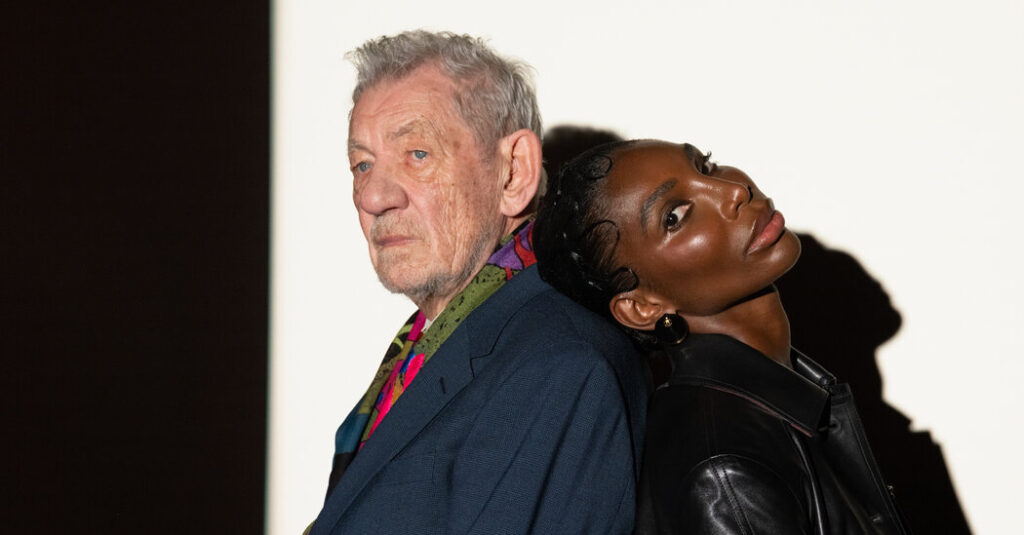
Michaela Coel didn’t need to read the script for “The Christophers” to understand that she and Ian McKellen would be a good, if unexpected, pairing.
He’s the 86-year-old thespian, known for his interpretations of Shakespeare, as well as for playing Gandalf in “The Lord of the Rings” trilogy. At nearly a half a century younger than McKellen, Coel, 38, is the multihyphenate behind two groundbreaking television series, “Chewing Gum” and “I May Destroy You.”
“It felt special to bring the two of us together because I think both of the audiences that follow us — I’m sure there’s a Venn diagram in which that audience is the same — but by and large, they don’t know each other,” she said in a video interview alongside McKellen. “And so we’re bringing together these audiences that would otherwise be completely separate.”
“The Christophers,” directed by Steven Soderbergh and written by Ed Solomon, leans into their odd-couple status. McKellen plays Julian Sklar, a once-acclaimed artist who became better known in his later years for doling out insults on a reality competition show. His greedy children (Jessica Gunning and James Corden) hire Lori Butler (Coel), who works in art restoration, to pose as his assistant while secretly completing the unfinished canvases locked in the top floor of his apartment so they can sell the artworks for a fortune after he dies. These pieces were meant to be additions to his beloved series called “The Christophers,” made up of portraits of an ex-lover. As Lori and Julian spend more time together, their relationship blooms into one of begrudging respect as they both are forced to interrogate why they make art.
McKellen, for his part, is thrilled to have made Coel’s acquaintance. “I like it that, in the reviews I’ve read, they just link our names together as if we’re playing Romeo and Juliet or something, or Antony and Cleopatra, and that suits me down to the ground,” he said. “My God, that gives me street cred galore just to be linked with Michaela.” She jumped in: “And you give me the fine stuff,” adding, “My drama school will be beside themselves. They never would’ve thought it would be me.”
The two spoke about how McKellen’s rehearsal process shaped the story and how they think about legacy. Below are edited excerpts.
How did you prepare for filming?
IAN MCKELLEN We had a good series of sessions before we actually started filming. Steven wasn’t up for discussing too much in advance. I like to rehearse, being a theater actor, on the whole and absorb myself and gradually get involved in what’s going on. So we met round my kitchen table with Ed, and made quite a few alterations actually. These were sent to Steven at the end of the day, and on the whole, he approved of what we were up to. But I did enjoy those sessions getting to know each other. I was reassured it was going to be all right. Didn’t you feel that, “Oh, we’re all right?”
MICHAELA COEL I did. I had been in Ghana for a few months. I arrived in the country at 6:30 in the morning, and I got a call from Ed saying Ian would like us to gather at his kitchen table to go through the script. So immediately I was like, “Yes.” Dropped my bags, and I went to the house. Though I went to theater school, I haven’t been in a play in 12 years. So for me, I did not have a clue what was going on. I didn’t understand what we were about to do. And what happened was we went through all of our scenes, and Ian just kept asking questions. And I was like, “Oh my goodness. This is really scary.” I didn’t know that we could question a script like this.
MCKELLEN [Solomon] was very generous. I mean, if I were a writer like you two, I’m not sure that I would want an actor interfering, but he was very, very open to it, wasn’t he?
COEL He was encouraging us actually.
What changed through these conversations?
MCKELLEN This story had begun as a sort of thriller, a heist, the plot was everything. And by the time we’d done our work, it became a film about two people rather than what particularly happened. And so the charm of the film is that you get to know these two bright characters who seem so far apart, but in some areas of their life and their imagination, they’re very close. It’s a sort of love story really.
You are both artists, and this is a film about making art. What were your perspectives on portraying these characters?
MCKELLEN It’s kind of you to call a jobbing actor an artist. I go to work, really. I don’t feel I’m creative in any way whatsoever compared to someone who writes a song or even sings a song, or writes a play or a screenplay like Michaela does. I’m sort of genuinely modest about what I do for a living, but I do know a few artists, and I’ve had affairs with artists, I’ve lived with artists. David Hockney is one of my best pals. He’s not seen the film yet, but we’re going to send it to him. He’s the same age as my character, but the story is utterly different. I’ve got a lot of art on my walls at home because I’m in awe of painters. That was my connection, really. I had to really work to imagine what it was like to be an artist. Have you ever painted, Michaela?
COEL No.
MCKELLEN I thought you were about to say that of course you had. There’s nothing you can’t do, is there? Can you cook?
COEL No, I can’t really. No, Ian. I’ll have a corned beef sandwich at your house any day over my cooking.
To make art, it’s a very vulnerable thing to do, but also you have to calcify yourself a little bit to protect yourself from a diversity of energies that come your way. This includes love, adoration, critique, mockery, people that are repelled by you, all these things. And so you have to build this thick skin, but also you need to be completely soft to make the work. The need for validation, the need for approval, the need for love — which maybe comes from some kind of absence of love, some kind of absence of normal attention that people get — I think a lot of us, we find ourselves being artists. So I draw on that. But did I spend my time making sure that I read some kind of fancy, really amazing book about art? I didn’t.
MCKELLEN Michaela is omitting one of her greatest qualities in this movie is that she listens. And in the silence, as the camera just looks at her, you may not know exactly what’s going on in her mind, but my God, she’s so alive. Of course that fits in, doesn’t it, with being someone who writes about the world and imagines the world, because it comes out of observation of the world.
COEL Thank you, Ian. I think it’s very hard not to listen to you. You have a way of moving and being, and your voice is sometimes like hills and valleys, and you have an instinctive connection to anger, to delight, to playfulness. And actually, it’s so easy. It’s so easy to just drop into your frequency and dive into you.
MCKELLEN Well, that’s because we’re Romeo and Juliet, you see.
COEL We really are. We were holding hands by day three of the kitchen room reads. He’s got these lovely soft hands. They’re so soft.
MCKELLEN They’ve never done a day’s work in their life.
This film is about legacy. Do you think about legacy at all? Do you think about what you leave behind?
MCKELLEN I do, and I know it’s not very much. I can talk to actors who are 20, 30 years younger than me who have never heard of Laurence Olivier or Noël Coward or John Gielgud or Peggy Ashcroft or these giants of my youth: Gone. Particularly theater actors, over and done with. That’s fine. And I don’t have children. That’s most people’s legacy, isn’t it? No. I don’t think there’s any life after death in both senses of heaven and hell and a legacy. It’s over. So you better enjoy it while you’re here.
COEL I like that, Ian. The question is, does legacy matter? It seems to me it’s important for some people, and that’s fine. And believing in legacy has led them to do things that have changed the course of human history, but does it have to be important for everybody? Absolutely not. I think I’m not thinking about that. I’m thinking about what’s happening today and who across from me can I impact? Who can I give something to? What young woman or man needs something here now? I’m not really thinking about life beyond when I’m gone. I’m thinking of what I can do today.
The post Ian McKellen and Michaela Coel on Art, Fear and Soft Hands appeared first on New York Times.