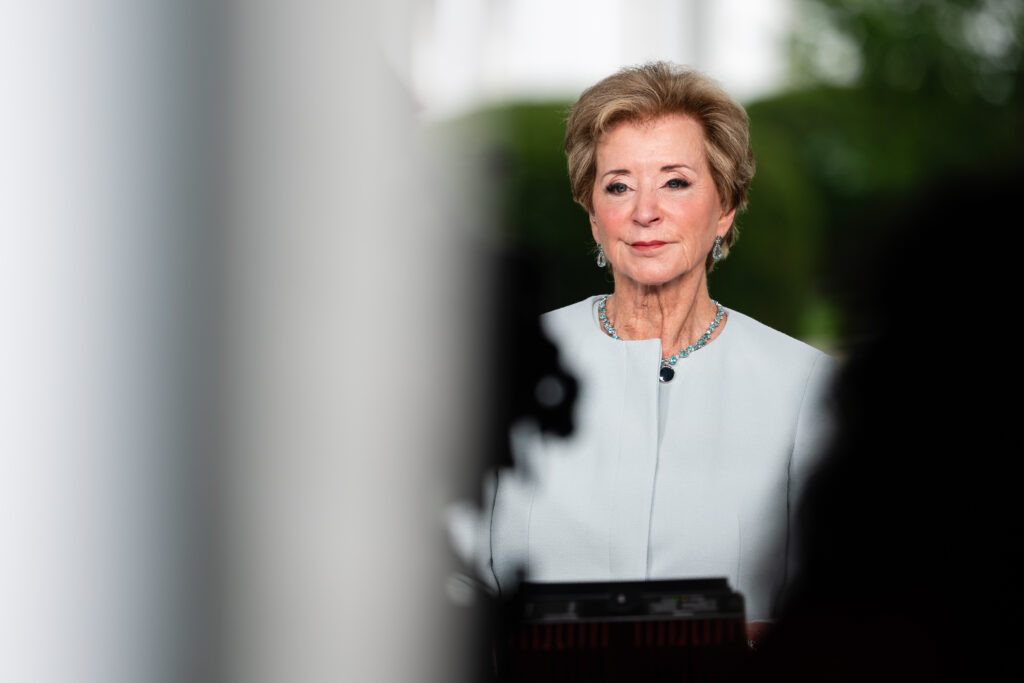
Education Secretary Linda McMahon lauded civil rights activist and journalist Ida B. Wells on Truth Social on Friday, part of a series of posts praising celebrated women in American history.
But the photo attached to the post wasn’t of Wells. It was an image of a woman at a desk, holding a quill pen. The image carried the label “Photo by Gemini,” a reference to a Google AI tool.
Critics decried the photo as historically inaccurate and unnecessarily fake.
The post is the latest in a string of AI creations and other digitally altered images shared by the Trump administration.
McMahon’s use of the fake image disappointed Paula Giddings, the author of a 2008 biography on Wells.
“While I appreciated the recognition of Ida B. Wells, the decision to use an AI generated image undermines the very values she stood for: truth-telling and her lifelong campaign against false representations,” Giddings, a historian who wrote “Ida: A Sword Among Lions,” said in an email to The Washington Post.
“To use a fabricated image — even a respectful one — is not only unnecessary but is evidence that the secretary of education misreads [Wells’s] legacy.”
Wells, who died in 1931, documented lynchings of Black people in the South, co-founded the National Association for the Advancement of Colored People, and fought for women’s right to vote.
Over the past year, President Donald Trump and the White House have sparked backlash for sharing fake images, including a video that depicted former president Barack Obama and his wife, former first lady Michelle Obama, as apes, as well as ones depicting Trump as a king and the pope.
In January, the White House shared a digitally altered picture of a social justice activist, Nekima Levy Armstrong, that inaccurately showed her in tears after her arrest for allegedly disrupting a church service in Minnesota.
The Labor Department also drew scrutiny for depicting workers as mostly White men in illustrations that some experts thought may have been created with AI.
And more recently, the White House posted mash-ups of footage from the Iran war with images from video games.
Friday’s post was the latest computer-generated image featured on McMahon’s personal Truth Social account in recent weeks.
She has used several AI photos and illustrations to celebrate famous women in U.S. history under the hashtag “HerStoryInAction.” It includes AI images of Susan B. Anthony, Sojourner Truth and Sacagawea.
McMahon also posted a map of the 13 original American colonies that contains an unusual pronunciation guide for the number 13 (/thar-ten/) with mislocated states. For instance, the image shows Rhode Island west of Connecticut and Pennsylvania. New Jersey appears to be located in two places, including in the area that is now the state of Maine (which was part of Massachusetts at the time). The source of the map is not listed.
McMahon could not be reached for comment. A spokesperson from the Education Department noted that the images came from a personal account and were not associated with the agency.
The post on Ida B. Wells comes after a Democratic lawmaker challenged McMahon’s knowledge of Black history, and critics protested stops on her “History Rocks!” tour across the country.
Sarah Weicksel, executive director of the American Historical Association, lamented the growing use of AI to create historical images and illustrations on social media, including McMahon’s account.
“The use of AI to pull together infographics about individuals has resulted in poor quality and inconsistent resources in education,” Weicksel said.
She pointed out that on McMahon’s post, the woman in the image is depicted as writing by a candle with a quill pen, though gas lights and metal dip pens were more common when Wells was at the peak of her career as a writer and activist in the late 1800s and early 1900s.
“The AI images are pulling from material that is historically inaccurate,” she said. “We have excellent sources for all of these women, so there is no point to using something that is AI generated.”
Weicksel did credit McMahon for showcasing a wide range of women in history on her account, and not everyone The Post spoke with expressed concern about the AI image. That includes Wells’s great-granddaughter, Michelle Duster.
“I’ve seen a lot of artwork of my great-grandmother, that’s original or AI generated, so this is nothing new,” said Duster, who wrote a biography on Wells called “Ida B. the Queen.” She said it is possible Wells may have used a quill pen at some point early in adulthood.
Duster said she hopes the secretary encourages all Americans to read books on Wells to “further understand the times Wells lived in, the violence and oppression she faced, and why her fight for justice and equality continues.”
Razzan Nakhlawi, Andrew Ba Tran and Aaron Schaffer contributed to this report.
The post Education secretary used fake photo in post about Black history icon appeared first on Washington Post.