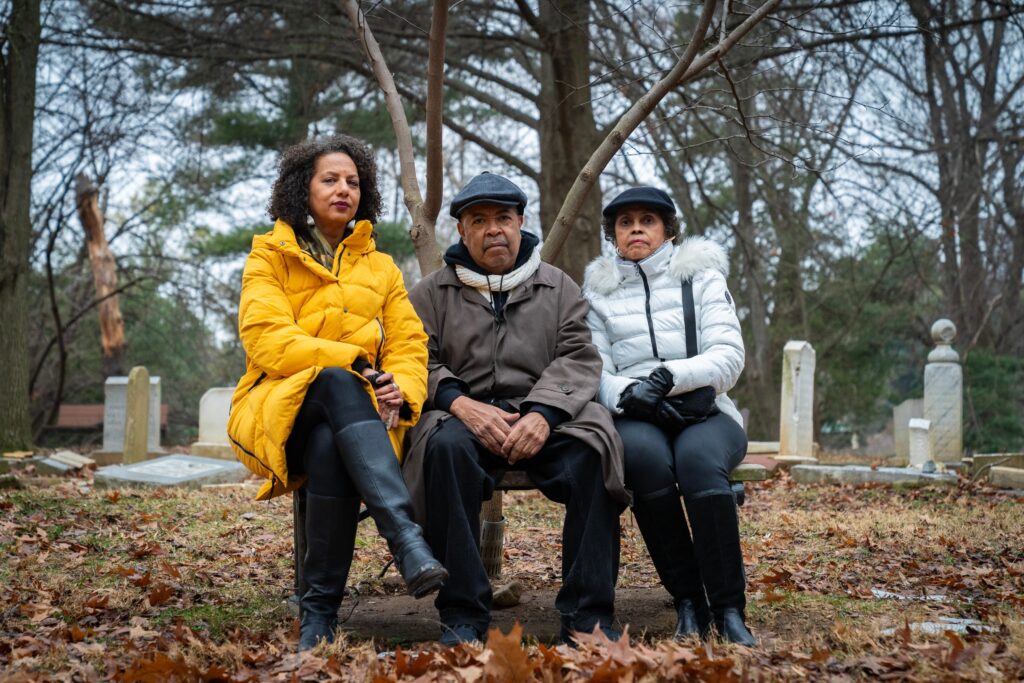
Neville Waters III stepped through two of D.C.’s oldest Black cemeteries on a recent spring morning, surveying overgrown weeds and broken and decaying headstones marking the grave sites of at least 10,000 enslaved and free African Americans.
For more than six decades, Waters, his relatives and a handful of supporters have fought to preserve the adjoining cemeteries — Mount Zion and Female Union Band Society — overlooking Rock Creek in what was once known as Black Georgetown. Historians say the site served as a stop on the Underground Railroad, where people escaping slavery hid in a brick vault that was used to temporarily store bodies when the ground was too cold or too wet for burial.
“My blood was a part of this history that’s here,” said Waters, referring to at least four of his ancestors who are buried at the site.
The cemeteries’ advocates have staved off developers in a neighborhood of regal mansions and colonial-style townhouses, stopped excavation on a slice of former cemetery land and repeatedly pushed the District to undertake a $1.6 million project now underway to stop stormwater runoff and erosion at the historic burial grounds.
Now the Black Georgetown Foundation, the nonprofit that oversees and works to preserve the cemeteries, has launched a more widespread campaign this spring to educate the public on the often overlooked and unknown properties.
The group is giving dozens of tours and seminars to businesses, researchers and school, civic and university groups, boosting an existing program that has helped raise funds for the site. On Saturday, they will host an event where volunteers will help clean up the burial grounds, and organizers will honor D.C.’s Emancipation Day — April 16 — by reading the names of roughly 3,100 people who were freed after President Abraham Lincoln signed the act in 1862 that ended slavery in the nation’s capital.
“We have to not only save the cemeteries, but also educate and spread the word that they’re here and an important part of the D.C. fabric and history,” said Lisa Fager, executive director of Black Georgetown Foundation.
The two cemeteries sit on three acres in a neighborhood known as Herring Hill, where residents once fished for herring that were bountiful in Rock Creek. The Mount Zion Cemetery is owned by the nearby Mount Zion United Methodist Church. On the other side, the Female Union Band Society Cemetery is owned by a trust. The Black Georgetown Foundation oversees and manages both cemeteries.
Advocates for the cemeteries said telling the story of the 200-plus-year-old properties and those who are buried there has been a journey of learning their own families’ connections to the site. The foundation has found records of at least 4,500 people interred at the cemeteries and created a database featuring their names, marriage status, occupation, relatives and burial details. Their effort to promote the historic properties comes at a time when the Trump administration has intensified its push to remove historical markers about slavery and other bleak chapters in history from national parks and other tourist sites.
“To think there are attempts to erase, ignore or lie about this country’s history of Black people and slavery is disheartening,” said Waters, board president of the Black Georgetown Foundation. “It’s history. Yes, slavery was a horrible institution, but it should not deter us from talking — and learning — about it. And that’s a part of the history of this cemetery. We should tell these stories, not hide them.”
Among those buried at the cemeteries are: Rev. Joseph Cartwright, who became one of the first Black ordained Methodist ministers in the region and bought the freedom of his wife and children; Eliza Williams, who died at the age of 111 and had 12 children; and Clement Beckett, who was born enslaved and secured his freedom at 20 years old before becoming a founding member of the Ebenezer AME Church.
Some of the first Black men in the country to vote were also buried at the property — three years before the 1870 passage of the U.S. Constitution’s 15th Amendment that barred the government from denying citizens the right to vote based on race, color or because they had been enslaved. There’s also the grave of a Black girl named Nannie, who died at the age of 7 in 1856. Her marker bears no last name and passersby have left small toys, candles and trinkets in tribute to her.
“Too often, Black cemeteries like this one are unfortunately deliberately neglected,” Fager said, as she led a recent tour of the properties. “We’re not taught of them in schools. It’s really important to change that and tell the stories of those who lived there and what they did for this city.”
“This is not just a cemetery,” she said, “but a place that’s a truth teller of Black Washington. It tells a story and it honors the dead.”
Waters, a fifth-generation Washingtonian, said his great-great-grandparents — Hezekiah and Martha Turner — and their twin sons are buried at the site. The Turners’ sons were leaders in the Republican Party in the 1870s, according to researchers of the cemetery.
“My great-grandfather was born into slavery, freed as a child and went to work for the federal government,” Waters said. “He became a homeowner and was eventually known as the mayor of Black Georgetown. That’s just a remarkable life and part of my family legacy.”
The cemeteries have a long history.
Established in 1808, Mount Zion — formerly known as the Methodist Burying Ground — served as a burial ground for White and Black people who attended Montgomery Street Methodist Episcopal Church. In 1842, freed Black women founded the Female Union Band Society cemetery next to Mount Zion.
When the Oak Hill Cemetery was established nearby in 1849, some White people disinterred their relatives and moved them to that site. In the 1930s, the U.S. government used its eminent domain authority to take half an acre from the cemeteries to build a trail. Gradually, the surrounding neighborhood that was an enclave for African American doctors, lawyers, laborers, merchants and clergy changed. Black families were forced out as gentrification swept through the area and White wealthy homeowners moved in.
In 1950, Mary Logan Jennings, a Female Union Band Society president, was the last person to officially be buried at the site before the city condemned the property for disrepair and prohibited additional burials. In the 1960s, preservationists fought off developers who wanted to build housing on the site, and as part of a cleanup effort years later, many gravestones were moved and not returned to their original spots. In 1975, the National Register for Historic Places placed the property on its list. Nearly 40 years later, the DC Preservation League recognized the site as one of the most endangered historic places in the area.
Vernon Ricks, 87, was born in a one-bedroom apartment in Georgetown. He recalled how his family would take him when he was young to visit the cemeteries on Memorial Day for an event called “Decoration Day.” Youths sold water and lemonade and families placed flowers on gravestones to pay their respects.
“This is a part of my life, my culture,” said Ricks, a board member of the Black Georgetown Foundation and a lifelong member of Mount Zion United Methodist Church who now lives in Potomac, Maryland. At times, Ricks said, it “hurt my dignity” to see how well-maintained Oak Hill cemetery was as it sat next to the neglected Black cemeteries.
“You’d look over there at the White cemetery and it was preserved and neat,” said Ricks. “You’d look at ours and it was a slap in the face. It was run-down. It was sending a message that Black burials were not as important and maintaining them wasn’t either.”
“We have a duty to do something to make our cemetery as important — and known — to the community,” Ricks said.
Vincent deForest, 90, who’s president emeritus of the Black Georgetown Foundation’s board, has been involved in working to preserve the cemeteries since 1970. He said he feels the group’s work follows an African proverb: the wholeness of a people are diminished if the ancestors are not honored.
“That’s what we are attempting to do in our work,” he said. “We still have that challenge and it may be even greater today than it was decades ago.”
The post Descendants renew fight to save historic Black cemeteries in D.C. appeared first on Washington Post.