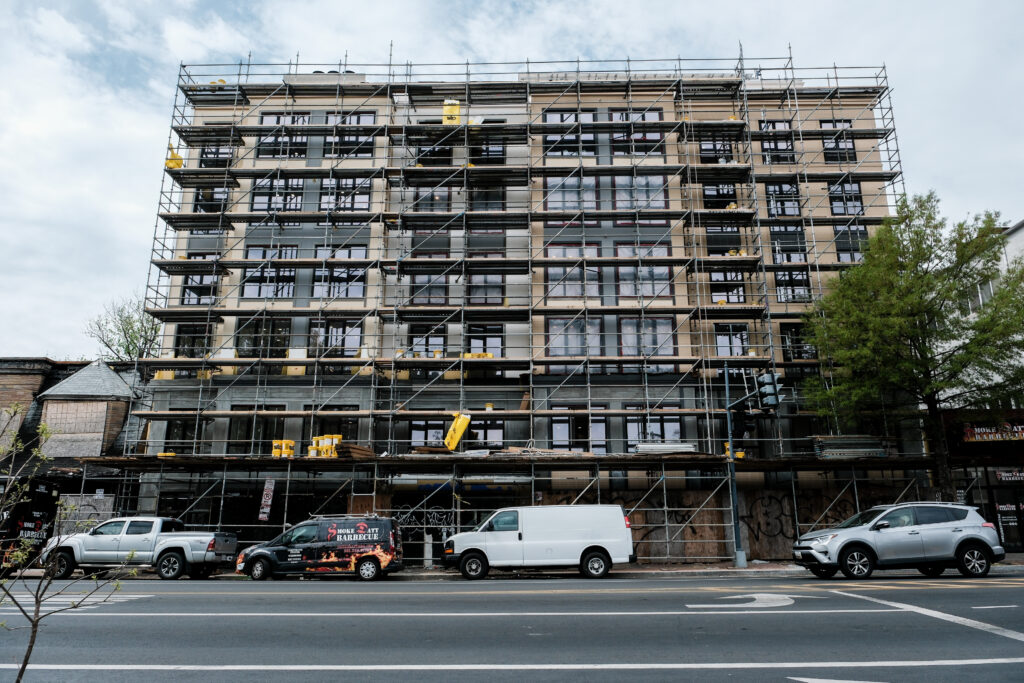
D.C.’s leading Democratic candidates for mayor are vowing to build thousands of new housing units in a bid to increase supply and bring down high costs squeezing renters.
The only problem: Their proposals are coming at a time when developers and investors aren’t interested in building housing. New building permits have plummeted by 58 percent since 2023.
Council member Janeese Lewis George (D-Ward 4) has pledged to build 72,000 new housing units within five years if elected, a plan that would double the goal achieved by Mayor Muriel E. Bowser (D). Meanwhile, Lewis George’s top rival, former longtime council member Kenyan R. McDuffie, is promising to build 12,000 new units by 2030 and preserve 20,000 affordable ones.
In a city of roughly 700,000, where rentals make up more than 60 percent of housing units, the rental market is in significant distress. Tenants have struggled to pay. Landlords have struggled to collect, a problem that was exacerbated during the pandemic and that has threatened foreclosures of buildings and deterred investors from wanting to build more.
Against that backdrop, McDuffie and Lewis George are confronting tension between what’s ambitious and what’s realistic for new housing — along with political challenges in selling their vision.
Lewis George, a democratic socialist often seen as a fighter for tenants, argues that her plan meets the urgency of the moment. To achieve it, though, she would need buy-in from developers and landlords she’s clashed with over housing policies. McDuffie, who has more support from developers, said his plan is calibrated to current challenges. But he will have to work to convey a tenant-friendly rep and assuage detractors who see his goal as too modest.
“The plan that I’ve laid out is one that I can actually execute on from day one,” McDuffie said in an interview.
Lewis George, meanwhile, sees her big housing target as a way to unlock other policy aspirations, such as growing the tax base enough to fund even more robust social services.
“Imagine the social safety net we could generate if there were 800,000 or one million Washingtonians living and working here,” she wrote in an op-ed in Greater Greater Washington, which endorsed her, last week.
Ian Ruel, a D.C.-area commercial real estate broker who noted that lately his clients would rather not invest in D.C., said he sees McDuffie’s topline goals as “more conservative but probably realistic.” And Lewis George’s? “God bless her if she can figure out how to get that done,” he said.
“I don’t know, given the environment right now, how that would be possible,” he said. “I drive around and used to see 30-plus cranes in the air in D.C. Now I’m lucky if I see one.”
Lewis George built a reputation as an ally for tenants’ rights over five years on the council — a commitment that was on display at a rally at the Woodner Apartments in Mount Pleasant last month.
“Janeese is on our side,” Sierra Ramírez, president of the tenants’ association there, told the crowd of several dozen, many clad in “Stomp Out Slumlords” tees.
Taking the mic, Lewis George promised to fight rent hikes, go after slumlords and poor housing conditions, and build social housing — publicly owned, privately run mixed-income housing in which higher rents subsidize lower-income residents.
“You deserve leaders who have courage and who will not cower to the landlord lobby in this city,” she said. “There are more renters than there are landlords. There are more workers than there are bosses.”
It was somewhat of a manifesto for Lewis George, whose campaign has focused heavily on energizing tenants and unions — giving her a political edge in grassroots organizing.
In an interview, Lewis George said she would pursue a dual strategy of pro-tenant reforms, including expanding rent stabilization, and policy changes that are pro-development.
“Pairing those two things together, we have a real path,” she said.
Lewis George said her tenants’ rights values were informed by her family’s experience of having to move after a rent increase they could not afford. They left their house in the Kennedy Street neighborhood, where her mom had rented for decades, two weeks before Lewis George started law school, forcing her to live in her sister’s attic until they could find stable housing.
The experience taught her “the impact of displacement,” she said. “Having to leave that neighborhood was just heartbreaking.”
On the D.C. Council, she has been one of the most ardent supporters of emergency rental assistance and eviction protections. When tenants in rent-stabilized buildings faced historic rent hikes three years ago, Lewis George was one of the lawmakers who pushed for the most aggressive cap on increases.
She has not detailed how, if elected, she would expand rent stabilization, which limits rent increases in older buildings. Her campaign said she wants to solicit more public feedback.
In one of her starker contrasts with McDuffie, Lewis George was the most outspoken opponent last year of Bowser’s signature housing bill, the RENTAL Act. Bowser pitched the bill as a way to stabilize the rental market for housing providers and restore investor confidence by speeding up the eviction process, undoing some pandemic-era policies and rolling back tenant protections that can lengthen sale timelines when buildings go on the market. Like most of the council, McDuffie was for it.
Tenants like Ramírez say they have felt seen by Lewis George’s outspoken advocacy. She said the idea to bring social housing to D.C. proved to her that the candidate has real solutions.
“We’re really feeling the cost-of-living crunch,” said Ramírez, who became a tenant organizer to help her neighbors fight eviction. “I see her as representing the chance to have a mayor who doesn’t hate us. Who understands our needs, the profoundly difficult times our residents are facing.”
But the question for Lewis George will be how to sell her development-boom vision to skeptics who say stances such as her vote on the RENTAL Act demonstrate a lack of understanding of the economic headwinds facing landlords and developers.
Lewis George said she would appeal to them by making building easier, pointing to plans to “cut red tape, reform permitting and overhaul zoning so we can build more kinds of homes and rowhomes and apartments in more places.”
McDuffie said his vision for housing is informed by his upbringing in the city and a commitment to ensuring that native Washingtonians like him can afford to remain in the District. He and his wife bought his childhood home from his mother nearly 20 years ago and have raised their children in the same Northeast D.C. rowhouse that his grandparents purchased in 1952.
He’s promising both to expand home-purchasing assistance — which Lewis George has also pledged — and to improve the rental market by removing permitting barriers and zoning appeals that can delay construction of units and drive up costs. He witnessed one such notorious delay across the street from his home, where the major development at the McMillan site got snagged for decades.
McDuffie set targets for lowering hurdles to construction — including goals to cut housing development approval timelines by 50 percent and reduce lawsuits against the zoning commission to zero, mirroring a recent effort by Bowser.
“It’s too expensive and too slow to build in the District of Columbia,” McDuffie said in an interview. “Right now the system’s broken, and I’m fixing the system so housing can actually get built.”
But detractors said his goal of building 12,000 units by 2030 — and preserving 20,000 affordable units — is not nearly ambitious enough compared with Lewis George’s plans. “If a mayor is not willing to think big, then they’re probably not going to go big,” said David Alpert, a Lewis George backer and former executive director of Greater Greater Washington, a hub for urban development and transit lovers.
McDuffie counters that he is avoiding offering voters “empty promises.”
He argued that his vision is backed up by his record on the council, where he led legislation requiring affordable housing to be built on public land being sold to a developer, restricted D.C. landlords from asking about prospective tenants’ criminal histories and supported efforts to fund free legal representation for residents facing eviction.
Nigel Crayton, a senior director at Greysteel who works with real estate investors in the D.C. region, said the leading Democratic candidates’ contrast on housing issues before the council — namely on the RENTAL Act — “speaks volumes.”
McDuffie, he said, has demonstrated a willingness to be “listening to developers and how they are looking for help.” He said Lewis George’s rhetoric or stances could create the perception of a “you versus me” approach, rather than a partnership with developers or landlords providing the housing she hopes to build. Dean Hunter, director of the Small Multifamily & Rental Owners Association, said that was in part why he was endorsing McDuffie, calling him a “responsible legislator.”
McDuffie said he’s pitching himself to residents of all generations across the city, including renters and prospective home buyers. But given his opponent’s deep connections with tenant organizers, along with the fact that many prominent developers and landlords have donated to his campaign, he is likely to face more of an uphill battle in proving his tenant-friendly bona fides.
Asked how he would pitch himself to renters, McDuffie said he would point to his vision for “economic growth with guardrails.”
“We’re going to grow our economy in the District of Columbia, but we’re going to put up guardrails so we’re not displacing people,” he said.
Questions about funding
Academics, developers and others in real estate assessing both plans said they were still looking for one important detail from the candidates: How would they pay for their ideas?
Neither campaign would detail the per-year funding needed to achieve their housing production goals. Bowser funded the city’s main engine for housing growth, the Housing Production Trust Fund, at $100 million per year, at times higher.
Derek Hyra, an American University professor who studies housing and neighborhood change, said cost has become a central consideration in D.C., where the loss of tens of thousands of federal jobs has stymied budget growth. The city currently faces a $1.1 billion shortfall.
“When the city has a budget surplus, you can more easily talk about these affordable-housing policies,” Hyra said. “But when you speak about them now, you’ve got to think about, where is the money going to come from?”
Patrick McAnaney, director of development at D.C.-based Somerset Development Company, said he saw both plans as hitting the right notes to make it easier to build and potentially entice investors to come back. Both candidates say they would pursue strategies such as easing permitting headaches, increasing density around Metro stations and rethinking zoning to allow more homes in more areas.
Still, McAnaney said, the ability to attract capital remains the biggest hurdle. McAnaney — along with Hunter, Crayton and others in development — said the RENTAL Act has not solved the problem or substantially renewed investor interest in the District.
“It’s going to be the first thing a new mayor is going to have to deal with coming in, because if they haven’t gotten the market stabilized, then no big ideas are going to work,” he said.
The post D.C. mayoral candidates want to build more housing — but investors don’t appeared first on Washington Post.