China’s best-known modern writer, Lu Xun, made his name a century ago as a coruscating critic of traditional Confucian culture, foreign bullying and the grandiose pieties of Chinese despots old and new.
Today, in his hometown, Shaoxing, a prosperous city in eastern China laced with canals, the writer has transformed from a fiery anti-establishment rebel into a cuddly Communist Party mascot. His prickly character and sharp views have been smoothed as flat as the refrigerator magnets sold across town as souvenir tributes to him.
Shortly before his death in 1936, Lu Xun wrote that “when the Chinese suspect someone of being a potential troublemaker, they always resort to one of two methods: they crush him, or they hoist him on a pedestal.”
Hoisted atop a giant pedestal by Mao Zedong, who in 1940 declared the writer “a hero without parallel in our history,” Lu Xun (pronounced Loo SHWUN) has stood for decades at the center of China’s most expansive literary-political cult.
Mao’s preferred version of Lu Xun as an iconoclastic enemy of stale orthodoxies, however, has been cast aside in recent years to make way for a tamer, cheerier version — one that’s more in tune with the drive by China’s current leader, Xi Jinping, to promote national pride by celebrating the “glorious achievements” of the country’s past. As such, the author has become something of a case study in the Communist Party’s efforts to repackage China’s complex history to serve its official narrative.
Under Mr. Xi, the authorities have cracked down hard on negativity, punishing bloggers and online influencers for demonstrating “excessively pessimistic sentiment” — something that Lu Xun himself often displayed.
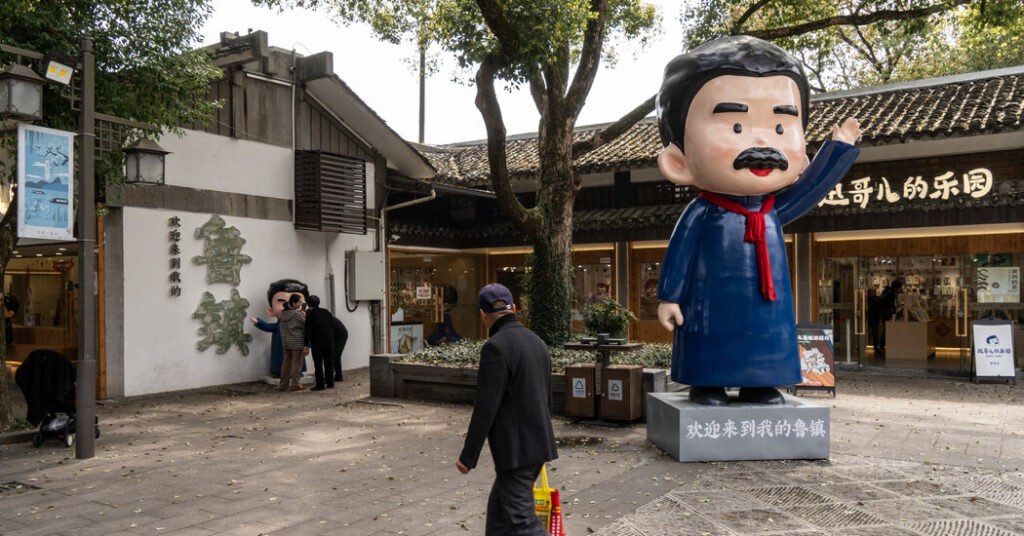
No longer portrayed by the Communist Party as an irascible rebel, the writer is now represented as a cute Disney-style cartoon character, the stone streets around his childhood home dotted with big fiberglass dolls bearing his likeness.
At Lu Xun’s boyhood school in Shaoxing, which he once recalled as a place of such mind-numbing tedium that he wanted his teacher to “fall ill and — ideally — die,” he is remembered on a sign outside as a “diligent and reflective learner” who eagerly soaked up what he was told in the classroom.
Across the road, the facade of a Lu Xun museum has been plastered with one of Mr. Xi’s favorite slogans aimed at young people: “Inherit the Red Gene and Promote Patriotism.”
And in another possible step by officials to revise the author’s image, a big Lu Xun memorial complex in Shaoxing has been closed since the end of last year for “repairs,” as has an even larger complex in Shanghai.
Lu Xun was born Zhou Shuren in 1881 into a scholar-gentry family that had fallen on hard times. He adopted the pseudonym to publish his first major work, “Diary of a Madman,” the first modern short story written in vernacular Chinese, in 1918.
The story’s protagonist, convinced that Confucian tradition encouraged cannibalism, is driven mad by the idea that he had been “living all these years in a place where for 4,000 years they have been eating human flesh.”
That dark reading of China’s history sits uneasily with Mr. Xi’s “China Dream,” a program of “national rejuvenation” that largely blames foreigners for the country’s past problems and exalts Chinese tradition.
Hostile to “historical nihilism” — code for any version of history that besmirches the party or China — Mr. Xi has created what Geremie Barmé, an Australian Sinologist who studied in China during the Mao era, calls an “empire of tedium,” a cheery chloroformed calm in which even grumpy troublemakers like Lu Xun are made to smile and fall into line.
But even before Mr. Xi came to power, Lu Xun’s mordant pessimism had drawn flak from some nationalist intellectuals who accused him of channeling colonial-era missionary stereotypes of China as backward and cruel.
His grandson, Zhou Lingfei, dismissed this as a “serious misreading” of Lu Xun’s works. He declined to be interviewed in person, but said, in a written response to questions, that his grandfather’s “aim was to help the Chinese people stand up and rise above their circumstances, not to blindly copy the West or pander to prejudice.”
The study of Lu Xun has been part of China’s national school curriculum for decades, though the list of his mandatory texts has been periodically pruned to keep up with shifting political winds. Gone since the Chinese army’s 1989 assault on Tiananmen Square, for example, is “In Memory of Miss Liu Hezhen,” a rage-filled essay he wrote to mourn the death of a student protester shot by government troops in Beijing in 1926.
Also omitted from study is Lu Xun’s observation to the American journalist Edgar Snow about the 1912 collapse of China’s last imperial dynasty: “Before the revolution we were slaves. And now we are the slaves of ex-slaves.”
Though hailed by Mao as the “saint of modern China” and a “true Marxist and thorough materialist,” Lu Xun never joined the Communist Party or considered himself a Marxist. He was tormented during the last, illness-plagued period of his life by overbearing party commissars who hijacked a group of left-wing writers that he nominally led, pressuring him to abandon his individualistic ways and embrace “proletarian literature.”
Opposed to Chiang Kai-shek, China’s Nationalist leader from 1928 until 1949, Lu Xun did mentor many young, Communist-inclined writers in the 1920s and ’30s. But his closest disciples, who included the poet and literary theorist Hu Feng, suffered terrible persecution after Mao took power in 1949.
Most foreign scholars and many liberal-minded Chinese believe that Lu Xun would have faced the same fate had he lived long enough to see Communist Party rule. He most likely would have fled China, possibly for Japan, where he had studied medicine as a young man and had many close friends, Mr. Barmé said.
In a book published in 2001, a time of relative openness, Lu Xun’s since-deceased son, Zhou Haiying, reported that even Mao had once acknowledged that the writer “would either have gone silent or gone to jail” if he had been alive after the 1949 Communist victory. The book attributed Mao’s remark to a Chinese official and translator who said he had heard it at a private meeting between the Chinese leader and Shanghai intellectuals in 1957.
Party historians insisted in 2018 that Mao never said any such thing, citing the “untrue rumor” as an example of why China must commit to a “long and arduous struggle against historical nihilism.”
On the edge of a lake in Shaoxing, a literary theme park called Lu Town has recreated the settings of Lu Xun’s best-known stories. A stone inscription next to a statue of the writer at the entrance celebrates him as “the soul of China.” Stalls hawk Lu Xun-themed ice cream, noodles, cardigans and knickknacks.
Lu Xun’s grandson, Mr. Zhou, said he welcomed the park’s “initial intention” — getting young people to engage with a long-dead author whose idiosyncratic prose, a mix of classical and modern Chinese, is often hard to understand — but “firmly opposes excessive commercialization and cheap entertainment.”
“The True Story of Ah-Q,” a biting satire that ends with the execution of its main character, is played for laughs in a small theater in Lu Town that stages five short shows a day.
A character created by Lu Xun in 1921 as a craven Chinese Everyman, the original Ah-Q cuts a pathetic figure, groveling to the authorities while bullying the powerless.
The Shaoxing theme park has turned this bleak story into slapstick comedy. During one recent show, the postal worker-turned-actor who plays Ah-Q hammed it up onstage and, afterward, posed for selfies with Chinese tourists. Lu Xun, the actor said, “was writing about a very different time” when China was still poor and weak, and needed to be reminded that the flaws of people like Ah-Q were to blame.
Today, he added, those shameful times have passed and “Ah-Q is dead.”
Siyi Zhao contributed reporting from Beijing.
Andrew Higgins is the East and Central Europe bureau chief for The Times based in Warsaw, on temporary assignment in Shanghai.
The post China’s Most Famous Modern Writer: From Fiery Rebel to Cute Communist Mascot appeared first on New York Times.