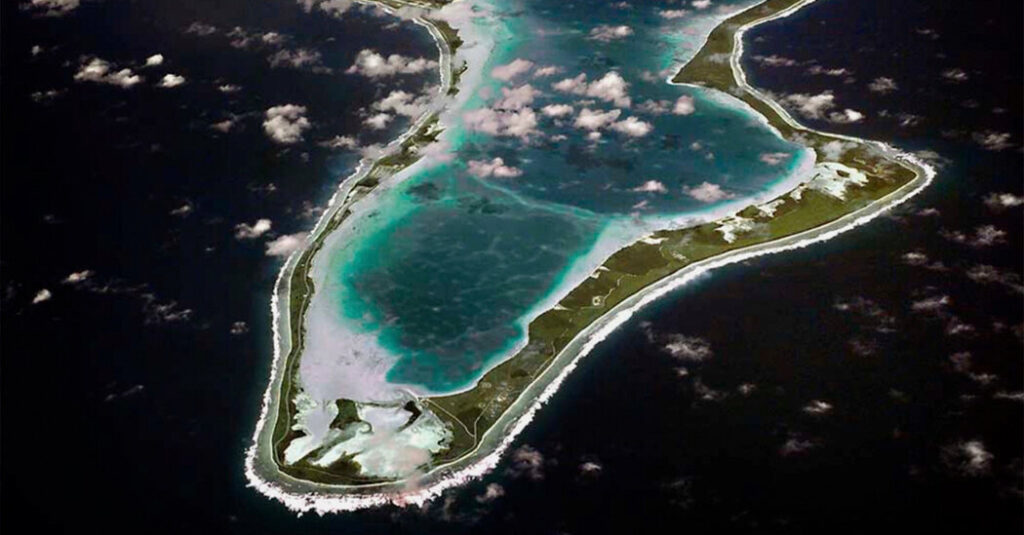
Britain said on Saturday that it was suspending its plan to give up sovereignty over the Chagos Islands, which are home to a strategically important British and American military base, following criticism from President Trump.
An agreement to give Mauritius formal control of the islands, a remote Indian Ocean archipelago that Britain has held since the colonial era, had been in trouble since January, when Mr. Trump called the plan an “act of great stupidity.”
Under the deal, reached in 2024, Mauritius would assume sovereignty over the tropical island chain, but Britain would lease the base on its largest island, Diego Garcia, for an initial period of 99 years.
On Saturday, the British government said it was not abandoning the agreement permanently but acknowledged that it could not proceed without Washington’s support.
The developments came at a time of trans-Atlantic tension. Mr. Trump, who initially supported the Chagos Islands deal, denounced it at the height of his bid to acquire Greenland from Denmark, which Britain and other NATO allies opposed.
When the Iran war began in late February, Prime Minister Keir Starmer of Britain refused to let the United States use British air bases to launch attacks on Iran. He later gave permission to use them for defensive strikes, but Mr. Trump has continued to criticize Mr. Starmer and other European leaders for not taking a more active role in the war.
In its statement on Saturday, the British government called the Diego Garcia base a “key strategic military asset for both the U.K. and the U.S.,” saying that ensuring its operational security was “the entire reason for the deal.”
Britain’s control of the Chagos Islands had come under growing criticism in recent years, and a series of court rulings had cast doubt on its viability. The agreement with Mauritius was meant to provide certainty under international law, though some Chagossians who were expelled from the islands by Britain saw it as a betrayal, saying it failed to guarantee their right to return.
The deal would require formal U.S. approval under a process known as an exchange of notes, which has not taken place. “We continue to believe the agreement is the best way to protect the long-term future of the base, but we have always said we would only proceed with the deal if it has U.S. support,” the British government said in its statement.
The agreement would also have to be approved by Britain’s Parliament, whose current session ends in a few weeks. Next month, the British government will propose a raft of new legislation for the next session, but it is not expected to include a bill to ratify the Chagos Islands deal, effectively putting the agreement on ice, at least in the medium term.
Some British politicians have criticized the terms of the proposed lease arrangement, which was expected to cost Britain about 100 million pounds, or about $135 million, per year.
Kemi Badenoch, the leader of the main opposition Conservative Party, welcomed the decision not to proceed but accused the government of flip-flopping over the plan, which she said would have decreased Britain’s value to the United States as a military ally.
“I welcome the news that the Chagos surrender may finally be on the dust heap where it belongs,” she said in a speech on Saturday, describing the proposal as “astonishingly naïve.”
Stephen Castle is a London correspondent of The Times, writing widely about Britain, its politics and the country’s relationship with Europe.
The post Britain Puts Chagos Islands Deal on Hold, Citing U.S. Opposition appeared first on New York Times.