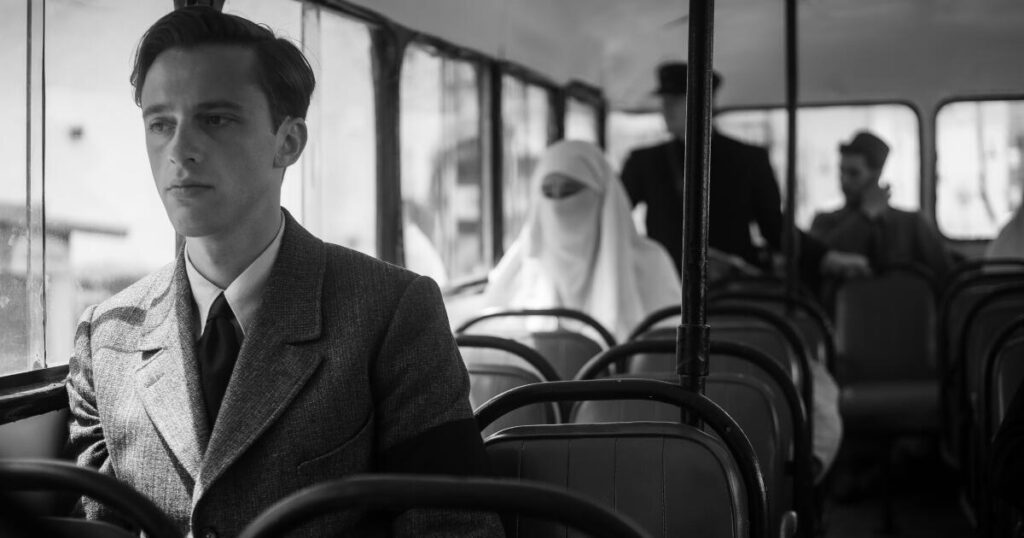
It’s the same sun beating down on us all, Albert Camus memorably conveyed in his oft-debated 1942 novel “The Stranger,” it’s just the individual temperatures that vary. Now French director Franҫois Ozon, with abiding respect for the high-wattage brilliance of his countryman’s spartan masterpiece about an apathetic killer, has given us a movie adaptation that does daylight-noir justice to its alluring mysteries, while threading in some freshly necessary political context.
That context starts with archival footage of French-colonized Algeria in the 1930s, the visuals speaking to both a humming aura of activity and the reality of who’s indigenous and who’s not. Ozon sticks to black-and-white when he takes over and in much the way that eschewing color imbued a chilly, otherworldly elegance to Netflix’s recent “Ripley” (Camus-influenced), Ozon’s choice of hot monochrome to supplant cool prose puts the splendidly shot “Stranger” on a luscious footing. (Manu Dacosse is the DP.) All the better to be entranced by beautiful cipher Meursault (a well-cast Benjamin Voisin), a clerk in Algiers whose nearly every spoken response is some version of “Nothing matters.”
That means he stoically tolerates the teary rituals surrounding his mother’s funeral in the beginning, then jumps right into a sexy fling with Marie (Rebecca Marder), whose marriage entreaties get the same impassive reaction. He seems unconcerned that his bilious old neighbor (Denis Lavant) abuses his dog then wants sympathy when it flees.
But it’s Meursault’s blithe friendship with sleazy Raymond (Pierre Lottin) — who beats his Arabic girlfriend Djemila (Hajar Bouzaouit) — that leads to a change in his one-thing-after-another approach to life. On a beach one Sunday at Raymond’s invitation, alone and in the throes of heatstroke, Meursault shoots a young Arab man who’s been following them, an act as senseless as it seems spurred by inner turmoil.
Instead of adopting a performative defense, however, he remorselessly owns his crime. It’s this exposé of societal absurdity and Meursault’s atheistic refusal to play along with pacifying notions of sin and redemption, that makes“The Stranger” a pinnacle of confrontational literature.
Ozon gives it all a fascinatingly detached gloss so that our curiosity is well-tapped. Still, when he’s loosened from the crisp tempo of the first half’s episodic nature, he makes the most of the latter scenes, especially when Meursault vigorously pushes back against a chaplain (Swann Arlaud) insistent on saving someone. Coming on the heels of two great French-language films with thorny courtroom scenes that nail the impossibility of trials to fully capture human complexity — “Anatomy of a Fall” and “Saint Omer” — Ozon reminds us that Camus was the OG at this.
But the director, who wrote his adaptation in collaboration with Philippe Piazzo, also isn’t content with mere novelistic faithfulness to an author whose traces of colonial allegory in “The Stranger” have often been found problematic. So with thoughtful invention, Ozon gives the distraught Djemila — the murdered Algerian’s sister, unnamed in the book — a voice to go with her ignored status. “No one cares about my brother,” she says to Marie during the trial. Ozon then has Marie express an anodyne comment about Algiers being “home,” which earns from Djemila a mildly derisive laugh.
It’s an added shading, an honest commentary, that feels right, as if it were there all along in the DNA of this well-traveled tale of existential concern, just waiting to be uncovered.
The post A new take on Camus’ ‘The Stranger’ by a veteran French stylist digs unto the unspoken appeared first on Los Angeles Times.