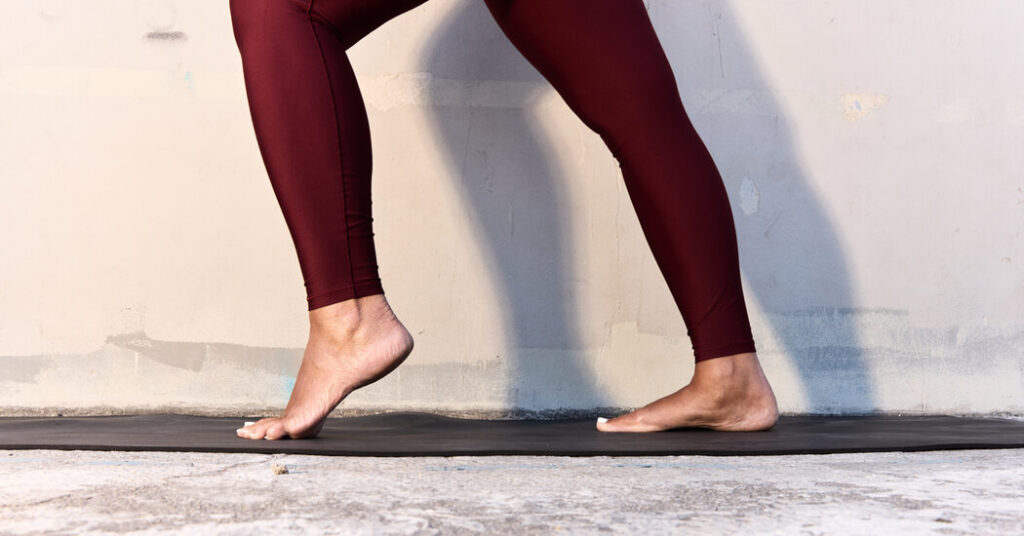
Every spring, says Denise Smith, a physical therapist in Chicago, she sees an increase in patients with pain in the bottoms of their feet. They’ve spent the winter in heavily cushioned shoes or boots that don’t engage their foot’s muscles, and suddenly they’re wearing sandals and flip-flops, which do.
The sudden change can overload the plantar fascia, the thick band of tissue that connects your heel to the base of your toes. That stress can cause plantar fasciitis, which generally presents as a sharp pain in the sole or heel, often most noticeable with those first steps out of bed in the morning.
Approximately 10 percent of Americans will suffer from plantar fasciitis at some point in their lifetime. If not treated properly, the condition can persist for months or even years.
Doctors have traditionally recommended treating the symptoms with rest, orthopedic boots or even surgery. However, podiatrists, physical therapists and scientists are increasingly recommending exercise instead, training not just the foot but some of the muscles and tendons in the leg, too.
“As much as we talk about getting ‘beach-body ready,’ we should also talk about getting sandal-foot ready,” Ms. Smith said.
What causes plantar fasciitis?
Plantar fasciitis can stem from several causes: how the foot moves, issues in the back of the leg or stiff tendons and muscles around the foot. Exercise changes can play a role, too, whether you’re a runner who rapidly goes from 10 to 15 miles in a week or you’ve gotten a little too aggressive with a new walking routine.
In either case, your plantar fascia tries to stabilize your foot in ways it normally doesn’t, which can be more than it can handle. At first this causes inflammation, but eventually the fascia tissue becomes weak, and over time that leads to degeneration and damage.
How can exercise help?
While things like icing, boots and injections might ease the pain, they don’t fix the underlying movement issues, and in some cases can lead to problems later, according to Dr. Diana Rogers, a foot and ankle surgeon in Gainesville, Fla.
Steroid injections, for example can cause more damage of the fascia, even leading to rupture. For that reason, she said, “I haven’t performed a plantar fascia surgery or a steroid injection for years.”
Ms. Smith agreed. “We still see doctors putting patients in a boot, which only makes things worse,” she said. Anything that braces the joint limits mobility, which causes the tissues to tighten, she added.
Wearing thick-cushioned shoes might offer some relief, but research increasingly supports exercise to manage plantar fasciitis long term. It turns out that your fascia can become stronger and more resilient, just like muscles and bones.
The best exercises for plantar fasciitis challenge the many small muscles in your foot, especially the ones that run along the bottom, which both support and strengthen the fascia, said Jay Dicharry, a doctor of physical therapy in Bend, Ore. For instance, elevating your toes while exercising isolates the muscles and fascia, strengthening it.
But you also need to work on tissues above the foot. Strengthening your Achilles’ tendon, your ankle ligaments and even your hips and glutes can all improve your gait and decrease strain on the plantar fascia.
Which exercises should you try?
If you think you have plantar fasciitis, your first step should be to contact a medical professional who can confirm the diagnosis and recommend exercises. If you want to keep plantar fasciitis from returning — or prevent it in the first place — Dr. Dicharry recommends trying these moves.
Warm up
Before any exercise session, warm up your foot by standing with your feet about hip’s width apart. Place a firm, round object like a lacrosse ball under the outside edge of your foot, just in front of the ball. Turn both feet inward into a slight pigeon toe position and softly bend your knees. Place your hands on your hips and rotate your pelvis and trunk right and left for about 90 seconds, which helps relax the plantar fascia.
Pass around
Most people with plantar fascia pain tend to shift their weight toward the outside of the foot when they walk, which can stress the tissue. This exercise can help break that habit.
Place one side of a board on a book or rolled up towel so that it becomes slightly slanted. Stand on the board so the outer part of your foot is higher. Standing on the tilted foot, pass a light weight back and forth between your hands for two minutes, taking breaks as needed. Switch legs and repeat on the other side.
Advanced calf raises
A weak calf or Achilles’ tendon can also overstrain the plantar fascia. As the pass around starts to feel easier, try this exercise to strengthen your calf muscles and Achilles’ tendons to better share the load in the lower half of your legs.
Roll a hand towel into a tube and set it against a wall. Facing the wall, place the toes of one foot on the towel, heel on the ground. Lift the other leg, if you can, so that you are standing on one foot. With a soft bend in your knee, slowly lift your heel off the ground, aiming for two to three seconds up, and then two to three seconds down. Work up to 25 repetitions on each leg.
Tippy twist
This more challenging move can improve your balance and help ground your big toe for better foot control.
Place your hands on your hips and balance on one leg. Maintaining a neutral spine and keeping your hips level as you bend forward, extend the nonsupporting leg behind you. Twist your hips in toward the floor, then out and up toward the ceiling, keeping your weight across the middle of the foot as you pivot.
Do 40 repetitions per leg, if you can, and put one hand on a chair for balance, if you need. Lean as far forward as is comfortable — the most important part of the move is the twisting, not how far you lean.
The post 3 Simple Exercises to Keep Your Feet Pain Free appeared first on New York Times.