As wars rage and American alliances look less certain, China’s leader Xi Jinping is making a renewed case to Taiwan: Its future lies not with Washington, but with Beijing.
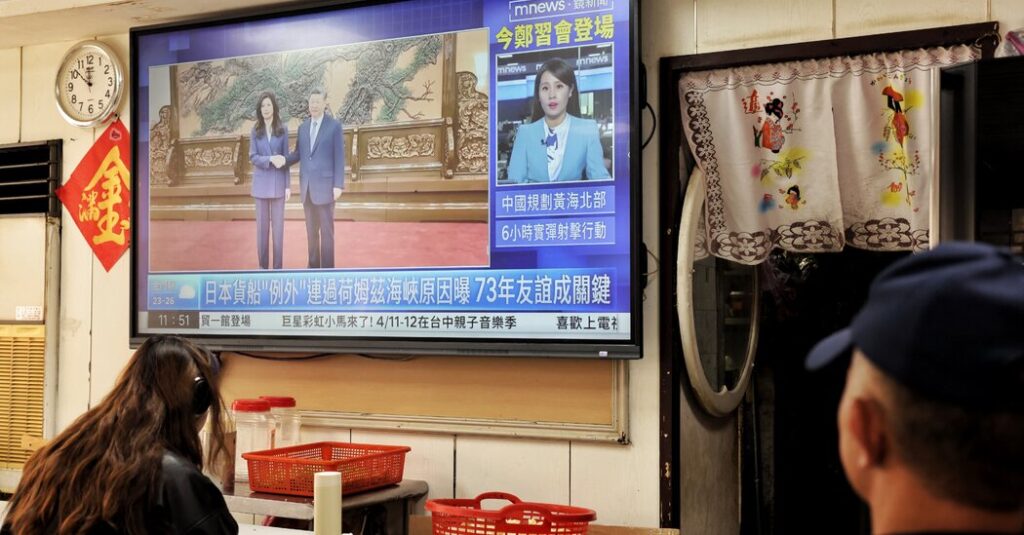
Mr. Xi delivered that message implicitly in a rare meeting in Beijing on Friday with Cheng Li-wun, the chairwoman of the Nationalist Party, Taiwan’s main opposition party.
The meeting underscored how Beijing is trying to shape Taiwan’s politics by courting parties more open to its stance and spurning those that are not. Beijing shuns Taiwan’s governing Democratic Progressive Party, which rejects Beijing’s claim that Taiwan is its territory. But China maintains ties with the Nationalist Party, which favors closer ties with Beijing.
“The world today is far from tranquil, and peace is all the more precious,” Mr. Xi told Ms. Cheng at the opening of their talks, according to a Taiwanese television broadcast of the meeting. “Compatriots on both sides of the strait are Chinese, one family, and the desire for peace, development, exchanges and cooperation is a shared aspiration.”
In her response, Ms. Cheng cited Mr. Xi’s slogan for his program of national revival, saying that “the great rejuvenation of the Chinese nation is the shared rejuvenation of people on both sides of the strait.”
Ms. Cheng is the first sitting Nationalist leader in a decade to hold talks with Mr. Xi. Mr. Xi’s outreach appears aimed at increasing pressure on Taiwan’s president, Lai Ching-te of the Democratic Progressive Party, who wants Taiwan to forge a future separate from China. The meeting elevates a rival of Lai’s and potentially undercuts his argument that Taiwan must rely on Washington to deter threats from Beijing.
Mr. Lai has proposed increasing Taiwan’s military spending through a $40 billion package to be spent across eight years, on top of the regular budget outlays.
“Xi wants to cast doubt in Taiwan over the Lai Ching-te administration’s focus on self-defense by showing the benefits of a more conciliatory stance toward China,” said Amanda Hsiao, a director on China policy in the Eurasia Group, a consultancy firm.
The talks with Ms. Cheng could also serve a tactical purpose for Mr. Xi as he prepares for a summit with President Trump in China next month. “This narrative of China as peacemaker could also help Xi make a more convincing argument to Trump for why the U.S. president should, for example, hold off on arms sales to Taiwan,” Ms. Hsiao said.
But Mr. Xi’s message may struggle to gain traction with Taiwanese voters. Even as Mr. Trump’s tariffs have dented Taiwanese public confidence in the United States, confidence in China remains even lower. Thirty-four percent of Taiwanese said the United States was a “credible country,” according to a survey in January by Academia Sinica, a research academy in Taiwan, compared with 17 percent who said the same about China.
China may offer trade and other economic incentives to entice Taiwan to grow closer to Beijing. But that inducement is undercut by Beijing’s sustained military pressure on Taiwan, including in recent years exercises that simulate blockades and amphibious assaults.
“If Cheng Li-wun wants Taiwanese people to clearly feel she has accomplished something in her trip, the fastest way would be reducing Chinese military activity against Taiwan,” said Wei-feng Tzeng, a professor at National Chengchi University in Taipei who studies cross-strait relations. “But that is unlikely because she doesn’t have the chips to negotiate this with Xi Jinping. She’s an opposition leader after all.”
Still, Mr. Xi and Ms. Cheng appear to be betting that Taiwan’s voters will be drawn to a message of rapprochement with Beijing, especially in a more turbulent world.
“The flames of war are spreading and people are fearful,” Ms. Cheng said at a Nationalist Party meeting in Taipei before departing for China on Tuesday. “In Taiwan, we must exhaust every effort to avoid war breaking out.”
In her youth, Ms. Cheng was a fiery proponent of independence for Taiwan. But now she says she is proudly Chinese, as well as Taiwanese, and argues that a shared culture can heal divisions.
She has cast the visit as a “journey of peace,” invoking a 2005 trip by a previous Nationalist leader that reopened talks with the Chinese Communist Party after decades of hostility.
Chris Buckley, the chief China correspondent for The Times, reports on China and Taiwan from Taipei, focused on politics, social change and security and military issues.
The post Xi Seeks to Sway Taiwan, and Trump, With Message of Stability appeared first on New York Times.