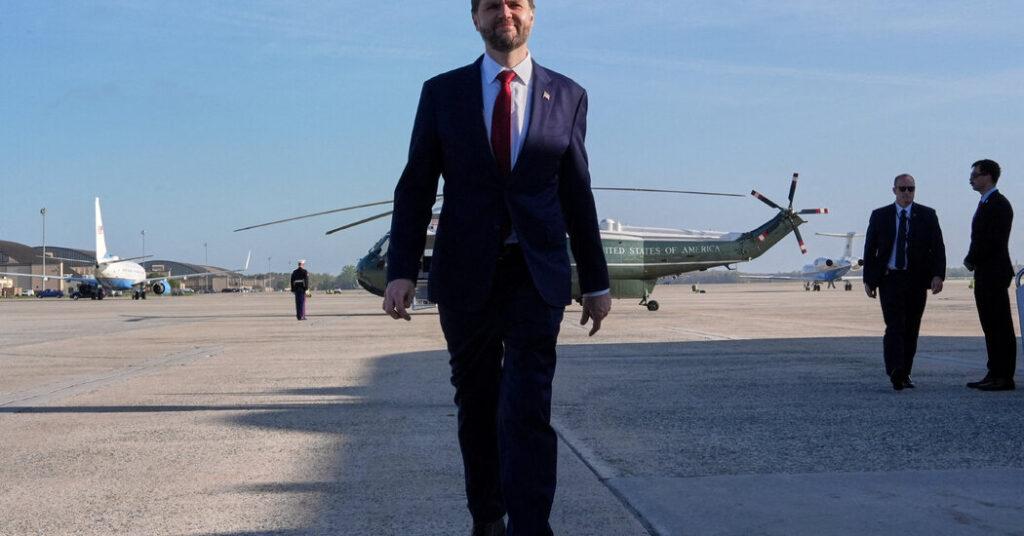
Vice President JD Vance traveled to Pakistan on Friday for peace talks with Iran, even as Israeli strikes against Hezbollah in Lebanon and uncertainty over the Strait of Hormuz raised questions about the durability of the cease-fire and whether the United States and Iran could reach a long-term deal.
Mr. Vance said he believed the negotiations were “going to be positive,” but he also had a warning for Iran.
“If the Iranians are willing to negotiate in good faith, we’re certainly willing to extend the open hand,” he said before departing for Islamabad, the Pakistani capital. “If they’re going to try to play us, then they’re going to find that the negotiating team is not that receptive.”
The speaker of the Iranian Parliament, Mohammad Bagher Ghalibaf, on Friday reiterated Iran’s position that negotiations with the United States could not start until there is a cease-fire in Lebanon. Mr. Ghalibaf also introduced what appeared to be a new demand for frozen Iranian assets to be released.
“Two of the measures mutually agreed upon between the parties have yet to be implemented: a ceasefire in Lebanon and the release of Iran’s blocked assets prior to the commencement of negotiations,” Mr. Ghalibaf wrote on social media. “These two matters must be fulfilled before negotiations begin.”
Later, the Iranian delegation, led by Mr. Ghalibaf and Abbas Araghchi, the Iranian foreign minister, arrived in Islamabad to participate in the talks, Pakistan’s Foreign Ministry said.
President Trump wrote on social media that Iran was overplaying its hand in advance of the talks. “The Iranians don’t seem to realize they have no cards, other than a short term extortion of the World by using International Waterways,” he wrote on Truth Social, referring to Iran’s control of the Strait of Hormuz. “The only reason they are alive today is to negotiate!”
Mr. Ghalibaf’s demand for frozen assets was not part of a 10-point framework for peace talks that Iran released on Wednesday, a day after the cease-fire was announced. A slightly different framework published this week by Iran’s state broadcaster did mention unfreezing assets, but described it as a basis for negotiations, not a prerequisite for them to begin.
The State Department did not immediately respond to a request for comment on Friday, but the United States has been blocking Iranian funds. “We now know where the Iranian leadership bank accounts are,” Treasury Secretary Scott Bessent said last month. “Those are being frozen.”
While Iran has threatened to pull out of the talks if Israel does not stop its strikes in Lebanon, Israel has vowed to continue attacking Hezbollah, the Iranian-backed militant group that has been firing rockets and drones into Israel in solidarity with Tehran.
On Friday, Lebanese officials said, Israeli strikes in the southern Lebanese city of Nabatieh hit a government building and killed 13 members of Lebanese State Security, one of the country’s main security and intelligence agencies. An Israeli military spokesman said there had been strikes in Nabatieh on structures used by Hezbollah and said the military was aware of reports about harm to Lebanese security personnel, adding that the incident was under review. The Israeli military also said two of its soldiers had been injured in a drone attack in southern Lebanon. More rockets were also fired into northern Israel on Friday.
Rescue workers in Lebanon’s capital, Beirut, continued on Friday to clear the wreckage from a devastating series of Israeli strikes this week that killed more than 350 people, according to health officials in Lebanon. Lebanon has described the bombardment as a massacre. The Israeli military has asserted that many of the dead were militants.
Mr. Trump said after a phone call with Prime Minister Benjamin Netanyahu of Israel on Thursday that Israel was “scaling back” military operations in Lebanon. European leaders have called more forcefully for a cease-fire in Lebanon, arguing the Israeli strikes there are imperiling the fragile two-week truce in the U.S.-Israeli war on Iran.
In a possible concession, Mr. Netanyahu said on Thursday that Israel would start talks with Lebanon’s government on disarming Hezbollah. The Israeli and Lebanese ambassadors to the United States are expected to meet in Washington next week to begin those talks, according to three Lebanese officials, one Israeli official and another person familiar with the matter. But Mr. Netanyahu said that Israel would not stop striking Hezbollah and declared: “There is no cease-fire in Lebanon.”
The fighting in Lebanon is just one of many issues straining the cease-fire and weighing on the negotiations in Islamabad.
Mr. Trump has expressed intense frustration with Iran for not fully reopening the Strait of Hormuz, a vital route for crude oil and natural gas shipments that Tehran effectively choked off with mines and sporadic attacks on ships after the war started in late February. While the cease-fire announced on Tuesday led to a drop in global oil prices, ship traffic in the strait remains below prewar levels over fears of further attacks.
The Iranian military said in a statement carried by state media on Friday that it would maintain control of the strait and would unleash a “crushing and painful response” if Israeli strikes against Hezbollah continued.
European airport officials have warned that the continent could face jet fuel shortages if ships are not allowed to pass through the strait soon.
The closure of the strait has already led to higher fuel costs for airlines, which have cut flights, raised ticket prices and added fuel surcharges.
Reporting was contributed by Pranav Baskar, Leily Nikounazar, Tyler Pager, Christina Goldbaum, Natan Odenheimer, Aaron Boxerman and Niraj Chokshi.
Yeganeh Torbati is the Iran correspondent for The Times.
The post With Peace Talks Set to Begin, Prospects for Long-Term Deal Uncertain appeared first on New York Times.