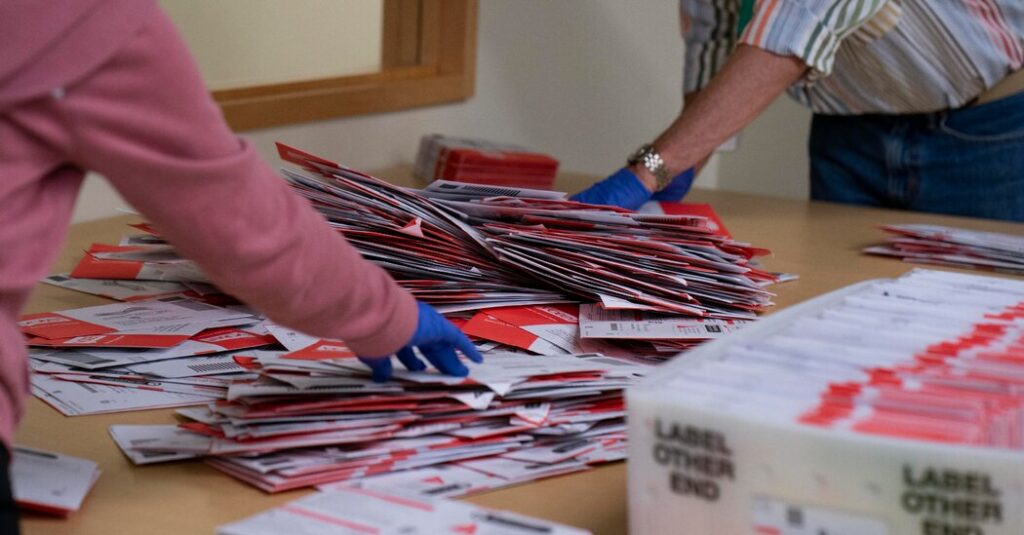
The American system of voting by mail can, like flannel and grunge rock, trace its roots to the 1990s Pacific Northwest, where Washington and Oregon moved to adopt mail-in balloting as the statewide default, driven in part by Republicans hoping to improve turnout among rural populations.
But like so much in contemporary politics, what was once bipartisan has broken down into familiar battle lines, as President Trump declares war on voting by mail. Now, even where mail-in balloting has become as much a part of the culture as artisan coffee and eschewing umbrellas, officials are worried that a three-decade-old tradition is already fraying under pressure from the president, his government and his followers.
“They’re undermining trust, even here where voters understand the system so well,” said Stuart Holmes, who oversees Washington’s elections.
Last August, Mr. Trump promised an executive order written “by the best lawyers in the country” to end all mail-in ballots. Last month, the Supreme Court’s conservative majority appeared poised to curtail at-home voting by rejecting a Mississippi law that allows ballots postmarked by Election Day to be counted if they are received within five business days after the election. Oregon and Washington could both have to change their election schedules, and they’re already warning voters to mail ballots earlier this year because of U.S. Postal Service cuts.
Late last month, Mr. Trump voted by mail in a special election in Florida, and then declared, “Mail-in voting means mail-in cheating.” Then, last week, the president issued a new executive order directing federal agencies to scrutinize state election practices and consider withholding funding from states that do not comply.
The president’s attacks have local ripples: Ben Edtl, a Republican activist and consultant in Oregon, said he has gathered 85,000 signatures for a proposed November ballot measure to kill mail voting in the first state to adopt it statewide. He blames it for Democratic dominance.
So far, such efforts have stalled, largely because the system is so popular and Republicans are outnumbered by Democrats and independents. Repeal bills died in the Washington legislature this year, and a similar proposal in Oregon last year drew so many comments, almost 10,000 and mostly negative, that the state legislature’s website froze.
Mr. Edtl’s effort is just halfway to the 160,000 signatures needed by July 2 to make the fall ballot.
The irony is that Republicans initially seemed like the biggest beneficiaries of voting by mail — and were its earliest boosters.
“Oh, it was intensely partisan in the beginning,” said Phil Keisling, Oregon’s secretary of state in the 1990s. “Democrats hated it.”
Oregon’s first mailed elections were the brainchild of a rural county clerk who wondered whether local election officials, already required to send sample ballots to voters, could just ship them the real thing instead. Early experiments in the 1980s focused on minor local races like school levies, where mailed ballots increased turnout and led to a series of defeats for funding measures as the pool of voters expanded beyond education advocates.
The Republican-led state legislature approved taking the “Oregon experiment” statewide in 1994, but the Democratic governor vetoed it.
“The thinking among Democrats was that Republicans would be better at it than we were, that they’d outthink and outspend us,” Senator Ron Wyden, Democrat of Oregon, said.
When Senator Bob Packwood, Republican of Oregon, resigned amid a sexual harassment scandal a year later, Mr. Keisling, a Democrat, made the special election to replace him a mail-in contest because, he said, “if I didn’t, I was going to get thrown out of town by all the people who loved it.” Mr. Wyden won that race.
Oregon voters adopted mail voting statewide in a 1998 ballot measure, with 70 percent embracing it.
Vote by mail’s original story was similarly bipartisan in Washington. Republican lawmakers and county election officials pushed to expand absentee balloting to help rural voters, and state lawmakers granted everyone the right to ask for a mail-in ballot in 1974. A Republican county auditor, Sam Reed, held the first all-mail primary in 1993 and championed the push for statewide mail voting when he became secretary of state in 2001. State leaders transitioned fully to mail-in ballots in 2011, when most in Washington were already choosing it.
Studies have found that mail-in balloting increases participation, with scant evidence of fraud.
“You can suppress the vote in so many ways on Election Day,” said Oregon’s junior Democratic senator, Jeff Merkley. “Vote by mail removes most of those options.”
The biggest controversy in the Northwest came in 2024, when Oregon discovered that its Department of Motor Vehicles had mistakenly registered about 1,600 people who had not provided proof of U.S. citizenship. State officials later said about a dozen actually cast ballots.
Dennis Richardson, Oregon’s Republican secretary of state during the early years of the first Trump administration, warned the president that unsupported allegations against mail voting risked undermining public trust. Kim Wyman, a Republican who held the same job in Washington for nearly a decade, urged critics within her party to follow the evidence rather than repeat unsupported claims of fraud.
Those requests have gone unheeded, as the Trump administration cuts funding to guard against election cyberattacks, presses states to turn over voter rolls and pushes to make potential voters show proof of citizenship.
All of those steps are seen as attacks on mail voting in particular because they add logistical hurdles to easily registering people to receive mailed ballots. Oregon, for example, automatically registers people to vote when they obtain a driver’s license. There’s no county election office to visit or additional paperwork to mail.
The goal of conservative cuts and challenges, said Tobias Read, a Democrat and Oregon’s current secretary of state, “is to put strain on the system, to add steps, to add inconvenience and holdups.”
Last week, the president issued a new executive order that would force vote-by-mail states to stop automatically sending ballots to all registered voters. Instead, the president wants the Postal Service to vet the list of people receiving ballots and impose requirements on ballot envelopes and how they’re tracked. Mr. Trump said the order was meant to “stop the massive cheating that is going on.”
Oregon’s Democratic attorney general, Dan Rayfield, said the president simply fears his party will lose in November. Republicans, Mr. Rayfield said, “aren’t even pretending right now.”
Leaders in Oregon and Washington have responded to all this with a series of lawsuits, including one filed last week arguing that the president’s latest executive order illegally intrudes on state authority to oversee elections.
So far, the states are winning. But Mr. Holmes expects anti-mail-balloting efforts in the legislature to continue, despite their long odds for success, because, he said, even failed attempts undermine confidence in election results and help losing candidates justify refusing to concede.
Oregon’s senators said worries about the fate of voting by mail had, along with the war in Iran, dominated what they had heard from constituents at recent town halls.
“People here are very, very worried about the future of this system they pioneered,” Mr. Merkley said, “as they should be.”
Anna Griffin is the Pacific Northwest bureau chief for The Times, leading coverage of Washington, Idaho, Alaska, Montana and Oregon.
The post Where Mail Voting Began, Worries Spread Over Trump’s Attacks appeared first on New York Times.