The United States’ shaky ceasefire with Iran is under intense pressure ahead of scheduled diplomatic talks in Islamabad, as shipping remains effectively blocked through the Strait of Hormuz and Israel and Hezbollah continued to trade strikes.
President Donald Trump accused Iran of “doing a very poor job, dishonorable some would say, of allowing Oil to go through the Strait of Hormuz” in a post on Truth Social overnight. “That is not the agreement we have!” he wrote, referring to the two-week ceasefire announced Tuesday.
It followed an earlier warning from the president that Iran “better not be” charging fees for tankers to pass through the narrow waterway that carries around 20 percent of the world’s oil and natural gas shipments.
The price of the barrel of Brent crude, an international benchmark, rose nearly 2 percent Friday morning, above $97 per barrel, while Asian and European markets were mostly flat.
Restoring the passage of ships through the strait is a key objective for the White House. But traffic has remained at a virtual standstill, with Iranian state media saying the strait is closed to “99% of ships” after Israeli attacks on Lebanon.
All the ships that have passed through the strait since Monday are linked to Iran in some way, such as through trade or ownership, according to Lloyd’s List Intelligence, a global shipping monitor. Traffic remains 90 percent below normal volumes, with 600 cargo vessels trapped, it said in a briefing Thursday. Clearing the vessels is likely to take several weeks, even if volumes increase toward pre-conflict levels, Lloyd’s added.
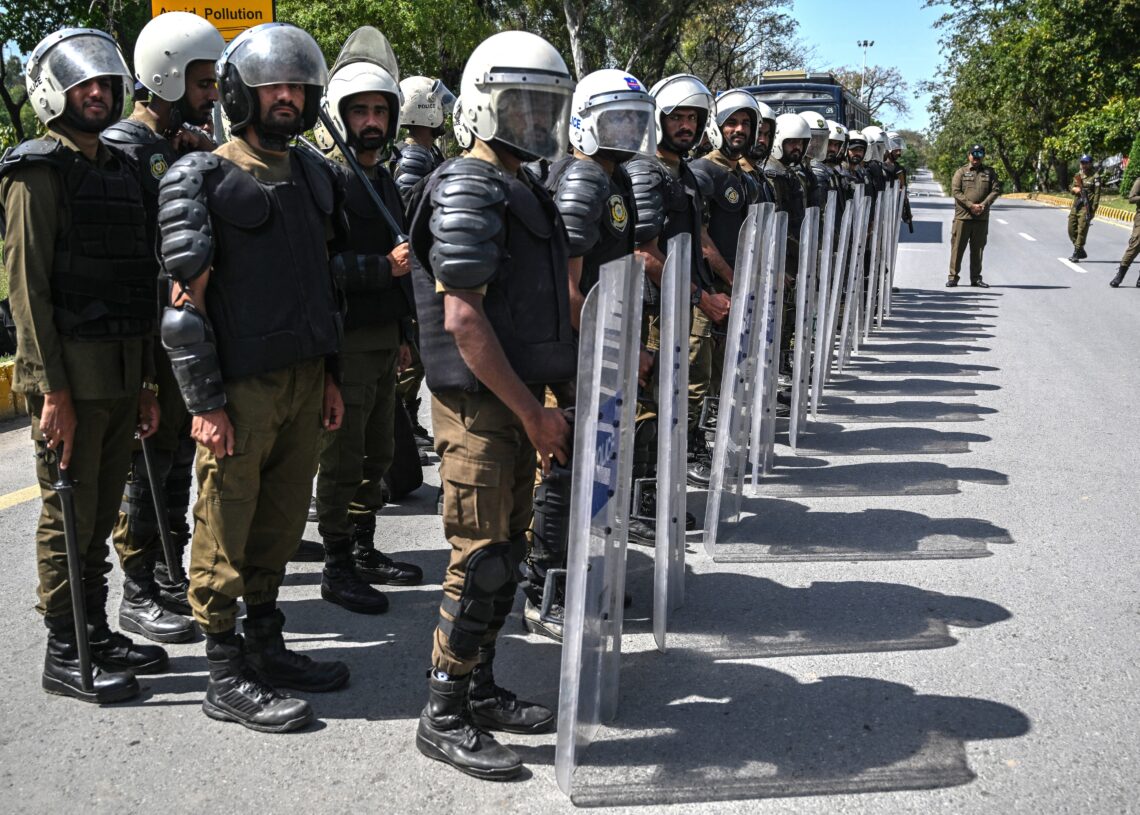
Diplomatic negotiations to end the war are scheduled to take place in Islamabad on Saturday, having been brokered by Pakistan. On Friday, Pakistan’s army and police forces could be seen around the capital, where a public holiday has been declared, with some areas cordoned off and checkpoints in place. Pakistan’s Prime Minister Shehbaz Sharif has held a series of conversations with world leaders ahead of the talks.
Vice President JD Vance is set to lead the U.S. delegation, which will include special envoy Steve Witkoff and Trump’s son-in-law Jared Kushner. Parliamentary speaker Mohammad Bagher Ghalibaf will lead Iran’s contingent.
Talks are likely to be fraught from the start, with the two sides not agreeing even on the terms of the existing ceasefire. In addition to the status of the Strait of Hormuz, the inclusion of Lebanon in the ceasefire agreement and Iran’s demands to enrich uranium remain major obstacles.
Iran has threatened to withdraw from the talks, citing what it claimed were breaches of the agreement over Israel’s attacks in Lebanon. Israel’s offensive there, including a ground invasion of south Lebanon, has forced more than a million people to flee their homes.
More than 303 people were killed and more than 1,100 wounded on Wednesday, according to Lebanon’s Ministry of Health, in a barrage of strikes on Beirut that Israel described as its largest in more than a month of war. The strikes drew a wave of international condemnation and calls from several European nations for Lebanon to be included in a ceasefire agreement.
Ghalibaf said that “time is running out” in a post on X Thursday that shared three Iranian objectives in relation to the negotiations.
Lebanon and Iran’s allies form “an inseparable part of the ceasefire,” he noted, saying there was “no room for denial and backtracking” on whether Lebanon was included in the deal. “Ceasefire violations carry explicit costs and STRONG responses. Extinguish the fire immediately,” he added.
Strikes between Israel and Hezbollah continued Friday. The Israel Defense Forces said it had struck Hezbollah launch sites in Lebanon, while Hezbollah said it had launched rockets in retaliation.
Vance has previously described the dispute over Lebanon as a “legitimate misunderstanding.” Trump told NBC on Thursday that Israel would scale back operations in Lebanon after a conversation he had with Israeli Prime Minister Benjamin Netanyahu Wednesday. “He’s going to low-key it. I just think we have to be sort of a little more low-key,” Trump said.
But Netanyahu has remained emphatic. “There is no ceasefire in Lebanon,” he said in a post on X Thursday, adding that Israel had opened direct negotiations with Lebanon to disarm Hezbollah.
The State Department is expected to host Israel-Lebanon talks next week, a U.S. official, speaking on the condition of anonymity to share sensitive details, told The Post. Israel and Lebanon have not held direct talks aimed at normalizing relations since a U.S.-mediated process in 1983, which led to an agreement that quickly collapsed.
Suzan Haidamous in Beirut contributed to this report.
The post Trump fumes as Iran retains choke hold on Strait of Hormuz ahead of peace talks appeared first on Washington Post.