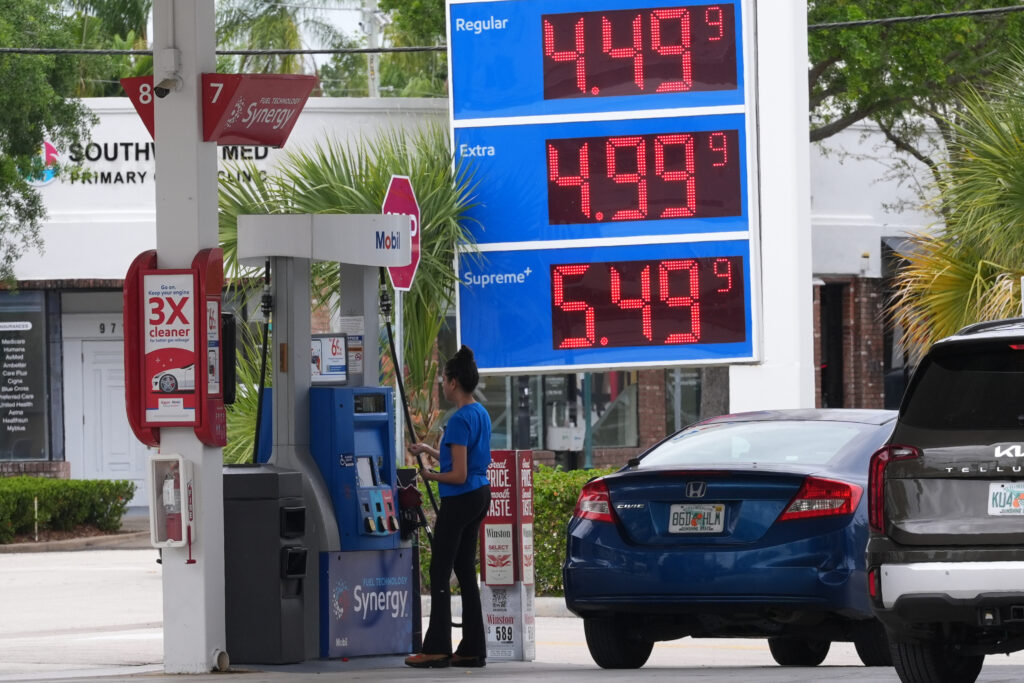
The White House on Friday received its worst inflation report of President Donald Trump’s second term, as the war in Iran sent consumer prices surging at the fastest monthly pace in four years — handing the administration a significant political problem at a moment when it has staked much of its economic credibility on bringing costs down.
Consumer prices rose 0.9 percent in March from the month before, the Bureau of Labor Statistics reported, the biggest monthly gain since 2022. On an annual basis, prices climbed 3.3 percent, up sharply from 2.4 percent in February. Energy prices drove much of the increase, jumping roughly 11 percent — the largest monthly gain in more than two decades — with gasoline prices posting the biggest single-month spike in the history of the index.
The White House moved quickly to minimize the report. White House economic adviser Kevin Hassett said the price increases will be temporary because they were confined to energy and didn’t spill over into other goods. He noted declines in other categories such as eggs, beef and sports tickets.
“Once we get back to the normal pace, then we expect things to get back to normal,” he said in a Friday interview on Fox Business, referring to tanker traffic through the Strait of Hormuz that has been interrupted because of the war in Iran.
But the critical oil chokepoint remains squeezed — only four tankers crossed on Thursday, according to ship-tracking company Kpler. And the backup takes time to ripple through the supply chain, from crude oil to refined products such as diesel and gasoline, eventually to all the consumer products those fuels help produce and transport.
Republicans expressed optimism that the oil shock would subside by the time most voters start paying closer attention to midterm campaigns in the fall.
“President Trump has always been clear about short-term disruptions as a result of Operation Epic Fury, disruptions that the Administration has been diligently working to mitigate,” White House spokesman Kush Desai said in a statement. “As the Administration ensures the free flow of energy through the Strait of Hormuz, the American economy remains on a solid trajectory thanks to the Administration’s robust supply-side agenda of tax cuts, deregulation, and energy abundance.”
Financial markets were mixed. The Dow Jones Industrial Average fell in early trading while the S&P 500 and Nasdaq composite index edged higher.
Democrats indicated they would pound the inflation data as a betrayal of Trump’s campaign promises to address the cost of living and avoid foreign wars.
“Skyrocketing inflation, the highest in years, all because of Donald Trump’s unnecessary, ill-planned, reckless war of choice,” Senate Democratic leader Charles E. Schumer said on social media. “Americans are paying the price for Trump’s idiocy every day.”
Consumer sentiment was already deteriorating before Friday’s report. The University of Michigan’s preliminary April reading showed confidence plunging 11 percent from March, with every demographic group posting declines. Year-ahead inflation expectations surged to 4.8 percent, the largest one-month jump since last April. Notably, 98 percent of interviews were completed before the ceasefire announcement, suggesting the final reading could look somewhat better.
Some Republican allies of the administration signaled anxiety about the political cost of negative data. GFormer Trump strategist Stephen K. Bannon said the president needs advisers willing to deliver hard truths about the economic data rather than offer empty encouragement, saying honest counsel is essential to successfully implementing the president’s agenda.
“What the president doesn’t need right now is people with pompoms, trust me,” he said on his daily show “War Room.”
The conflict in Iran has fueled a rapid rise in the cost of oil and refined petroleum products, including gasoline and diesel, an expected outcome of the conflict that nonetheless intensifies pressure on an administration that has made tackling high prices a central political promise.
There are encouraging signs the report isn’t a harbinger of lasting inflation. The surge in overall prices masked a more optimistic signal underneath: so-called core inflation — which strips out volatile food and energy prices — held relatively steady, rising just 0.2 percent last month, or 2.6 percent on an annual basis.
Even so, some economists cautioned that relief is unlikely to reach consumers quickly, even if the ceasefire announced this week holds. Negotiations in Pakistan are expected to begin Saturday with Vice President JD Vance leading the U.S. delegation.
“Even if the negotiators in Pakistan stick the landing and the ceasefire turns into a durable period of non-conflict, the lagged impact of the oil and energy shock will impact consumers in a variety of ways through the remainder of 2026,” said Joe Brusuelas, chief economist at RSM.
Private-sector data suggests the surge is already well underway. The State Street PriceStats index, which tracks retail prices in near-real time, recorded a 1.5 percent monthly increase in March — the largest single-month jump since the series began in July 2008. On an annual basis, the index put inflation at 4 percent, a level not seen since early 2023.
“This means that in just one month, the inflation picture has shifted materially,” said Michael Metcalfe, head of macro strategy at State Street Markets. What happens next will depend in large part on energy prices and how quickly those costs feed through to everyday items, he said, with early sector data already pointing to above-average monthly increases in recreation, electronics and apparel.
The March report arrives as inflation completes five consecutive years above the Federal Reserve’s 2 percent target — and as hopes of a final push back to normal appear to be fading. After cooling markedly from its 2022 peak, price growth had appeared to stall out at around 3 percent, about one percentage point above where the Fed wants it, even before the Iran conflict added fresh fuel.
Without evidence that inflation is easing, the Fed is unlikely to resume cutting interest rates beyond their current range of 3.5 to 3.75 percent — unless the labor market weakens sharply enough to force their hand.
The post Trump faces surging inflation report, fueled by Iran conflict appeared first on Washington Post.