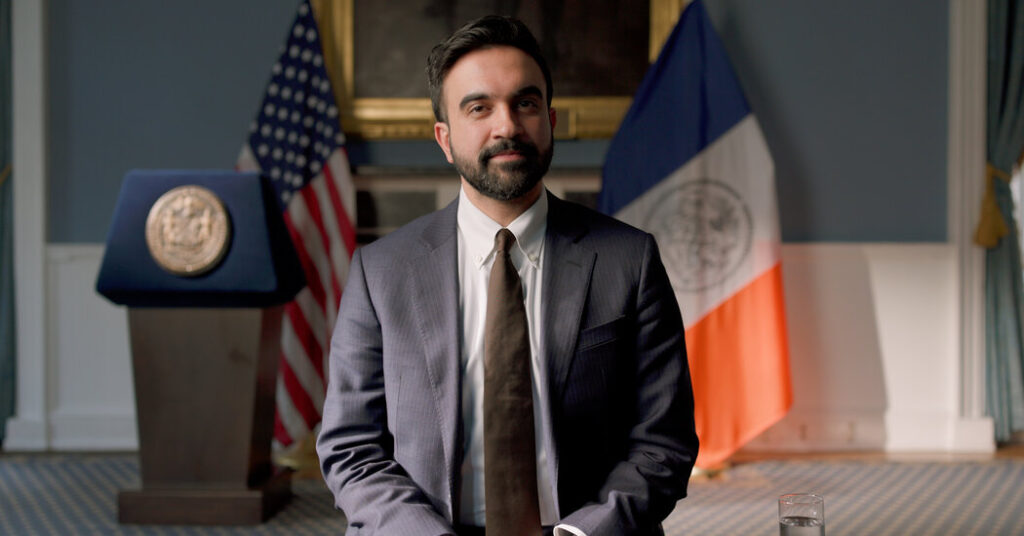
Mayor Zohran Mamdani swept into office in January promising to deliver a set of plans for New York City as ambitious as it was concrete.
“Fast and free” buses. A rent freeze. Universal child care. And a smattering of other changes to how the city polices its streets and feeds its people.
One hundred days into the mayor’s term, his progress report is mixed. While he has meaningfully advanced key proposals, the 34-year-old mayor has stalled or shelved others as he bumps up against the realities of governing a complex and cash-strapped city.
Here is where seven of Mr. Mamdani’s key promises stand.
Free City Buses
“As mayor, he’ll permanently eliminate the fare on every city bus — and make them faster.” — Mamdani campaign platform
Status: stalled except potential pilot programs
New York City already subsidizes bus and subway fares for low-income riders. Mr. Mamdani campaigned on a more sweeping vision to make every one of the city’s 340 or so bus routes totally free.
He has contended that ending fare collection would put money back in working New Yorkers’ pockets and speed up buses themselves. The plan would cost upward of $700 million a year.
Yet since taking office, Mr. Mamdani has not prioritized securing state funds for the change, and Gov. Kathy Hochul and the Metropolitan Transportation Authority have thrown cold water on it. Instead, the two sides are talking about funding more limited pilot programs this year, like the one he championed as an assemblyman. He has announced the creation of new bus lanes meant to speed up transit times.
A Rent Freeze for Rent-Stabilized Units
“As mayor, Zohran will immediately freeze the rent for all stabilized tenants.” — Mamdani campaign platform
Status: incomplete, to be determined by a vote this spring
Mr. Mamdani’s pledge to “freeze the rent” for rent-stabilized units was never as simple as it sounded. But he stands to have a decent chance of succeeding.
Here’s how the process works. The mayor does not directly set the rents for the nearly one million units regulated under the stabilization program. He does exercise influence, though, by appointing members to a nine-person panel, known as the Rent Guidelines Board, that determines annual rental increases.
Since taking office, Mr. Mamdani has stacked the board with appointees who are expected to share his pro-tenant viewpoint, increasing the odds of a freeze. Still, the board is required by law to balance the interests of landlords and renters, taking into account expert testimony about the city’s housing market.
The board is expected to vote in May or June. (The verdict will not affect market-rate apartments.)
Free, Universal Child Care
“Zohran will implement free child care for every New Yorker aged 6 weeks to 5 years.” — Mamdani campaign platform
Status: deal reached for the first phase of expansion
Providing universal, government-funded child care was the most difficult and costly of Mr. Mamdani’s campaign plans. It is also the one on which he has made the most progress.
In January, the mayor and Ms. Hochul, a Democrat, announced a major agreement to put a down payment toward that goal. Their deal would add more seats to the city’s existing preschool program for 3-year-olds to try to make it truly universal. It would also establish a new program for 2-year-olds, starting with 2,000 seats for toddlers this fall.
For all the fanfare, though, big hurdles lie ahead. Implementing the program will be a huge operational challenge in the coming years. And while the deal includes more than $1 billion in state funding, it does not include permanent funding, leaving it vulnerable to future budget woes.
A New Department of Community Safety
“Zohran will create the Department of Community Safety to prevent violence before it happens by prioritizing solutions which have been consistently shown to improve safety.” — Mamdani campaign platform
Status: created but reduced to a mayoral office
Mr. Mamdani, who was once a staunch critic of the Police Department, campaigned on a suite of law enforcement changes. The centerpiece was a new $1.1 billion city agency to shift responsibility for mental health emergencies from the police to social workers.
In March, Mr. Mamdani rolled out a version of the initiative as promised, but it was drastically pared down. Rather than the full-fledged city agency he once spoke of, it will now be housed in a mayoral office with just two staff members: a deputy mayor and a commissioner.
The office started out with about $260 million in funding from existing programs. (Mr. Mamdani pledged to increase that amount in the future.)
The mayor has also yet to deliver on another promise to disband the Police Department’s Strategic Response Group — a counterterrorism unit that has also been sued for its aggressive tactics policing protests. He said this week he was working on it, and touted low crime rates in an interview.
Open City-Owned Grocery Stores
“As mayor, Zohran will create a network of city-owned grocery stores focused on keeping prices low, not making a profit.” — Mamdani campaign platform
Status: incomplete, funding subject to ongoing budget negotiations
Few ideas prompted more debate during the campaign than Mr. Mamdani’s proposal to open a municipal grocery store in each borough to drive down prices.
Three months into his term, Mr. Mamdani has made almost no mention of the stores, but there are signs his administration is moving forward.
The mayor’s budget proposal includes a $70 million request for capital funding for the stores, and his deputy mayor for economic justice told Bloomberg in February that the administration was scouting potential locations. The City Council must sign off on the funding for it to advance.
A Tax Increase for Corporations and the Wealthy
“The Mamdani administration has a plan to pay for this agenda by raising taxes on the most profitable corporations and the wealthiest New Yorkers.” — Mamdani campaign policy paper
Status: stalled by Governor Hochul
Mayors do not have the power to levy income or corporate taxes. But Mr. Mamdani was consistent through his campaign that he intended to push Albany to enact increases to pay for expensive new social services.
As mayor, his position has gotten more complicated.
Mr. Mamdani still argues that tax increases are the fairest way to raise billions of dollars in new revenue and close a municipal budget gap. Leaders in the State Legislature agree.
But the mayor has taken pains not to push too hard, lest he antagonize Ms. Hochul, who opposes raising rates and has promised the city billions of dollars in state aid already. It remains unclear how the competing priorities will be resolved.
Expand Rental Assistance for Struggling Tenants
“Zohran will drop lawsuits against CityFHEPs and ensure expansion proceeds as scheduled and per city law.” — Mamdani campaign policy paper
Status: reversed position
Though he did not actively campaign on the issue, last summer Mr. Mamdani threw his weight behind expanding a city program, known as CityFHEPs, designed to help struggling tenants pay rent.
At the time, he chastised former Mayor Eric Adams for opposing the growth of one of the city’s most ambitious tools to address the housing crisis.
Now, as he confronts a multibillion-dollar budget gap, Mr. Mamdani has reversed that position, arguing (as Mr. Adams once did) that the city cannot afford to implement the law underlying the expansion. By the city’s estimate, doing so without changes would cost as much as $17 billion over five years.
His administration is now negotiating with housing advocates to try to settle a lawsuit that sought to force that expansion.
Nicholas Fandos is a Times reporter covering New York politics and government.
The post Tracking 7 of Mamdani’s Biggest Campaign Promises appeared first on New York Times.