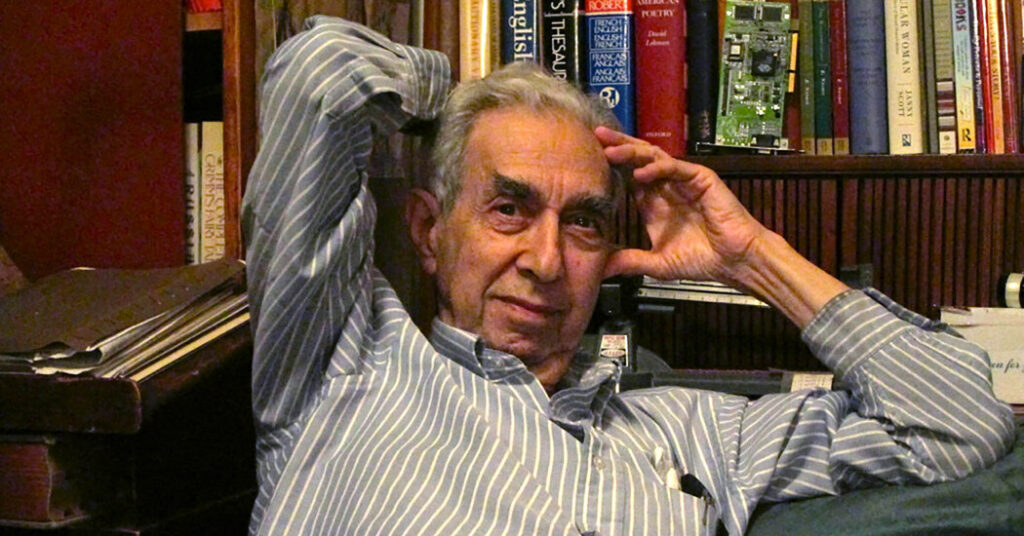
Thomas S. Langner, a sociologist who helped lead a landmark study of New Yorkers that revealed striking insights about the social, cultural and economic forces that shape mental illness, died on March 16 at his home in Sandy Hook, Conn. He was 102.
His wife, Susan Kassirer, confirmed the death.
When “Mental Health in the Metropolis: The Midtown Manhattan Study” was published in 1962, headline writers had a field day with the top-line finding: that only 18.5 percent of Manhattan residents could be considered psychologically well adjusted, while 23 percent showed significant impairment in daily functioning.
“City Gets Mental Test, Results Are Real Crazy,” Newsday declared. The Daytona Beach Morning Journal wondered: “New York Living for ‘Nuts’ Only?”
The actual substance of the two-part study — the second installment appeared in 1963 — was the challenge it posed to the widely held view in psychiatry that biological and individual factors are the primary drivers of mental illness.
Professor Langner, along with a team of psychiatrists, anthropologists and social workers at Cornell University Medical College (now Weill Cornell Medicine), spent more than a decade studying 1,660 people who lived on the East Side of Manhattan, between 59th and 96th Streets.
The researchers concluded that developing mental illness didn’t simply come down to a genetic lottery.
Instead, they showed that mental impairment was highly correlated with socioeconomic levels. People with low incomes were more likely than those with higher incomes to be mentally ill, and they suffered more severe levels of impairment.
The second part of the study, “Life Stress and Mental Health,” which Professor Langner oversaw, expanded the analysis to explore specific stressors associated with low socioeconomic status. Employment worries, social isolation, marital difficulties and parental conflict all presented challenges, but they found that it wasn’t any one stressor in particular that caused a decline in well-being — it was the accumulation of them.
“There is no ‘breaking point’ in the number of factors beyond which there is a sudden marked increase in mental health risk,” Professor Langner wrote. “The linear principle governing the relationship of environmental stress factors to mental health risk seems to be ‘the more, the unmerrier.’”
The findings heralded a new era of social psychiatry that coincided with an emerging movement among physicians, public health researchers and federal health officials who were developing community-based interventions to stem rising rates of mental illness. In 1963, Congress passed the Community Mental Health Act, providing federal funding for neighborhood clinics to offer psychological services.
“This study was really pioneering in the sense that it got people to look at the issue from a much different angle, a much broader perspective about what causes mental illness,” Matthew Smith, a professor of health history at the University of Strathclyde in Glasgow, said in an interview. “It was a societal issue.”
But in the 1970s, the pendulum swung back toward a biological focus, with funding from the National Institute of Mental Health increasingly redirected toward studying neurochemical and genetic causes. Social psychiatry faded into obscurity.
In 2015, Professor Smith gave a presentation to New York City public health officials about research he had done on the Midtown Manhattan Study, as it came to be known.
“I went in assuming they would know what I was talking about, and none of them really had any clue,” he said. “The idea that you can have a public health preventive approach to psychiatry had been forgotten to a certain extent.”
Thomas Simon Langner was born on Jan. 1, 1924, in Manhattan. His father, Herbert Langner, was an international patent lawyer, and his mother, Ruth Livingston Langner, was a linguist who translated foreign-language plays for Broadway.
Growing up, his home was a kind of literary salon, with writers, actors and artists cycling through for dinner and sometimes staying for months. As a teenager, he joined his parents at parties in Greenwich Village, meeting writers like Edgar Lee Masters and James T. Farrell.
In private, though, their family life wasn’t always jubilant. His parents were loving and supportive, but they could also be volatile, short-tempered and argumentative. He and his younger sister, Clare, both experienced depression.
“As an adult,” he wrote in an unpublished memoir, “the recognition of my parents’ faults and the damage those faults did to me and my sister enabled me to see my parents as human — as the frail creatures we all are.”
At Harvard, he was initially a pre-med major. He became friendly with Norman Mailer, a fellow student, and once double dated with him.
In 1943, after his sophomore year, he was drafted into the U.S. Army, rising to first lieutenant. Returning to campus three years later, after completing his military service, he switched his major to sociology. He graduated in 1948 and received his doctorate from Columbia in 1954.
Around the same time, he was invited to join the Midtown Manhattan Study, led by Thomas A.C. Rennie, a psychiatrist at Cornell University Medical College.
During the study, Professor Langner developed a 22-item screening tool for measuring psychiatric impairment that became widely used and known as the Langner Scale. After the Midtown research was finished, he continued working in social psychiatry, joining New York University’s medical school and later Columbia University’s School of Public Health.
He studied mothers in Manhattan, tracking how family stress and low socioeconomic status contributed to mental illness in their children. He traveled to Mexico to investigate whether women of high social status had lower rates of psychiatric disease than those with low status. (They did.)
“Tom and his colleagues drew the attention of Americans away from their individualism and their bodies to something more social, cultural and economic,” E. Doyle McCarthy, a retired Fordham professor who collaborated with him during the 1970s, said in an interview. “What’s happening to the group matters.”
Professor Langner’s first marriage, to Nola Malone, ended in divorce. He married Ms. Kassirer, an author and editor of children’s books, in 1989.
In addition to her, he is survived by their daughter, Laura Langner; three children from his first marriage, Josh, Eli and Lisa Langner; four granddaughters; and two great-grandsons. Belinda and Gretchen Langner, twin daughters from his first marriage, predeceased him, Belinda in 2020 and Gretchen in 2021.
“Very few people are given the chance to work on their own ideas independently,” Professor Langner wrote in his autobiography. “I look back on those years with a feeling of accomplishment, and not a little bit of pride.”
The post Thomas S. Langner, Who Linked Social Ills to Mental Illness, Dies at 102 appeared first on New York Times.