When Haiti’s president Jovenel Moïse was assassinated in his home in July 2021, few Haitians imagined the horrors that would unfold.
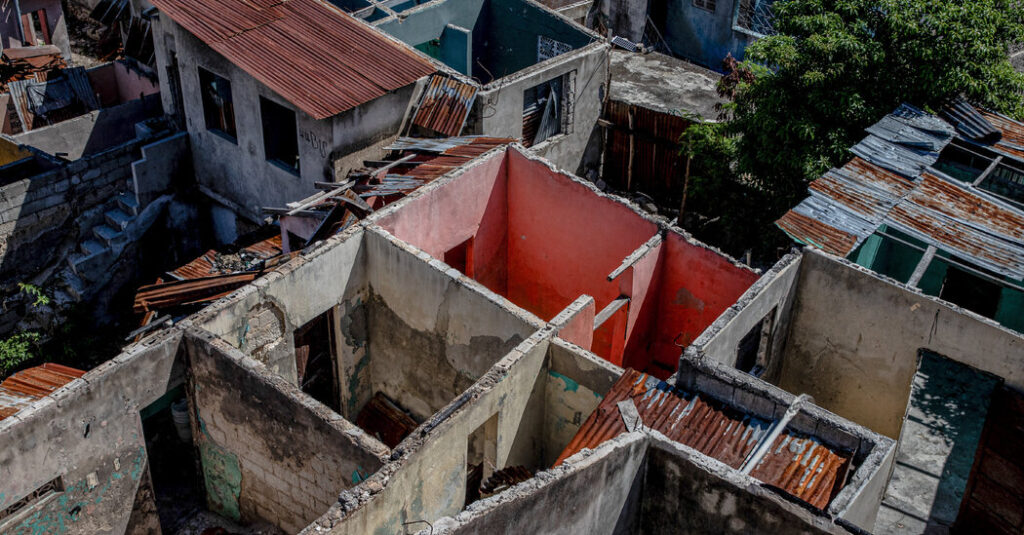
Since then, gangs that enrich themselves through extortion, kidnapping and drug trafficking have devastated the capital of Port-au-Prince and nearby provinces. They have used scorched-earth tactics and sexual violence to instill fear and expand their territorial control. More than 1.4 million people have been displaced, and over 10,000 people have been killed in the last two years alone. The state has proved incapable of curbing the violence and establishing order; many of those in power today have done little more than squabble over control of public posts and budgets.
As attempts to get the situation under control have failed, the crisis in Haiti has not only deepened but fallen off much of the world’s radar.
Now, with the emergence of a strong prime minister and the deployment of an enhanced multinational security mission, there could be an opportunity to finally dismantle the gangs that have blighted Haiti. Much will depend on whether the authorities can strike the right balance between a show of might and a readiness to negotiate.
Gangs have tormented Haiti for decades. Today’s groups have roots in small armed organizations that for decades have served as armies for hire for politicians and businesspeople seeking to sway elections, repress protests, protect businesses or carry out attacks against their competitors. Even as gangs have grown more independent, their connections with members of the Haitian elite remain very much alive.
Poverty and inequality have also provided the perfect breeding ground for recruitment; with more than half of the country suffering from acute food insecurity, gangs have exploited people’s hardships to swell their ranks. The recruitment of minors, who account for up to half of all gang members, has shot up. Far fewer children can now be seen begging in the streets in Port-au-Prince than just a few years ago, having been lured by gangs with offers of hot meals, weekly payments and protection — or simply forced into joining.
Haiti’s plight is not solely because of its poverty, and the ascent of these hyper-violent gangs and their livestreaming bosses. The country’s dysfunctional politics have systematically impeded efforts to check the waves of violence. Haiti has not held elections since 2016, and many of its institutions, including courts, hospitals and schools, have been devastated by the gang-induced chaos.
Two years ago, the gangs escalated their attacks on the state. As Prime Minister Ariel Henry, who came to power after Mr. Moïse’s death, was in Kenya negotiating the deployment of Kenyan police officers to aid Haitian authorities, gangs rampaged through Port-au-Prince in an effort to stymie that mission, leaving Mr. Henry stranded abroad. Amid mounting pressure for Mr. Henry to resign, the United States and other countries brought together representatives from across Haitian politics and civil society to create a Transitional Presidential Council, which appointed first a civil servant, Garry Conille, and later a businessman, Alix Didier Fils-Aimé, as interim prime minister. The aim was to convene elections and transfer power to a newly elected government by Feb. 7, 2026.
That timeline proved overly optimistic. In the months leading up to Feb. 7, it became clear that insecurity and various institutional failings would make the planned elections impossible. The Trump administration threw its support behind Mr. Fils-Aimé, who it saw as an effective partner in the effort to tackle Haiti’s security crisis. When Haiti’s politicians could not agree on a viable alternative, Mr. Fils-Aimé emerged, empowered, as the sole head of the executive in late February.
Mr. Fils-Aimé is, in theory, better equipped to take on the gangs than any of his recent predecessors. Last fall, the U.N. Security Council authorized the creation of a multinational Gang Suppression Force, or G.S.F., which began deploying to Haiti in early April. Unlike the perennially underfunded and undermanned Kenyan-led mission that has been operating in Haiti since 2024, the G.S.F. is expected to have more reliable funding and to ultimately number some 5,500 troops.
Those forces could boost Mr. Fils-Aimé’s efforts to hit back against the gangs, which he has proved quite willing to do. By turning to foreign contractors and the use of armed drones, his government has helped put gangs on the defensive and sent some of their leaders into hiding. But those same tactics are perilous for bystanders, dozens of whom have been killed over the past year by drones alone. Nor have these measures helped Haiti’s short staffed security forces hold on to territories that have been reclaimed from gangs.
While foreign troops could help Haiti’s embattled government and exhausted population weaken the gangs, though, force alone will not rid the country of these groups.
Many Haitians have long opposed government negotiations with gangs, fearing they will lead to impunity for crimes they consider unforgivable. But negotiations with these groups happen every day. Informal talks conducted through local mediators keep humanitarian aid moving, oil flowing and supermarket shelves stocked. Such discussions have even enabled past elections, allowing voting to take place in gang-controlled slums.
It’s true that talks to disarm gangs are of a different order. Informal deals take the groups’ power for granted; official negotiations will work only if criminals are on their back foot. The first priority should be a well-oiled security strategy that has strict rules of engagement and coordinates among the constellation of parties: the G.S.F., the police, the military and Mr. Fils-Aimé’s task force. But once the balance of power on the ground has shifted, Haitian authorities should be prepared to turn to the negotiating table if they want to see these groups dismantled for good.
Planning for that moment must start now. The U.N. political mission to Haiti has already been tasked with helping Port-au-Prince think about how to convince gangs to abandon their weapons. It can start by empowering the National Commission for Disarmament, Dismantlement and Reintegration, which was recently reactivated after years of lying dormant. The commission was established two decades ago with the goal of offering weapons buybacks, encouraging criminals to surrender and helping gang members transition out of a life of crime by providing training and jobs. It failed not because its objective was impossible, but because it lacked political and financial support. Now, with the world’s help, a robust demobilization strategy is entirely within reach.
Haiti can’t drone strike its way to peace — especially not when bombing gang targets might mean killing children. Bringing gang members back into society won’t be easy. But force alone will only prolong the country’s ordeal.
Diego Da Rin is the Haiti analyst for International Crisis Group. Renata Segura is the program director for Latin America and Caribbean at International Crisis Group.
The Times is committed to publishing a diversity of letters to the editor. We’d like to hear what you think about this or any of our articles. Here are some tips. And here’s our email: [email protected].
Follow the New York Times Opinion section on Facebook, Instagram, TikTok, Bluesky, WhatsApp and Threads.
The post There’s a Way Out of Haiti’s Nightmare appeared first on New York Times.