
Whatever book club you’re in, Thomas Pynchon has you covered. Many of us consider him the best American writer since F. Scott Fitzgerald. Turns out that Pynchon’s perennially Nobel-touted shelf offers a book for each book club category featured in this year’s L.A. Times Festival of Books issue, from politics to romance.
Maybe you’ve heard Pynchon’s notoriously hard-to-summarize work called “difficult.” But it’s just this supposed difficulty that should ideally qualify him for all but the most timid of book clubs. Like barn raisings or pub quizzes, Pynchon may be best tackled among friends, with each contributor volunteering their insights and interpretations to inspire the rest.
So, in keeping with Ranganathan’s third law of library science — “Every book its reader” — here’s a book of Pynchon’s for every book club:
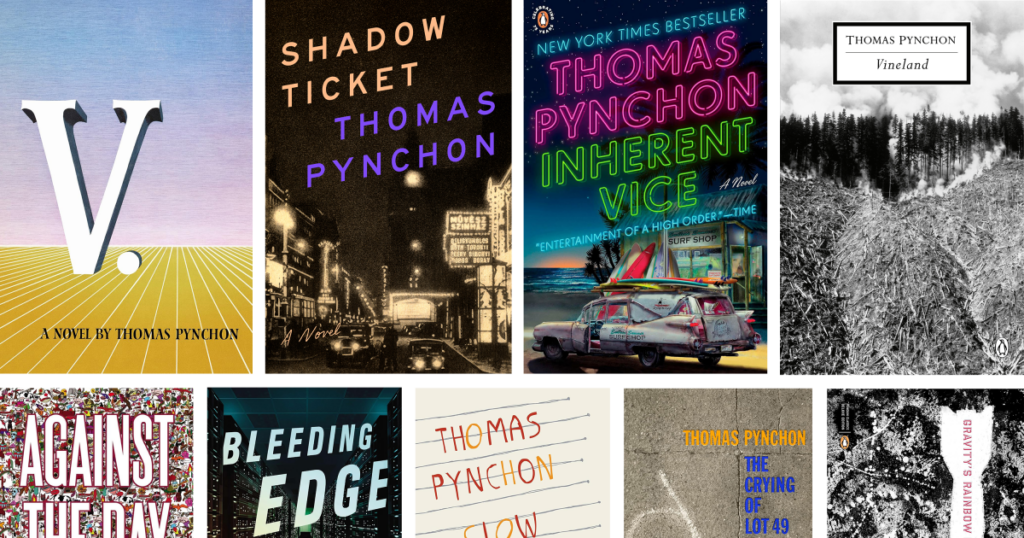
Travel: Hyperventilatingly funny, emetically horrifying, aphrodisiacally romantic, “Gravity’s Rainbow” follows its antihero, Tyrone Slothrop, all over Europe in the waning days of World War II. It’s a travel book like “Finnegans Wake” is a bedtime story, but that won’t stop me from visiting as many of its locales as possible on my way to the International Pynchon Week conference in June.
Memoir: The short-story collection “Slow Learner” contains not only the ideal place to start reading Pynchon’s fiction — that’s “The Secret Integration” — but also his charmingly self-deprecating introduction, which conveys more sanity and self-knowledge than any 12 book-length memoirs you can name.
Long reads: At 1,085 pages (in my copy), “Against the Day” is Pynchon’s longest book and his most underappreciated. The joy of discovery hovers over every page. Most of what you see in it or say about it has never been seen or said before.
True crime and mystery: As with Raymond Chandler, you don’t read “Shadow Ticket” expecting to find out who killed the chauffeur. Just know that, whoever did it, they’re driving now, and they don’t have our best interests at heart.
Literary fiction: “V.” practically invented a genre all its own. The twin-track novel’s alternating timelines have influenced works as varied as A.S. Byatt’s “Possession” and Tom Stoppard’s “Arcadia.”
Romance: Another of Pynchon’s late crime novels, “Bleeding Edge” also chronicles the tender but tested love between insurance investigator Maxine Tarnower and her phlegmatic husband, Horst. Think fewer ripped bodices, more compression socks — and all the sweeter for it.
L.A. literature: In a durably famous metaphor for Southern California, “The Crying of Lot 49’s” heroine, Oedipa, compares the sight of a distant sprawling suburb to a transistor radio’s printed circuit board. Pynchon is so prophetic, he looked at California in 1966 and already saw a silicon chip.
Outdoors: Of all of Pynchon’s outlandish novels, “Mason & Dixon” is, literally, the wildest. It narrates the bittersweet adventures of the titular astronomer and his surveyor sidekick who carved the boundary separating slave states from free. One charts the earth, the other the sky. Between them, they encounter America at its most beautifully primeval.
Fantasy and the fantastical: Everybody’s missing in “Inherent Vice.” The L.A. private detective Doc Sportello is looking for his ex-girlfriend’s lover, an ex-junkie pines after her disappeared husband and a sinister real estate developer tries to keep tabs on his wandering daughter. Alongside the mysteries, expect a few phantasmagorical hallucinations, including a race of Lemurians living inside Mt. Shasta and a surfing Jesus.
Politics: This brings us to Pynchon’s “Vineland,” which — as anybody who’s seen Paul Thomas Anderson’s loose adaptation of it into the Academy Award-winning “One Battle After Another” can safely guess — is nothing if not a political novel.
The case for ‘Vineland’
All that said, no good book belongs to just one genre. In fact, you could make a case for “Vineland” belonging to all 10 of the above categories. Politics is an obvious one, but “Vineland” is also:
- Long — not as long as “Against the Day,” but thoughtful about America in ways that even Anderson’s epic can’t make room for.
- A crime novel featuring escaped fugitives, FBI informants and a whole brilliant chapter about the murder of an unlikely campus political leader.
- Literary, of course, as what Pynchon novel isn’t?
- Nowhere close to a memoir, but like any fiction, it draws partly on the author’s experiences — specifically, Pynchon’s years in Northern, Central and Southern California during the ’60s, ’70s and ’80s.
- If not a traditional romance, certainly a bighearted story about its antihero’s ill-fated marriage and his devoted, redemptive love for his daughter.
- An eminently glovebox-ready travel book, its pan-Californian itinerary embracing the state more thoroughly than any other novel I know.
- Partly an L.A. book, with the music of his language thrillingly alive to “the adobe air, the smell of distant fireworks, the spilled, the broken world.”
- Outdoorsy as all get-out, beginning and ending with the eponymous Vineland County — equal parts Humboldt, Shangri-la, Oz and Topanga Canyon.
- Fantastic, illumined by periodic excursions into surrealism, as when the crew of a mysterious UFO boards a transpacific Kahuna Airlines jet midflight.
Ultimately, “Vineland” is by no means unique among Pynchon’s novels in its suitability for any book club one might name. Is it just possible that all these genre-straddling Pynchon novels might work for any book club?
Why do we even need subject-specific book clubs, anyway? Isn’t any great book multifarious enough to have something for everyone? Show me a book that fits just one category and I’ll show you a narrow book. The same goes for narrow writers, even narrow readers. Why, I’ve heard of readers so narrow, they only ever read one writer. How can you even take such a person seriously?
The post There’s a Thomas Pynchon book for everyone. Here’s which one to read next appeared first on Los Angeles Times.