This is an edition of the Books Briefing, our editors’ weekly guide to the best in books. Sign up for it here.
Growing up, the novelist and New Orleans native Nancy Lemann didn’t know how culturally distinct her home city was. “I just thought, Okay, this is what it’s like. This is what life is like,” she told my colleague Kaitlyn Tiffany, who spoke with Lemann for an article about her first novel in decades, The Oyster Diaries. “But the minute I left and went up north”—to attend Brown University, in Rhode Island—“I just realized, Oh my God, I have this ace in my back pocket.” She saw that the details of her youth could fuel an entire writing career, and they have: Of her five novels, only one has a main character who is not from New Orleans. (That said, she is from Alabama.)
First, here are five stories from The Atlantic’s Books section:
- The banality of MAGA-fication
- The literary job AI can’t replace
- Who is Black comedy for?
- The feeling of becoming less and less of a person
- “Dreams in April,” a poem by Traci Brimhall
Southern experiences and traditions can be deeply compelling, even exotic, to Americans who live in other areas. In literature, the South can seem to represent the inaccessible past—either as a backward society beholden to outdated traditions or, alternatively, as an Eden uncorrupted by the march of modernity. In genres as varied as true crime, gothic horror, historical fiction, and memoir, it can serve as a purpose-built metaphor—the beautiful facade that conceals a dark, bloody past. Yet none of these portrayals fully explains why the South is so fascinating, and why we southerners carry it in our back pocket everywhere we go.
Perhaps the answer lies with a particular set of sensory and social experiences. For example, when Katherine Anne Porter remembered her late-19th-century childhood in Texas in a 1975Atlantic article, she unfurled a scroll of images most Americans will instantly recognize. Porter conjures her grandmother’s long, shaded porches; honeysuckle and mint juleps; the Natchez Trace; church revivals; thoroughbred horses; towns with no radios or televisions; the juice of peaches and grapes. Among these idyllic recollections, Porter throws in more complicated memories—a Black nurse her family had once enslaved, a poor Mexican family that was kicked out of a revival—essentially without comment, as if these were immovable realities of the world.
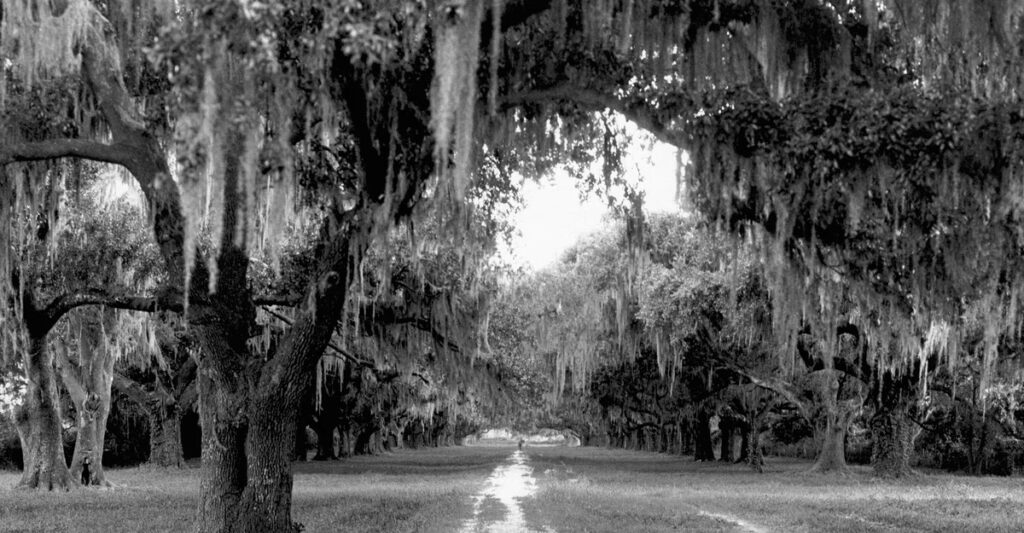
Porter was embellishing her past; she was an incurable fabulist who turned an impoverished childhood into a glamorous old-money upbringing. Yet the clichés she invokes are real. Children do run around on humid nights catching lightning bugs; Spanish moss does drip from trees, and kudzu does coat utility poles; church teachings (and gossip) do strictly define morality; people do say—and expect—sirs and ma’ams.
Perhaps Americans from elsewhere recognize these regionalisms so easily because, as Imani Perry has argued, the region is at once distinct from the dominant culture and crucial to its development. When Perry wrote anAtlantic article collecting great books about the South, she noted that “any honest rendering of who we are as a nation requires us to understand how much of our national abundance has depended on southern land and labor, and how many of our tastes and pleasures have depended on southern folk.”
Lemann, in that spirit, is always writing about how other places compare to New Orleans. As Tiffany notes, New York reminds Lemann a little of home, but Washington, D.C., near where she (and the protagonist of The Oyster Diaries) lives, doesn’t. And why not measure the rest of the country against the South, for once? New Orleans was founded decades before D.C., or even the United States; defined by intermingling cultures and artistic innovation, as well as brutal enslavement, it held all the young nation’s contradictions in one place. I grew up outside Nashville, the buckle of the Bible Belt, and today, my cultural inheritance—country music, evangelical politics, hot chicken—is basically mainstream. Like Porter and Lemann, I’ll probably be devoted to the South, at least creatively, for life. Maybe that just makes me American.
A Writer of ‘Hypnotic Repetition’
By Kaitlyn Tiffany
With her first new novel in more than 20 years, Nancy Lemann returns, yet again, to New Orleans and its eccentricities.
What to Read
Power to Hurt, by Darcy O’Brien
O’Brien, the son of Hollywood actors, had a knack for turning lurid crimes of the sort you might find on Dateline or 20/20 into something akin to art, and Power to Hurt is his crowning achievement. Published in 1996, the book follows Vivian Forsythe, a divorced young mother from Dyersburg, Tennessee, who, in a stroke of unimaginably awful luck, applies to work for local Judge David Lanier. Lanier rapes Forsythe during a job interview, which O’Brien recounts in upsetting, unwavering detail. Afterward, Forsythe tells no one about the attack because Lanier and his brother, the local district attorney, effectively control the county. But eventually Forsythe and Lanier’s other victims—and there are many, she discovers—meet an FBI agent and work together to bring down the old judge, a campaign that takes the better part of a decade and comes to involve the U.S. Supreme Court. Power to Hurt is ultimately less a true-crime book than a post-crime book in which victims summon radical courage to confront a monster. — Jared Sullivan
From our list: Seven true stories that read like thrillers
Out Next Week
 Jan Morris: A Life, by Sara Wheeler
On Eating: The Making and Unmaking of My Appetites, by Alicia Kennedy
Your Weekend Read

Ye Wants Your Forgiveness. So What?
By Spencer Kornhaber
Making judgment calls about public harm can be tricky, and the process is muddied by the forgiveness-focused language that rules so much of the conversation about celebrity conduct. Ye’s redemption campaign has foregrounded a theme that fits our parasocial zeitgeist: empathy for the individual. Yet while many of us may want Ye to get better, or believe he’s entitled to personal redemption, none of us has any real idea what’s in his heart. All we have is the record of how he’s acted before, and all we can do is make inferences about how he’s acting now.
When you buy a book using a link in this newsletter, we receive a commission. Thank you for supporting The Atlantic.
Sign up for The Wonder Reader, a Saturday newsletter in which our editors recommend stories to spark your curiosity and fill you with delight.
Explore all of our newsletters.
The post The Writers Who Can’t Let Go of the South appeared first on The Atlantic.