With rooms canopied in rippling silk or snow-globed by reams of falling paper; with 14,000 human and animal teeth, metric tons of horsehair and 750,000 pennies bound by honey; with live singers, readers, eaters and sheep, the artist Ann Hamilton has built some of the most elaborate art installations of the past 40 years.
They beg, by their sheer physicality, to be felt.
“We think through our bodies,” Hamilton said at her studio in Columbus, Ohio, a former auto-body shop with wooden rafters that groaned in the March wind. “If you look at the structure of the brain, so much of the circuity is devoted to the hands,” Hamilton said, flexing her own knuckly fingers. From a floor-to-ceiling bookshelf she pulled a copy of “The Hand,” Frank R. Wilson’s study of that appendage and its role in the evolution of intelligence.
She clarified: “We are our bodies.”
We were speaking in the days between a talk she gave at the Cleveland Museum of Art, where a solo exhibition of her work runs through April 19, and her departure for an artist residency in Hawaii, at the Merwin Conservancy.
The museum show, “Ann Hamilton: Still and Moving: The Tactile Image” is a classic Hamilton potpourri of media. It contains her video works from the turn of the century, a new sound piece performed by the whistler Emily Eagen and — the main draw — a small retrospective of the photography Hamilton has made since the 1980s but which has been overshadowed by her better-known installations.
It is a homecoming of medium, then, as well as of place. Born in Lima, Ohio, and raised in Columbus, Hamilton has lived here since 1992 after a stint in California, though the work she conceives in this studio — prompted by her archive of fabric, oddments, shredded book pages and ingredients from installations — usually gets installed elsewhere: New York, Sweden, Ecuador, Laos, Japan.
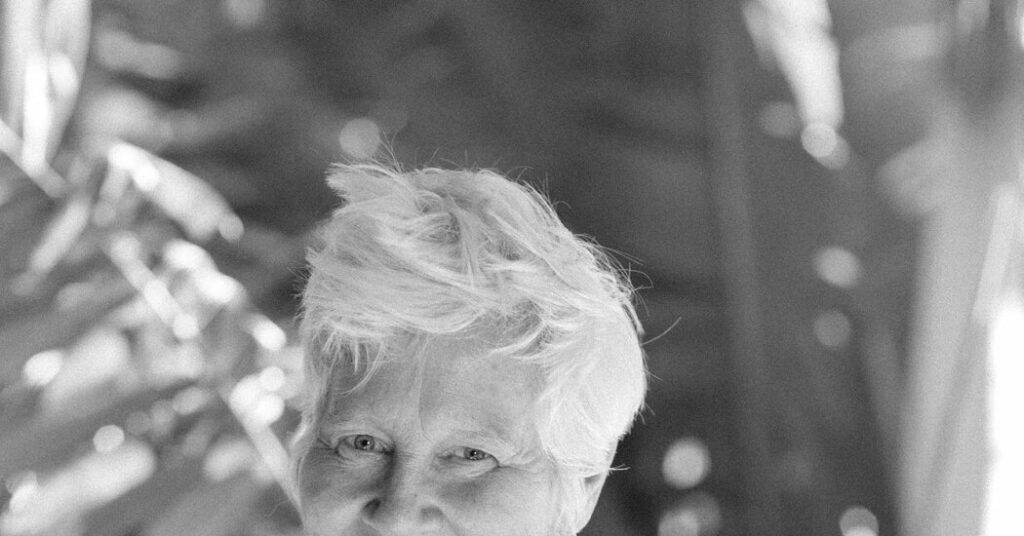
“Moving back here is what made this kind of work possible,” said Hamilton, 69, who is smiling and petite, and wore a burnt-orange corduroy dress and her bright white hair spiked into a fauxhawk.
Picturing the Photographer
Two small prints in the show, from 1984, portray a young Hamilton in unsettling poses. One depicts her with a shoe lodged into her mouth, appearing to merge with the skin tone and high angles of her face. In the other, dried sagebrush sprouts from the neckline of her dress, where her head should be. The series is called “Body Object,” and it came from her graduate student project at Yale, where she studied sculpture.
“I had done a really terrible installation that was probably heavily influenced by the picture photography of Sandy Skoglund, with, like, furniture going through the walls,” she recalled, cringing a little at her student urge to emulate. “But then I used those objects in this to put them in relationship to my body.”
Then came pinhole portraits. These unsettle, too. Throughout 2001 — now a working artist and MacArthur Fellow — Hamilton would pop a light-sensitive canister of her own devising into her mouth. She would face a subject — her mother, a friend, her young son — then say “aah” and expose the paper.
Six of these portraits are in Cleveland. Up close, personal and vague, they are framed by the fleshy window of the mouth, uncannily reminiscent of the human eye. That shape seems to imagine how it might feel to see, as it were, our own ability to see.
‘What’s Here?’
The gem of the Cleveland show is Hamilton’s latest experiment: scans of objects printed serially on paper, then wheat-pasted onto billboard-size canvases, unstretched. In one gallery, the panorama surrounds you with a sense of surveillance recalling Richard Avedon’s “Murals.”
Except Hamilton’s sitters are inanimate. The tarps portray figurines that caught her eye while scrolling through the museum’s collection online: a wooden magus from 19th-century Naples, a peasant in tin-glazed ceramic from 18th-century France, a porcelain mythological figure of the Qing dynasty. With conservators and preparators, she pulled these objects from storage and scanned them in batches.
“When Ann is asked to go to a place, she wants to make something of that place,” said Barbara Tannenbaum, the museum’s curator in photography, who invited Hamilton. “As an installation artist, the impulse to be site specific is very strong.”
Hamilton has scanned collections in Chicago, Portugal and China, which have included folk Buddhas and Mesopotamian votives, among other objects. “It’s not, What do I want to do here?” Hamilton said of her approach. “It’s, What’s here?”
She takes invitations literally. When asked to install in the drill hall of New York’s Park Avenue Armory, in 2013, for instance, Hamilton went first to its photo archive. She expected to find stoic soldiers of the 19th century but was surprised to find portraits of tenderness: officers placing their hands on each other, smiling.
In the spirit of those hands, she and her assistants divided the armory with a gargantuan curtain of silk twill and attached the curtain to rope-swings in the ceiling that could make the fabric ripple, to the delight of patrons and critics as they swung. “It became like a park,” Hamilton recalled.
Fog and Pixels
But in Cleveland something is off. The figures in her photos seem to float in soupy, stuttery atmospheres, and extreme contrasts of focus that verge on topography.
It is the effect of her choosing cheap camera equipment with a very limited depth of field. “Staples,” Hamilton said, as she unsheathed a plastic wand scanner the size of a paper-towel tube. “It’s nothing super fancy.”
She led me through her archive room at her studio, its tall aisles stacked with boxes of old work. Bricks of sliced paperback books from a carriage pulley she installed at the Guggenheim Museum, in 2009. Mexican jumping beans from an environment in St. Louis, in 2010.
She pulled a box of small wood dolls. “My son had a babysitter who was really wild when he was a kid,” Hamilton said. “She made these for him.”
She lay the doll of her son, Emmett (now a lawyer in Philadelphia) inside a sandwich of plexiglass. “Let’s see.” She clicked a button on the wand. A bright blue light shone. She pressed the wand to the plastic and began to drag it very slowly. Then she plugged the wand into a laptop, and there he was onscreen: the doll face pensive but the rest of his body, and his Seussian topknot, swallowed by a digital black fog and weathered by the scuffs and scratches of the plexiglass barrier. Hamilton smiled. “That’s Emmett,” she said.
Making Touch Visible
It is a new direction for scanner photography, a method more often associated with punk Xerox aesthetics and second-wave feminist art than with the human caress.
Hamilton refined her idea for scanners in 2013 by using a durable, semi-translucent rubber called DuraFlex. Most recently, at Ohio State University, where she taught studio art for 20 years, Hamilton would stretch the material taut and, with a traditional camera, photograph people pressed up against it. The scrim allowed Hamilton to see and direct her subjects from the other side, but not vice versa.
“I was like, Oh my God, it makes touch visible,” Hamilton recalled of her sessions. A book of several hundred sitters is on view at the Cleveland museum. They seem to anticipate the lockdown “hugging walls” of the coronavirus pandemic, which Al Bello photographed so surreally.
One of her sitters was the jazz guitarist Bill Frisell. “I’m fascinated with dreaming. I want to know what a dream might be telling us,” said Frisell, whose curtain portrait by Hamilton became the dust jacket of his biography. “Ann Hamilton has found a way to bring this illusive beauty to the surface and to give us the chance to hold on to it for a while.”
The Cleveland tarps, too, seem to visualize how it feels to touch something, or someone. The ponds of pixilated light in which the figurines bathe recall the “greenish or bluish mist, vaguely luminous,” of which Jorge Luis Borges wrote in his essay on blindness, and their wheat-paste surfaces resemble crinkled foil. I watched a child fight the urge to graze his hand along them.
It must have been that hard at the 1999 Venice Biennale, where Hamilton lined the United States pavilion in oversize Braille (poetry by Charles Reznikoff) and rigged the ceiling to rain neon-pink pigmented powder atop it, to let your eye “feel” the Braille. As the powder gathered, speakers played Hamilton whispering the speech Abraham Lincoln gave after four years of a devastating Civil War (“with malice toward none, with charity for all”), but in the phonetic alphabet, in which code words represent letters. Foxtrot, Echo, Lima, Lima. …
‘Alone, Together’
Hamilton likens such challenging work to the exclusions of childhood: sitting at the top of the stairs while your parents converse with their friends below, in semi-audible tones. “You’re with the party but you’re not in it,” she explained. “You’re alone, together.”
“I was loved as a child,” she added, with a shrug. Whether the confidence and curiosity in her work will translate to posterity is less clear. Without the big team of, say, a Yoko Ono, Hamilton’s installations are rarely repeated. They are cumbersome to build and dependent on their sites. The Cleveland show, by contrast, required only a printer, some fabric and a prompt. It suggests a more portable key to futurity.
As do her books. The luxurious “Sense” (2023) and the companion volume for Cleveland are their own sense-confounding visual narratives of fabric, objects and word collage.
Though she has quoted Lincoln and Jefferson (in the New York subway station she where she designed an installation in the 2010s), Hamilton recoils at the possibility of messaging in her art. Just as often she has ritually erased, burned and hidden the words from printed books.
“The form you choose to work in has a politic, but it may not be political,” she said flatly. “My work is not about me. It comes from me, but it’s not about me.”
She did allow one thought near a moral. “Part of what’s going on here,” she said, as she flipped among the statuettes that swim through her Cleveland book, “is that all these figures are from all corners of the earth, and they’re turning toward each other.”
Ann Hamilton: Still and Moving: The Tactile Image
Through April 16, the Cleveland Museum of Art, 11150 East Boulevard, Cleveland; 216-421-7350, clevelandart.org.
The post The Sense of Touch at Billboard Scale appeared first on New York Times.