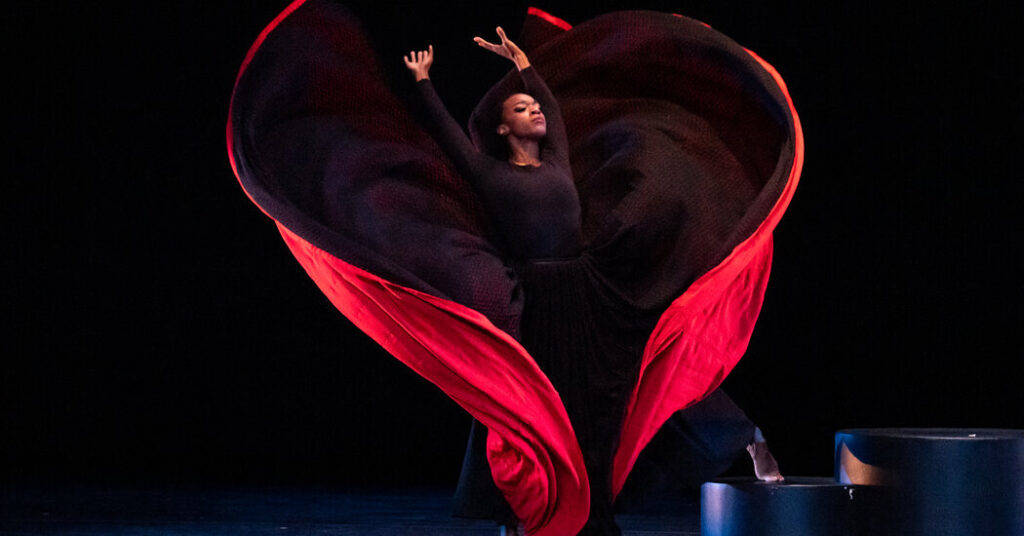
Before Martha Graham officially arrived on the scene in 1926, dance had a reputation. It was pretty. In certain circles, there still remains a battle between pointe-shoe beauty and barefoot, tensile strength. To witness Graham’s hard-won vision in action, though, is to see how she freed dance and the female body from conventional grace. In her work, there is “the grace resulting from faith,” she once wrote, “faith in life, in love, in people, in the act of dancing.”
Graham’s dances, especially her early ones, have much to say about the steely wisdom of female bodies. It was startling, this use of austere, experimental shapes to address the oppression that was brewing in the world. This season, the Martha Graham Dance Company celebrates 100 years, and for better and worse, her early works are back in fashion.
Two are included in the Graham company’s season at New York City Center: “Lamentation” (1930) and “Chronicle” (1936). (The group presents mixed bills through Sunday with live music by the Mannes Orchestra.) In those early works, Graham’s choreography stirs the stage up as dancers demonstrate faith from the inside out.
Even though they are generations removed from Graham, who died in 1991, members of the current Martha Graham Dance Company, especially the women, understand this devotion as they use the pelvis as a motor of sensation and force. More than just a dance language, the technique of contraction and release reveals the tightening and liberation not just of a dancer’s body, but of any body. Graham dancers just happen to be less repressed.
On Wednesday, the blistering “Chronicle” shared the program with “Appalachian Spring” (1944) and “Diversion of Angels” (1948), while Thursday’s program included two new works. One, the world premiere of “To the Brink and Back,” was an arresting solo by Jamar Roberts that stayed in dialogue with Graham — and not just because it was created for Lloyd Knight, a stellar Graham artist. Roberts, with a cool, subtle touch, excavated the Graham technique like a sculptor, patiently carving away excess and artifice to reveal new, shimmering bones.
Set to percussion by Stahv Danker, who performed onstage, “To the Brink” had Knight, shirtless in sheer black tights, calmly crossing a diagonal line before pausing to shift his torso slowly, revealing his body’s angles as he struck dynamic positions — feet parted wide in fourth position with his head thrown back — and then melted out of them.
Becky Nussbaum’s amber light, medieval in feeling, brushed over his rippling muscles without objectifying them. Knight’s plasticity was front and center as he moved to and against the beat, switching gears and directions, but always seeming to drift across the stage like a slow-moving mist.
In Hope Boykin’s New York premiere, “En Masse,” the score is the showpiece: a new arrangement of excerpted music from Leonard Bernstein’s “Mass” by Christopher Rountree. There is also a snippet of music — 49 seconds to be exact — that Bernstein is believed to have created for Graham in the 1980s. Roundtree creates variations on that theme in the final section.
The music flips around — dreamy and orchestral, upbeat rock, bluesy jazz — which gives the dance an episodic frame. Momentum is hard to come by, and throughout, Boykin’s choreography relies on formations that pluck the individual from the group for solos, some more maudlin and long-winded than others. Boykin’s finest muse is the formidable Meagan King, who spills onto the stage with clipped ferocity, rounding her arms and splaying her fingers as if she has electricity coursing through her veins. She’s a find.
But much of “En Masse” falls into redundant movement phrases that borrow from the Graham vernacular with a cut and paste approach. Boykin’s dances always lean into the idea of a higher power, and here performers, in shades of blue, tilt their heads upward with glistening eyes, ostensibly searching for heaven. The results are more anguished than mystical, and the ending — after a series of false ones — has the dancers converging to the front of the stage in a pack, appropriately if unsurprisingly, en masse.
As evocative as Roberts’s solo was, it seemed wrong that Graham’s dances weren’t the sole star of the company’s centennial season. Even though “Diversion of Angels,” Graham’s look at the stages of love, isn’t her most scintillating work, the dancers, particularly Anne Souder, Jai Perez and Marzia Memoli — fearless in yellow — brought passion to it.
“Appalachian Spring,” with its Isamu Noguchi set and music by Aaron Copland, is a classic, yet it doesn’t always hit the right notes. Created during World War II, it features a Bride (Souder), a Husbandman (Knight), a Preacher (Perez) and his four buoyant Followers (again, King leaped out of the pack). There is also a stately Pioneering Woman (Ane Arrieta), who, in the end, gives the couple her blessing to move into the future together.
The dance can feel both archaic and a bit too of the moment in relation to the current trad-wife trend. But there was a freshness to the opening night performance, and Souder, always impressive, has suddenly become a dancer you can’t keep your eyes off.
As the Bride, an arduous role that Graham first danced at the age of 50, she glowed with not just with elegance but with knowing wit. Dropping and turning in Knight’s arms, Souder’s lithe form flowed like a stream — natural, intuitive. Instead of “Appalachian Spring” being about submission — to the land, to a husband, to unborn children and to God — it was rooted in desire.
The most important dance so far has been “Chronicle,” a three-part work showing the Graham’s unflinching ability to fight against those who hold on too tight to power. She created “Chronicle” in 1936, the same year she refused the invitation of the Nazis to perform at the Olympic Games in Berlin.
Opening with a solo, “Spectre — 1914,” performed with ominous foreboding by the steely and statuesque Leslie Andrea Williams, “Chronicle” is an antiwar dance created in response to rising European fascism. A distillation of emotions told through tense choreography, the second section, “Steps in the Street” features a group of women, their torsos tight and strained as they methodically cross the stage like shadows of the dead.
It ends with force in “Prelude to Action” as a swirl of women race around Williams, stabbing the stage with their feet and springing into the air like fierce, floating angels. In the final moment, Williams stretches her body into an X while the others strike a single arm forward, palm flexed. Is it pretty? No. But when grace results from faith, it’s magnificent.
Gia Kourlas is the dance critic for The Times. She writes reviews, essays and feature articles and works on a range of stories.
The post The Enduring Body and Soul of Martha Graham at 100 appeared first on New York Times.