You may not have noticed, but it’s right there in the name: “and Arts.” As in, the Coachella Valley Music and Arts Festival.
Since 1999 — more than two decades as America’s most culturally influential music festival — music has dominated the spotlight at Coachella. Within the three-day festival is an immersive gallery staged over two weekends in April at Indio’s Empire Polo Club.
“The polo field is the ultimate blank canvas,” festival co-founder Paul Tollett said in the intro to the festival’s 2006 documentary, “Coachella: The Film.” “White tents. Green grass. Blue skies. The mountains. There’s not many things cluttering it up.”
Coachella’s foundational art scene had a DIY aesthetic, with early pieces including trash cans, alien sculptures and a Tesla coil. Commissions have changed over the years, allowing modern visionaries — art houses and creatives from across the globe — to showcase grand spectacles.
Artists are selected by a team led by Coachella Art Director Paul Clemente in collaboration with Raffi Lehrer. There is no open call or application. The pool is kept intentionally small, with just 12 to 16 proposals from 10 to 12 artists up for consideration each year. Each artist has roughly a 1 in 5 chance of being selected, said Lehrer, festival promoter, Goldenvoice’s curatorial advisor to the art program and the founder of Public Art Company in Los Angeles.
He said Goldenvoice searches for iconic works that will define the year, working with artists “ready to do something they’ve never done before” in “new mediums, new techniques and new ways of thinking.” The art has to fit the festival’s audience and “have the form, the color, the dynamism, the ability to connect instantly” with people who may have never been to an art gallery before.
“Opportunities to create at this scale are extraordinarily rare,” Lehrer said. “Most artists will never have a platform like this — a captive audience of 125,000, an open sky, no walls.”
Here’s a look at five artists whose works have left an indelible mark on Coachella over the years.
EMEK, COACHELLA POSTERS (2007-PRESENT)
Portland, Ore.-based Emek was already dubbed “The Thinking Man’s Poster Artist” by punk icon Henry Rollins years before he became Coachella’s resident illustrator in 2007. Festival organizers were searching for someone to create pieces similar to those at the New Orleans Jazz Festival when they saw his Musichead Gallery show featured on “Last Call With Carson Daly.”
Based in L.A. at the time, Emek was widely recognized for his blend of organic and industrial elements, establishing himself as a prolific concert poster artist. He already collaborated with Pearl Jam, Beastie Boys, The Prodigy, Phish, Radiohead, Tool and Queens of the Stone Age by the time he signed with Goldenvoice.
Growing up in a family of artists, Emek was inspired by the art clippings and 1960s rock, opera and World War II propaganda posters in his dad’s studio. From an early age he formed a clear viewpoint that has affected his work for decades: “Cool art should have text in it.”
His debut piece for Coachella captured a pastel desert with a giant California poppy-turned-Venus flytrap, its long stem ending in a stylus on a record player rooted in a tree stump. The festival’s mountains and palm trees are in the background. The word “Coachella” is placed in free-flowing sprawl across the top, punctuated with a forest green gradient and bright orange stroke.
Emek dedicates February and March to focus on Coachella’s poster, creating radical variation throughout the years while sticking to a few guidelines: No people. The art must include the San Jacinto Mountains. And there’s always a hummingbird, designed “like a mechanical Fabergé egg,” hidden among the art.
“For Coachella, it’s just something that always comes back,” Emek said. “It’s a symbol of hope and life.”
For the festival’s 25th anniversary (it went dark in 2020 and 2021 due to the coronavirus pandemic), Emek has taken an element from every poster he’s done for Coachella and compiled them into a single piece.
He draws the art by hand in sections, then scans it into a computer to color in layers. It’s output to film and screenprinted by longtime collaborator D&L Screen Printing in Seattle.
Emek posters are printed in the low hundreds for a festival serving tens of thousands, and sold for $150 to $250 depending on the variant. They’re treated like fine art by collectors. Some pieces, including his Coachella astronaut, mountain lion and turtle, are now listed for thousands in online forums and on eBay.
ROBERT BOSE, ‘BALLOON CHAIN’ (2010)
The first time New Jersey resident Robert Bose went to Coachella, he was part of the crew doing stage effects for New York electroclash duo Fischerspooner. He didn’t see much of the art, but the searchlights around the perimeter of the venue — which came together in a single point above the festival — made an impression on him.
Two years later, amid the dusty chaos of Burning Man on the Black Rock Playa in Nevada, Bose looked toward the sky once again and had a life-changing thought. He tied several balloons to two bikes so he and his girlfriend could still find each other at a distance.
“I looked straight up and it’s just going … 35, 40, 50 feet in the sky,” he said. “I just did that in a few minutes. What if I did that for an hour or two or three? How far into the sky could I go?”
Back at camp he compiled a chain of 100 balloons as people stopped to see it. The balloons became an annual practice after that.
In 2009, he came across the Coachella documentary on DVD in the bargain bin at a record store that was closing. Having not ventured into the festival when he was there, Bose was impressed by the realization that “whoever’s doing their art definitely goes to Burning Man.”
He knew Goldenvoice was producing the 2009 All Points West festival in New Jersey, so two weeks before the festival he approached its art curator at the time, Philip Blaine, with his proposal for “Balloon Chain.” It was accepted.
A year later, “Balloon Chain” debuted at Coachella 2010 and has been a staple of the festival every year, except during COVID-19 closures in 2020 and 2021.
It takes a crew of 18 to create and operate the mobile piece, which dots the desert sky from 4 p.m. to Coachella’s end each night.
It takes up to 120 biodegradable Tuftext-brand latex balloons spaced about 12 feet apart to create the chain, Bose said. They use about 900 balloons over both weekends.
“Every day we have to start fresh ‘cause … the helium starts seeping through [the balloons] and so they lose their lift over time,” Bose said. “It’s so crazy that we can build something so big and impactful but with minimal supplies.”
Outside of Indio, the chain has flown for several years at Corona Capital in Mexico City, and exhibited in countries including Japan, Switzerland, Germany and Portugal. Bose and crew have even been hired for a few celebrity birthdays and weddings.
“That some little idea of me putting some balloons on my bicycle ends up being a cultural thing — and instantly recognizable as the Coachella balloons — it never gets old,” he said.
POETIC KINETICS, ‘ESCAPE VELOCITY’ (2014) and ‘OVERVIEW EFFECT’ (2019)
Imagination was never the limiting factor for Poetic Kinetics creative director Patrick Shearn’s fourth project for Coachella. It was the physical materials he had access to at the time.
“It was driven by the largest size hemisphere I could get in acrylic to make the visor,” Shearn, based in Colorado, said. “I think it was a 10-foot diameter … everything kind of flowed back from that.”
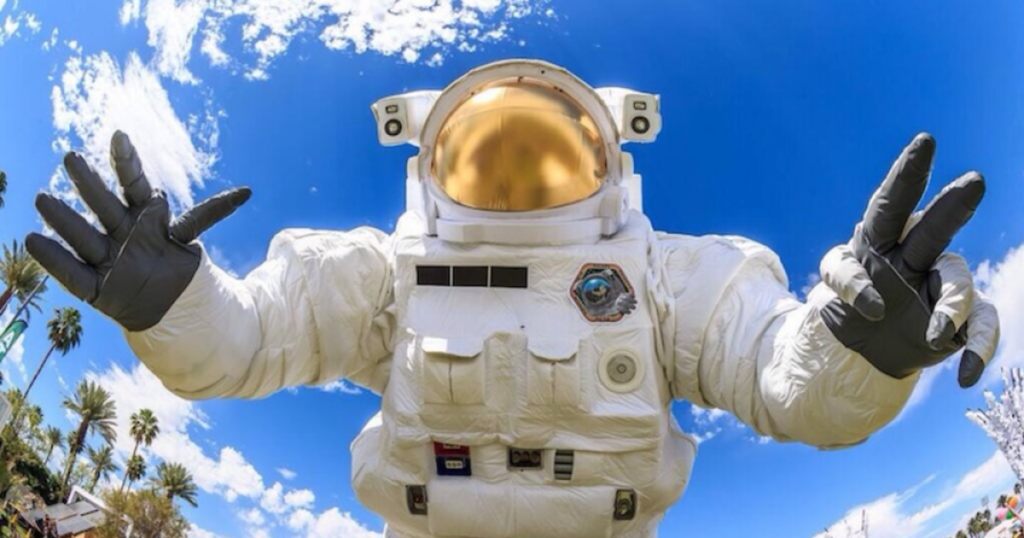
He pulled from experiences with the raptor team on “Jurassic Park,” producing giant puppetry and animatronics at the Beijing Olympics, and building towering metal flowers at Burning Man and EDC to create “Escape Velocity” — known by most as the Coachella astronaut.
Shearn and a team of about 15 modeled the astronaut around the shape of a forklift and constructed its wire frame in their L.A. studio. The threads in the suit were handmade to be 10 times bigger than normal with oversized yarn. An aluminum truss provided infrastructure, and custom joints, gimbals and animatronics gave the astronaut life.
Standing 36 feet tall, 57 feet long and 40 feet wide at final build, the piece was shipped to the festival in five loads to keep the fabric as pristine as possible. It was assembled for the first time on the polo field.
A team of nearly 50 supported operations during the festival as the astronaut roved the grounds at a speed of less than five miles an hour. Projection mapping allowed festivalgoers to see their own faces on the visor’s display. Paired with video sourced from NASA, it left the audience transfixed. Shearn did 95% of the driving, all with zero visibility, using a noise-canceling helicopter headset.
“We did crash Fatboy Slim. We went into the Sahara Tent,” he said. “We drove all the way in there. What are they gonna do? Kick us out?”
For Coachella’s 20th anniversary in 2019, Goldenvoice contacted Poetic Kinetics to bring the astronaut back. They called the second build “Overview Effect” after the “cognitive shift in awareness” experienced when viewing Earth from space.
“We came to this idea that it had come back through the atmosphere and had been scorched and burnt,” Shearn said of the design, which was adorned with festival wristbands and a VIP lanyard in alien languages. “… It had gone on this tour of the galaxy’s festivals and here it was back in the home festival.”
Poetic Kinetics strategy director Marnie Sehayek said the astronaut became part of the Coachella brand as the “most photographed art piece in the festival’s history.”
“It broke through in a way that continues to impact the way that the festival is interpreted and the way that the festival communicates with the fans,” she said.
Today, “Escape Velocity” is part of the permanent collection at the Science Museum of Minnesota in St. Paul, where it towers between the first and second floors, and sees hundreds of thousands of visitors per year. “Overview Effect” was purchased by the festival. Poetic Kinetics is contracted to display it if requested.
“We got no problem here, Houston,” Shearn said of a third outing. “Just give us a call.”
NEWSUBSTANCE, ‘SPECTRA’ (2018)
Physicality has always been the core driver for NewSubstance, the Leeds, U.K.-based creative studio responsible for Coachella’s most colorful, permanent landmark — the seven-story viewing tower “Spectra.”
NewSubstance utilizes over 20 years of experience to forge public art from a variety of immense canvases including a North Sea oil rig, Baku’s Olympic Stadium in Azerbaijan, and even the night sky above the Secret Garden Party in Cambridge, England.
Inspired by the global reach and scale of Poetic Kinetics’ “Escape Velocity,” NewSubstance first arrived on the polo field in 2016 to brainstorm.
“The site is very flat. You can see three football pitches with no drama whatsoever,” studio founder and Chief Creative Officer Patrick O’Mahony said. “… From the UK, we don’t see many sunrises and sunsets like you have in the Coachella Valley. I was there one morning at 6 a.m. before all the audience arrived and there’s this wash of color.”
The installation puts people inside that spectral array of color to capture the essence of those sunrises and sunsets. O’Mahony drew the original sketch on the flight home from the fest. It took a team of about 40 to build “Spectra,” first in a workshop in Leeds before final assembly on the festival grounds.
The tower uses 33 colors across 300 panels, made from the same toughened plastic used for fighter jet windscreens. A central steel core holds together 90 segments — “slices of cheese” as O’Mahony called them — that repeat all the way to the top. Behind every roof beam is recessed LED lighting, with individual lighting control for every strand. Different programs are designed each year and run in a sequence once the sun sets.
O’Mahony considers the installation Coachella’s accidental town hall. It was supposed to come down after the first year, but has cemented its legacy in the years since. “Spectra” has its own merch, and at least seven wedding proposals have occurred inside, he said. The tower was also memorialized in the cartoon “Family Guy” — “which blew all our minds.”
“Never had there been a resident piece before,” O’Mahony said. “It did really well in terms of an identity for the show. It’s just not gone away. I speak to them every year and go, ‘Is it the last one?’ And it’s like, ‘No.’”
Do LaB, ‘MACROdose’ (2023)
Off-the-grid electronic music haven Do LaB always felt like another world hidden within Coachella. With its latest work, “MACROdose,” free-flowing fabrics create a mesmerizing stage presentation devoid of video screens and theatrics yet just as mesmerizing.
Inspired by mushrooms, coral reefs and a renegade aesthetic influenced more by experience than formal education, it’s the culmination of 25 years of learning and design for the Pennsylvania-born, California-based Flemming brothers.
Josh and his brothers, Jesse and Dede, evolved from building forts, skate ramps and speakerboxes with their dad’s tools as kids to attending Burning Man and crafting installations and stages at Coachella and Lightning in a Bottle — the rave-turned-festival the trio runs independently.
The Do LaB first debuted under the name Lucent Misting Oasis at Coachella in 2005. The 60-foot geodesic dome provided a place for people to cool down and take in breakbeats, dubstep and, eventually, other electronic subgenres.
The dome became a makeshift stage in the middle of the field. As the crowd swelled and the sound bled, Do LaB was moved to a far corner of the terrace.
“It was a couple years after that that Josh … started to really want to do something more architectural that was more like a structure and not art,” Jesse said.
“Big Fish” was Do LaB’s first overhead piece in 2015, followed by “Beacon” two years later. That design was rebuilt in three days between festival weekends in 2018 after being decimated by 50 mph winds. “Warrior One,” inspired by an Egyptian scarab, arrived a year later.
In 2022, Josh spent a year working with a team to reinvent his style using familiar materials in a different fashion. They emerged with a multi-pod cluster built to withstand winds up to 90 mph.
“We’re still building forts, we’re just doing it at a large scale,” Josh said. “We like to say this too: ‘We’re always just f— around.’ We make fun for a living, but we don’t f— around when we’re f— around. We’re taking it very seriously.”
The stage is booked with separate acts across both weekends by Jesse Flemming and his partner Megan Perez-Carpenter, senior producer of music and content for Do LaB.
Do LaB receives hundreds of artist submissions each year, but just over 50 make the final cut. Just as many artists over the course of Do LaB’s run have moved on to play bigger stages. Others including Skrillex, Odesza, Rüfüs du Sol and Billie Eilish are among the superstars who have popped in for surprise sets, cementing the stage’s legacy within Coachella’s lore.
“Paul T. told us once, ‘The value of Coachella is incomprehensible.’ He said that people have offered him insane amounts of money for Coachella. And he had to ask himself a question: ‘If I had all the money in the world, what would I wanna buy?’ His answer was always, ‘I’d want to buy Coachella,’” Dede Flemming said.
“That’s how we feel too,” he added. “We’re already in the position of doing exactly what we would want to do if we had all the money in the world.”
The post The architects of Coachella: How five artists reshaped 25 years of the festival appeared first on Los Angeles Times.