In more than 210 churches across four continents, thousands of Roman Catholics worship every Sunday beside colorful mosaics designed by a Slovenian theologian and artist, the Rev. Marko Ivan Rupnik.
For decades, Father Rupnik’s distinctive mosaics won legions of admirers — until, about three and a half years ago, allegations emerged that he had sexually, spiritually and psychologically abused nuns. How many victims he is alleged to have abused is unclear, but a spokesman for the Jesuit religious order said it had contacted 20 people about reparations, including some witnesses.
Now, some of those women want his mosaics taken down. One wants them accompanied with labels that note the accusations. Most churches have yet to comply, a few have already covered them up, and some Catholic institutions have removed photographs of them from their websites.
Father Rupnik, 71, who has never publicly addressed the accusations, is being tried by a Vatican tribunal and has been expelled from the Jesuit order. He did not respond to requests for comment for this article.
The case has raised huge ethical and financial questions for the churches, while reigniting thorny debates about whether the value of an artwork can transcend the misdeeds of its creator.
Gloria Branciani, one of Father Rupnik’s accusers, said that, at the very least, the mosaics should be marked by a sign “making clear who Rupnik is” and what he had done. “Those mosaics are also symbols of an abuser,” she said in an interview.
The Rome-based Centro Aletti, which Father Rupnik once ran, said in a statement that removing art “ought never to be thought of as a punishment or a cure.” The statement added that Father Rupnik had denied the accusations “in the appropriate forums,” without clarifying what those were.
To some, Father Rupnik’s work should be treated no differently than that of other problematic artists whose paintings and sculptures have hung for centuries in Roman Catholic churches.
The artist Caravaggio, for example, a murderer often forced to flee from the law, produced one of Pope Francis’ favorite paintings. A crucifix by Benvenuto Cellini, a sculptor accused of theft and murder, hangs in a major monastery in Spain. And the paintings of Filippo Lippi, a priest who had a son and a daughter with a nun, adorn cathedrals and churches across Italy.
Marco Tibaldi, a Bologna-based Roman Catholic author and theologian said that Father Rupnik’s work had prompted such dispute “because the author is still alive, because the case is still open, and because he’s still creating works.” Mr. Tibaldi has removed photographs of Father Rupnik’s work from his website.
Father Rupnik was born in what is now Slovenia in 1954. He studied art and theology in Rome, and was ordained a priest in 1985. In 1991, he joined the Centro Aletti, an organization founded by the Jesuits that year to promote dialogue between the Eastern and Western Christian traditions. In 1995, he became the director of the center’s art atelier, which produces religious pieces for churches.
He won over the pope at the time, John Paul II, who commissioned the atelier’s first major artwork: mosaics for the Redemptoris Mater Chapel inside the Apostolic Palace at the Vatican.
The renown earned by the chapel work opened doors to other artistic commissions. For nearly a quarter-century, mosaicists from the Centro Aletti decorated churches and chapels on four continents, including at major shrines in Brazil, France and the United States.
Father Rupnik’s rise was halted in 2022 when allegations emerged that he had abused some of the nuns who were in his care when he was the spiritual adviser of a religious community in Slovenia in the 1980s and ’90s. One woman said that he had forced her to participate in a sexual threesome with another nun. Another said that he had groped her while they worked on mosaics in a church. Then it emerged that Father Rupnik had been briefly excommunicated because he had granted religious absolution to a woman with whom he had been intimate, a serious violation of church law.
The Jesuit order had already carried out an investigation into the allegations and expelled Father Rupnik in 2023 for “his stubborn refusal to observe the vow of obedience.”
Under Pope Francis, who was also a Jesuit, the Vatican began its own investigation, but at a slower pace. In October, about six months after Francis died, the Vatican said that it had appointed five judges to oversee Father Rupnik’s canonical trial. No further progress has been announced. The Vatican did not respond to requests for more information.
That has not stopped the women who have accused Father Rupnik from speaking out. In recent months, they have traveled widely to promote a 2025 documentary, “Nuns vs. The Vatican,” about the abuse and the broader victimization of nuns.
They have also written to bishops and church officials who oversee sites adorned by Father Rupnik’s mosaics asking that the work be removed. Only a few have publicly complied.
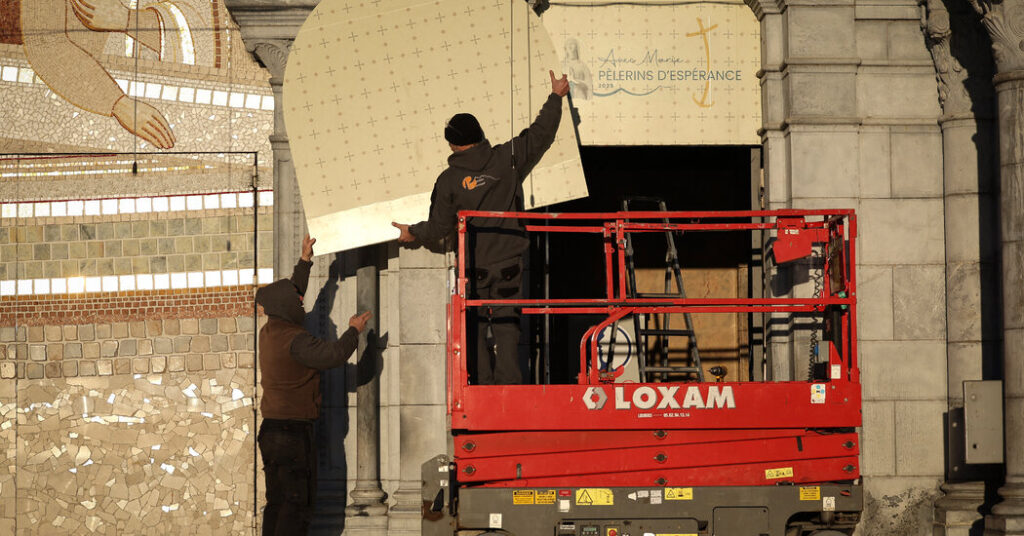
In 2024, the Knights of Columbus, a Catholic organization, announced that they would use fabric to cover Rupnik mosaics at sites it runs, the St. John Paul II National Shrine in Washington and the Holy Family Chapel in New Haven, Conn. A year ago, the bishop of Lourdes, France, announced that Rupnik mosaics at a basilica there would be covered with aluminum panels.
In Rome, the home of much of Father Rupnik’s work, no similar measures have been taken.
After the allegations against Father Rupnik were made public, some Vatican websites initially continued to use images of his work. One Vatican official even defended the use of Father Rupnik’s art, saying that the abuse case did not involve minors. Amid protests about the images, Cardinal Seán P. O’Malley, then the church’s leading adviser on sexual abuse, issued a plea for “pastoral prudence.” In selecting pictures to display, Cardinal O’Malley said, “We must avoid sending a message that the Holy See is oblivious to the psychological distress that so many are suffering.”
The Vatican websites quietly removed all images of Father Rupnik’s work in June.
Laura Sgrò, a lawyer who represents five women who have accused Father Rupnik, noted that saying the victims were not children reinforced the notion that the Vatican underplayed abuse against adult women, seeing it as merely sinful behavior by those involved rather than as a potentially lifelong trauma.
“That’s just not right,” Ms. Sgrò said.
She also expressed frustration about the lack of information about Father Rupnik’s trial, despite her countless requests to the Vatican for updates.
Some churches containing work by Father Rupnik have defended their decision to leave them untouched.
At the Corpus Domini church in Bologna, Italy, the Rev. Stefano Zangarini said that Father Rupnik’s 2013 mosaic had brought thousands of visitors to the out-of-the-way building.
“Not all works of art throughout history have been created by saints — quite the contrary,” he said, adding, “Perhaps art reminds us that there is a goodness that transcends our frailties, our ups and downs.”
In its statement, the Centro Aletti pushed back against “the widespread diffusion of the so-called ‘cancel culture,’” and said it would “await the results of the Vatican investigation” of Father Rupnik. Maria Campatelli, the center’s director, did not respond to requests for comment.
Father Rupnik is still listed on the page of team members.
The atelier continues to produce mosaics. Last year, it worked on a major church in Brazil and finished decorating another church in Bologna.
Elisabetta Povoledo is a Times reporter based in Rome, covering Italy, the Vatican and the culture of the region. She has been a journalist for 35 years.
The post Should Churches Remove Art by a Priest Accused of Sexual Abuse? appeared first on New York Times.