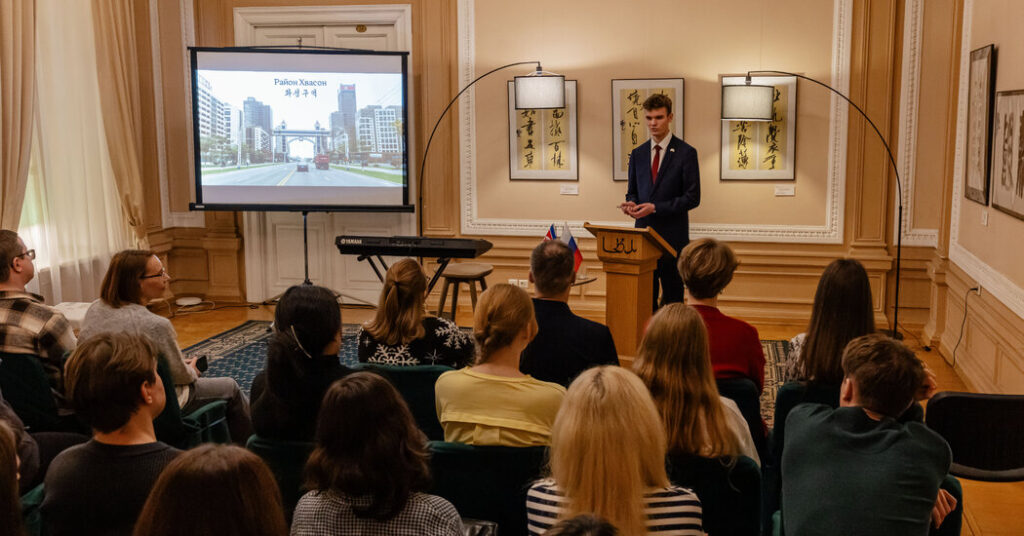
Anastasia Rusanova started learning Korean when she was 13, drawn to K-pop and the television dramas that helped make South Korea a cultural powerhouse. Now studying at a university in Moscow, she hopes to turn her hobby into a career.
But in a turn reflecting the drastic change in Russia’s global relations since its invasion of Ukraine in 2022, Ms. Rusanova now thinks her professional future might be tied to North Korea rather than its southern neighbor.
“Our country is improving relations with North Korea,” Ms. Rusanova, 21, said in an interview shortly after returning from the East Asian country as part of an exchange program. “And for me, as far as career advancement in Russia goes, North Korea seems more promising.”
North Korea, a totalitarian state most associated with famines, human rights abuses and nuclear threats, has an economy one-fiftieth the size of South Korea’s. But the Russian government sees much to like, and it has been working to promote warm feelings for North Korea among the Russian people.
As the war in Ukraine has intensified Russia’s isolation from the West, the Kremlin has looked east to like-minded authoritarian countries such as China and North Korea that see themselves as challenging a U.S.-led international order.
Pyongyang, badly in need of allies and new sources of aid, trade and military technology, has provided crucial support to Moscow in the war. It sent thousands of soldiers to fight in the Kursk region of western Russia, parts of which Ukrainian forces occupied in 2024 and 2025.
It also sends laborers that Russia needs as it loses working-age men to war and emigration. According to an estimate that South Korean intelligence officials presented to lawmakers, up to 15,000 North Koreans were toiling in Russia as of last year.
North Korea’s leaders had been “trying to engage Russia for decades, before finally succeeding,” said Fyodor Tertitskiy, a Russian-born professor at Korea University in Seoul who specializes in North Korea. “They understand that they will be useless to Moscow once the war ends, and it seems like they’re trying to build momentum with everything they can.”
For Moscow, “the relationship is built on a simple fact: Putin needs ammunition for his war. Everything else is secondary,” he added, referring to President Vladimir V. Putin.
As it seeks to build cultural ties and cement a long-term partnership, Moscow is promoting exhibitions of North Korean art, tourism to the hermitic nation and academic exchanges, all aimed at putting the North in a positive light.
Last autumn, the All-Russian Decorative Art Museum in Moscow hosted a high-profile exhibit, “Art of the D.P.R.K.: Country of a Great People,” featuring war paintings and works in the socialist realism style from North Korea, officially known as the Democratic People’s Republic of Korea. The secretary of Russia’s Security Council, Sergei K. Shoigu, and the Russian and North Korean culture ministers attended.
Other top Russian officials have sounded like ambassadors to the North Korean tourism board, rhapsodizing over the country’s summer delights.
“I was there just recently, last year — I was at the new resort of Wonsan, which I recommend everyone visit,” the Russian foreign minister, Sergey V. Lavrov, told the lower house of Parliament in February, referring to a beachy tourist spot that the North opened last year in hopes of earning foreign currency. “We were told that Russian tourists will be the top priority at this wonderful resort. The sea is magnificent, and the facilities are superb.”
The North Korean capital should not be missed either, Mr. Lavrov continued. Pyongyang is “getting better and better” every year, he said, despite international sanctions that have ravaged the North Korean economy.
Some of Russia’s most celebrated ballet, folk music and choral ensembles have performed in Pyongyang. So has a platinum-blond ultranationalist pop singer with big fans in the Kremlin. The singer, who goes by Shaman, performed last year in front of the North Korean dictator, Kim Jong-un, debuting a special ode to him.
“Comrade Kim Jong-un, Comrade Kim Jong-un, he leads the nation on,” Shaman sang. “And in his track, never looking back, the people march along.”
Culinary bridges are also forming. In Moscow, North Korean restaurants have opened, including one named Synri, or “Victory,” on Tverskaya Street, a wide boulevard that leads to the Kremlin. Top officials like Leonid Slutsky, the leader of Russia’s Liberal Democratic Party, attended a grand opening in November.
When I visited last month, waitresses served dishes from a menu that included a lobster platter, Pyongyang-style cold buckwheat noodles and soju, the national tipple. A pianist dressed in traditional garb played “Wind Beneath My Wings.”
In many cases, the push for deeper cultural ties is interwoven with harsher themes of shared military sacrifice.
“Shoulder to Shoulder,” an exhibition at the Victory Museum in Moscow, includes letters from North Korean soldiers stained in blood. It also features ornamental paintings of Russian and North Korean troops side by side in battle and equipment from the Korean War era, when the Soviet Union backed Communist forces loyal to Kim Il-sung, the grandfather of Kim Jong-un.
The exhibition, like many others, was ordered from the top. Ivan S. Koligaev, the museum’s deputy director, said in an interview that the exhibit had been “carried out by us on the instruction of the Ministry of Culture and the government.”
Not all of the Russian government’s efforts to promote North Korea are taking off. The National Library in St. Petersburg has an exhibit that features books by Kim Il-sung and family photographs. When I asked employees at the library, they seemed not to know about the display, which was centrally located on an upper floor — but with the lights off.
As a whole, though, the Kremlin’s campaign seems to be working. In 2021, before the war in Ukraine, 3 percent of Russians said they viewed North Korea as a friendly country, according to polling by the independent Levada Center. By 2025, almost a third of respondents listed North Korea as among Russia’s closest allies.
“In a semi-totalitarian regime such as Putin’s, much depends on the state, and the obedient majority accepts the state’s opinion as a given and as a guide for action,” said Andrei Kolesnikov, a Moscow journalist.
For most people, traveling to North Korea “is an exotic experience,” he said, adding, “but to a greater extent, it is a matter of symbolic support for our ‘allies.’”
Last year, Russians made almost 10,000 trips to North Korea, a record, according to data from the Russian border service. Direct flights from Moscow to Pyongyang started in July. (Three times as many Russians traveled to South Korea in 2025.)
For the past two summers, Russia has sent dozens or even hundreds of children, including some from occupied territories in Ukraine, to the Songdowon International Children’s Camp in Wonsan.
Ms. Rusanova, the university student who started studying Korean at 13, said there were now more opportunities in Russia to learn about North Korea.
Moscow universities have hosted lectures on Juche, the North Korean state ideology of self-reliance, and similar lectures are happening in other cities. Thirty Russian universities have signed cooperation agreements with North Korean institutions.
During my interview with Ms. Rusanova, she showed photographs of Koreans she had met during her exchange. She lamented that she could not stay in touch with them because the North Korean internet is closed off to the world. (Russia, while headed in the same direction, has not yet gone full North Korean in its isolation.)
“It’s very different from Russia, but the atmosphere didn’t feel like another country,” she said. “I mean, you see Korean signs, slogans, all that stuff, yeah. But everything else, just interacting with people, it’s like, well, they’re just like you.”
Choe Sang-Hun contributed reporting from Seoul, Milana Mazaeva from Berlin and Oleg Matsnev from Munich.
Valerie Hopkins covers the war in Ukraine and how the conflict is changing Russia, Ukraine, Europe and the United States. She is based in Moscow.
The post See You in Pyongyang: Russia Pushes Its People to Embrace North Korea appeared first on New York Times.