A few weeks into the first run of “Death of a Salesman,” in 1949, the playwright Arthur Miller wrote a piece for The New York Times with the headline “Tragedy and the Common Man.” The essay laid out Miller’s ambitions for his memory play about a man-in-twilight, Willy Loman, which the paper’s critic Brooks Atkinson had already raved about twice.
Even in its first days, the play was ascending into the stratosphere of American letters. Subsequent decades of that greatness have set their own pressure on the drama, sometimes compressing our understanding of it into one high school thesis topic or another — capitalism, the lie of the American dream, toxic masculinity. But in his essay, Miller is clear that Willy’s defeat must not be a foregone conclusion. Whatever the title might tell you about the outcome, “the possibility of victory must be there in tragedy,” Miller wrote. We should believe the guy can make it, every time.
Now at the Winter Garden Theater, “Death of a Salesman” has returned to Broadway, yet again in triumph. We haven’t exactly had a chance to miss it; four years ago, Wendell Pierce and Sharon D Clarke were playing Willy and Linda Loman only a few blocks away. Still, we don’t begrudge a few Hamlets every season. You’re telling me Nathan Lane and Laurie Metcalf were available? And the director Joe Mantello? To quote Willy’s older brother, Ben, played here by a sharklike Jonathan Cake: “One must go in to fetch a diamond out.”
Mantello has leaned into the play’s sense of abstraction — Willy often loses himself in his own mind — which has the effect of emphasizing both its timelessness and its timeliness. (Miller’s working title was “Inside of His Head.”) And there’s no doubt that Mantello has made a beautiful, atmospheric production, full of exquisitely calibrated performances. That beauty, though, does have its costs.
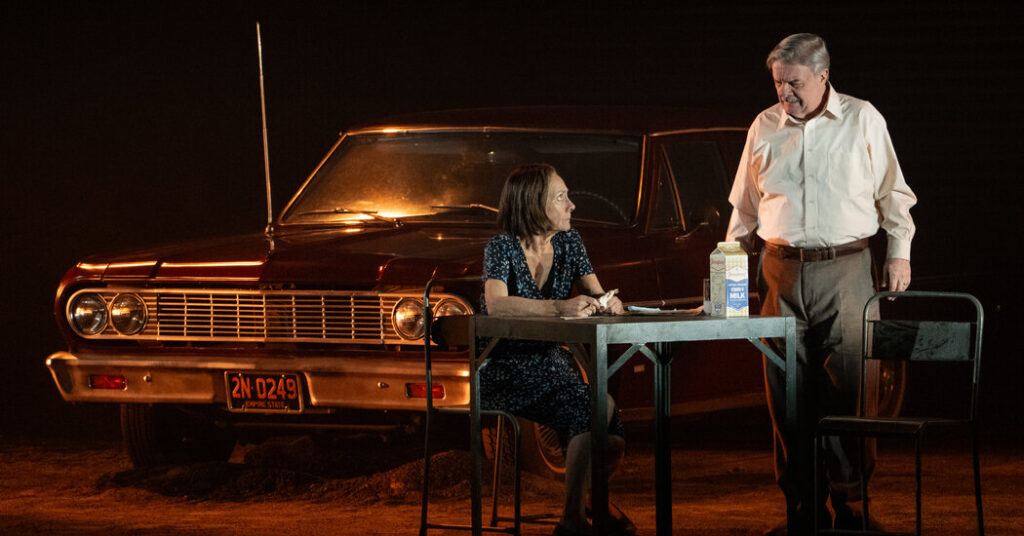
Chloe Lamford’s set ignores Miller’s domestic setting almost entirely. Everything takes place inside a huge, ruined, industrial space, backed by a triple-height metal garage door and a warehouse window that lets through only smeared, tired light. The room’s many tall columns, half covered in busted tiles, march into the wings, vanishing into a permanent gray fog. The lighting designer Jack Knowles pours in illumination from the sides of the stage, turning every face into a Caravaggio. Actors flicker among the pillars, as if among trees: It’s a garage that’s part cathedral, part Birnam Wood, part Hades.
The show begins with Willy driving his car onstage, a gleaming red 1964 Chevy, which then sits, glaring at us, through the whole show. It’s a menace; it’s a maw. Sometimes characters hop into it, then reappear mysteriously somewhere else, even though they’ve had no obvious means of escape. Mantello includes other moments of magic as well — at one point a grave materialized from nowhere; I also lost track of a watch-chain as Lane passed it from one hand to another.
We can tell from the car that we’re not in the play’s “New York and Boston of today,” or at least not Miller’s “today.” Clothes (designed by Rudy Mance) indicate, variously, the ’80s, the ’40s, and now. Whatever year it is, on the day we meet Willy, his life is already a car crash, whether he knows it or not. He’s a past-it salesman who’s too distracted to drive, too strapped to pay his insurance, too proud to admit to his wife, Linda, that he’s subsisting on “loans” from his neighbor Charley (K. Todd Freeman).
Linda tries to paper over his growing desperation with insistent cheer. His grown sons, the wary Biff (Christopher Abbott) and the himbo Happy (Ben Ahlers), have their father’s same delusional outlook, selectively remembering their history so that it’s a golden litany of ever-expanding promise. So why, with all his gifts, hasn’t Biff succeeded? Abbott’s nicely explosive performance finds the ugliness underneath Biff’s bewilderment; he seems on the cusp of violence the whole show. His tangible failure is the canker in Willy’s rose, and seeking the explanation for it — in the present, in the past — undoes them both.
Over the years, Willy Lomans have been either hulks or reeds. There’s the Brian Dennehy or Charles S. Dutton or Lee J. Cobb version, the stymied big man with a broken back. But Willy can also be the little fellow. Dustin Hoffman played him as a tiny fussbudget, reaching up to his giant, well-fed sons with pride and awe. (Look at what America can do!)
Now, in Lane, we have another slight Willy, one so light on his feet that he seems to drift like a tumbleweed. (Mantello positions him next to the looming Cake to accentuate his relative smallness.) As Willy’s weakening mind buffets him, he pivots between memory — he remembers Ben beckoning him away to seek his fortune long ago — and the current conflicts with his children. He gasps his trademark, wheezing Lane laugh, an accordion without a note. Lane seems to be in an existential hurry, anticipating his mortal punchline. No one else can do this particular merry despair: Lane’s our song-and-dance man, after the music stops.
It’s a choice, though, that cedes the play to Metcalf-as-Linda. If she turns, sometimes sharply, on her galoot-like sons, there’s no drifting to speak of. A great performance makes you hear familiar lines anew, so when Linda refers to Willy as “only a little boat looking for a harbor” it made me think of Linda as a great tanker ship, stalled behind a tugboat that has cut its engine. Her tough-as-boots Linda is a masterpiece of layered tensions, hiding pain under rage, under disappointment, under a smile. All that compression creates a kind of gravity; she only needs to peek around a column, and the whole show starts rolling toward her.
I was surprised, however, rather like Linda, to find myself at the end of Willy’s life with dry eyes. I looked down into my mind, looking for the wounds this play usually rips open and couldn’t see them. Mantello’s direction is so physically precise it amounts to choreography: The misty stage can seem like a fish tank, with Ben, Linda, Biff and Happy swimming gracefully in and out of the gloom. Mantello’s gorgeously realized production even manages to incorporate extra actors — Joaquin Consuelos as the younger version of Biff and Jake Termine as the baby-faced teen Happy — without disturbing this sense of a world unto itself.
I wonder if that perfection is the problem. If Miller thought that tragedy required the “possibility of victory,” what does it mean that everything in this sunless place glides along so smoothly? The Pulitzer Prize-winning composer Caroline Shaw has contributed an ominous score, full of horror-movie sighs and dissonances, so we spend most of the evening knowing the worst. The set is impressive, but nothing could save this salesman from death — we know he’s dead from the moment we see the stage.
This doesn’t mean that I felt nothing, though. Reading over those Atkinson reviews, I was struck at how decent he thought Willy was, despite the evidence of his actual deeds. I certainly weep every time I read the play: If a company could throw away a man who had given his whole life to it, if a man can crush his own sons simply by loving them — then, truly, tragedy will befall us all.
But, as this production makes clear, Miller’s Willy is a more carefully drawn character than that. He’s not simply an avatar for all us little guys. Willy insists on self-aggrandizing falsehood; he then bullies everyone around him into mouthing his lies too, chivying them along and talking over them till he gets his way. He isn’t Everyman: He’s a specific, recognizable kind of danger. If this is Willy as a “common man,” just imagine him with power. Sitting at the Winter Garden, I did — and I recognized him. My blood froze to ice.
Death of a Salesman Through Aug. 9 at the Winter Garden, Manhattan; salesmanbroadway.com. Running time: 2 hours 50 minutes.
Helen Shaw is the chief theater critic for The Times.
The post Review: A Cold, Perfect ‘Death of a Salesman’ for Our Time appeared first on New York Times.