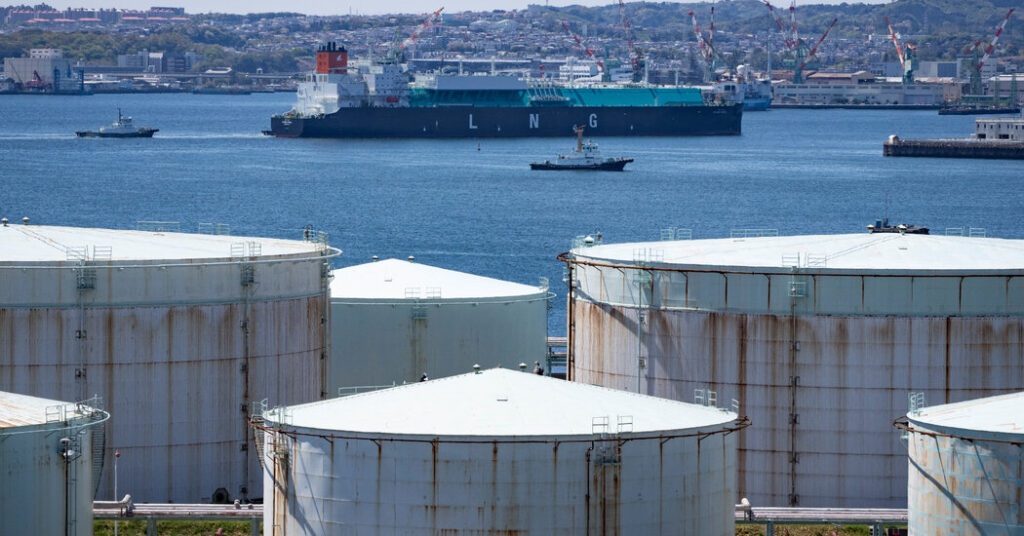
Oil prices and stocks in Asia rose on Friday as a temporary cease-fire in the war on Iran continues to face multiple hurdles, and investors braced for U.S. government data on inflation.
The Consumer Price Index, set to be released at 8:30 a.m. Eastern, will provide the most important gauge so far of how the war’s disruption of energy supplies has affected American cost of living.
Oil prices tick up.
-
The price of Brent crude, the global benchmark for oil, was about $97 a barrel, up less than 1 percent on Friday.
-
West Texas Intermediate crude, the U.S. benchmark, was around $98 a barrel, also up less than 1 percent.
-
Investors and analysts are focused on the continued disruption to shipping in the Strait of Hormuz, the narrow waterway between Iran and Oman that is a vital trading route for oil and natural gas that normally carries as much as one-fifth of the world’s oil supply.
Stocks in Asia move higher.
-
Stocks in Asia, where countries import vast quantities of oil and gas, were broadly higher on Friday. The Nikkei 225 in Japan was up 1.9 percent. Stocks in the region had mostly declined the day before.
-
Futures on the S&P 500 were flat as investors waited for the U.S. inflation report, which is due an hour before trading begins. On Thursday, the S&P 500 rose 0.6 percent, extending a rally. The index has yet to fully retrace its losses since the war began.
Gasoline prices rose again.
-
Gas prices rose again on Thursday, slightly, to a national average of $4.17 a gallon, according to the AAA motor club. The increase has raised the cost for drivers by 40 percent since the war began.
-
Gas prices do not move in lock step with crude, usually trailing increases or drops by a few days.
-
Diesel prices have increased even more quickly and stood at $5.69 on Thursday, up more than 50 percent since the start of the war.
What they are saying: “Winners and losers” in global power price surge.
-
Global energy prices have soared because of the damage the war has inflicted on supply chains. But some regions are more at risk than others, according to a report by Wood Mackenzie, an energy consultancy. “The Middle East crisis is splitting global power markets into winners and losers,” it wrote.
-
Heavily dependent on imported energy from the Middle East, Asia is contending with the most serious consequences. Market prices of liquefied natural gas in Asia have gone up 94 percent, Wood Mackenzie said. The price of coal, which is being used more as L.N.G. supplies run low, has jumped between 17 and 31 percent.
-
Wood Mackenzie counts Japan’s as the most vulnerable power market in the world — two-thirds of its electricity comes from imported gas and coal. Italy is the most exposed in Europe, at 47 percent, while the United States and Brazil face only “minimal vulnerability.”
The post Oil Ticks Higher and Stocks Rise Ahead of U.S. Inflation Report appeared first on New York Times.