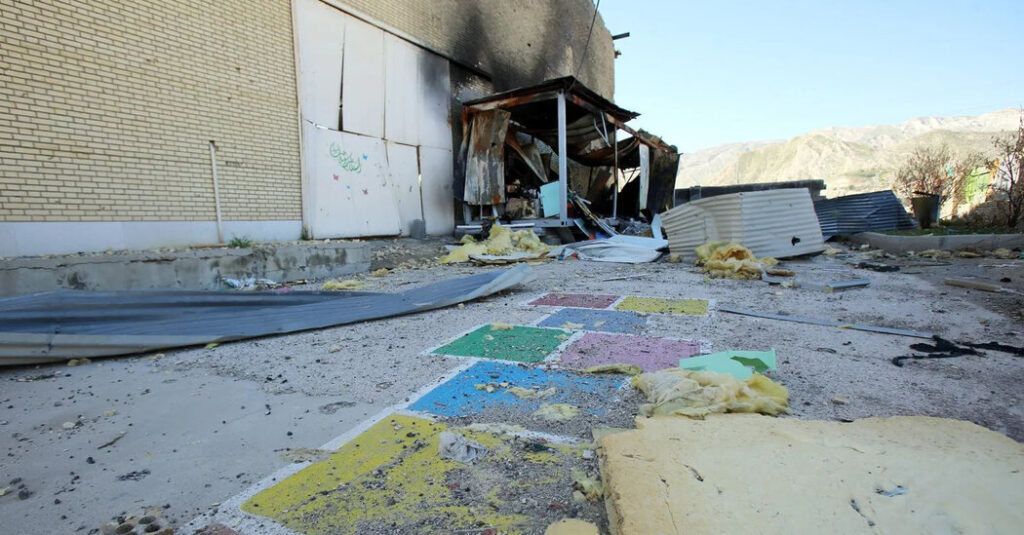
A new visual analysis by The New York Times and munitions experts has uncovered additional evidence showing that the weapons that struck a sports hall, a school and two residential areas in the Iranian city of Lamerd were U.S.-made Precision Strike Missiles, or PrSMs.
The U.S. military has rejected the conclusions of earlier investigations by The Times and other news organizations that found that PrSMs had hit civilian locations in Lamerd on Feb. 28. It has denied it was attacking there on the day in question, and claimed the incoming weapon captured on video more closely resembled an Iranian cruise missile called the Hoveyzeh, given its length.
The strikes killed 21 people, according to Iranian officials. The Times was able to independently verify the identities of the victims. At least five were children, the youngest being 2 years old. All told that would make it the second known attack by U.S. forces to result in large-scale civilian fatalities on the opening day of the war. About six hours earlier, a Tomahawk missile hit a school in Minab some 250 miles away, killing 175 people, an episode President Trump initially tried to pin on the Iranians. A military investigation’s preliminary findings later showed that the United States was responsible for the strike.
The latest analysis is based on new video footage of detonations, new photo evidence of the damage, a missile-trajectory assessment, and the perspectives of multiple experts, including three U.S. government officials.
Among the key findings:
-
The missile in the video lacks key visual features and characteristics of the Hoveyzeh and is closer in size to the PrSM. Experts have also told The Times that Iran does not have a cruise missile that functions the way a PrSM does.
-
The Times’s previous investigation identified two locations where PrSM missiles hit in Lamerd. The reporting team has now located a third. At all three locations, the missile detonations seen in videos occur directly above the target, not upon impact. This is consistent with a PrSM’s “airburst” mechanism, which is designed to explode in the air and blast more than 180,000 tungsten pellets outward.
-
At each location, those bursts of pellets created a distinctive damage pattern of pockmarking in the walls of the sports hall, nearby residential buildings and surrounding roadways.
-
The incoming angle of the missile captured in the video indicates it descended on Lamerd from the northwest, a direction that aligns with where U.S. forces are based, including Kuwait.
-
The sports hall, school and residential areas struck on Feb. 28 in Lamerd are all within 300 yards of an Islamic Revolutionary Guards Corps compound, though it remains unclear if any of the buildings in the compound were indeed hit.
Linking the PrSM to the Lamerd Weapon
The PrSM (pronounced like “prism”) is new to combat: Before the war with Iran, weapons experts had not seen it in real-world conditions. What is known about the missile has primarily been gleaned from the specifications of a similar, shorter-range weapon in the U.S. arsenal — the Alternate Warhead variant of the Guided Multiple Launch Rocket System, or GMLRS-AW — as well as from promotional materials put out by Lockheed Martin, which makes both weapons.
Lockheed features a video on its product page for the PrSM that shows a computer-animated depiction of the weapon in action: The warhead explodes and produces a dense cloud of what Lockheed calls “pre-formed fragmentation” — or tungsten pellets, in layman’s terms — rapidly expanding outward.
That promotional video also features what Lockheed says is an actual live-fire detonation of a PrSM, which shows an air-bursting explosion that projects downward to the ground. The footage appears almost identical to what is seen in videos of three separate explosions above the ground in Lamerd on Feb. 28, according to The Times’s analysis.
Debunking Claims of an Iranian Missile
U.S. Central Command, or Centcom, has contended that the missile seen in the video of the Lamerd attack “was consistent with the dimensions and silhouette” of an Iranian cruise missile called the Hoveyzeh. But The Times’s analysis as well as expert assessments essentially rule this out.
Photos of the Hoveyzeh show it has wings extending perpendicular to its fuselage as well as a jet engine that is external and affixed to the underside of the main missile body.
The video from Lamerd does not show a munition with wings or an external engine.
“The problem is that Centcom chose as a scapegoat a very identifiable missile,” said Amaël Kotlarski, who leads the weapons team at Janes, a defense intelligence firm. And, he added, the Hoveyzeh’s distinct features aren’t seen in the video.
Another critical factor: A Hoveyzeh does not have the ability to airburst — or detonate — over a target, according to a U.S. official with weapons expertise who spoke on condition of anonymity.
Similarly, Mr. Kotlarski noted that while some of Iran’s artillery rockets can explode midair over their targets, “crucially none of their ballistic missiles that we have observed so far have this type of fusing.”
Shahryar Pasandideh, another military analyst consulted by The Times, who is a fellow at the Bill Graham Centre for Contemporary International History at the University of Toronto, pointed out the same. “There is no public information to suggest that Iranian cruise missiles, including the Hoveyzeh, are equipped with an airburst fuse, let alone an airburst fuse and pre-formed tungsten pellets,” he said.
But in videos of three separate strikes in Lamerd, including the one below, the weapon is seen exploding aboveground.
Images of the aftermath show a pattern of pockmarks on surrounding streets, buildings and vehicles with no central crater — all characteristic of the PrSM, not the Hoveyzeh.
Central Command has also contended that the weapon seen in the video is “twice as long” as a PrSM, which is 13-feet, and more closely resembled the length of a Hoveyzeh, which is 20 feet. Weapons experts have pushed back on that.
Regarding the missile in the video, “The apparent length is about 15 feet,” Jeffrey Lewis, a nuclear nonproliferation expert at Middlebury College, said after completing a detailed analysis of the munition seen in the video. He added that the two-foot discrepancy in his analysis “could easily be explained by motion blur from an object moving more than 300 feet per second.”
A final factor that helps further rule out a Hoveyzeh — and implicate the PrSM — is the incoming missile’s apparent trajectory. A Times analysis of available security camera footage determined that the missile approached Lamerd at a steep trajectory from the northwest. While the in-flight maneuvering capabilities of the PrSM have not been publicly disclosed, a northwest bearing is consistent with where U.S. military forces are known to operate in the Persian Gulf.
The United States has said that at the time of the strikes it was operating in southern Iran, where Lamerd is, while its coalition partner Israel was in the north. Regarding Lamerd, Israeli military officials told The Times that it was “not aware of having conducted a strike at the specified area on the specific date.”
In its rebuttal statements, Central Command said that it did not attack Lamerd within the first 24 hours of the war and that the nearest location it did hit that day was 30 miles away, though it was not specified where. It declined to comment further when presented with these latest findings.
It remains unclear whether the strikes in Lamerd were intentional or a mishap, or whether the U.S. military may have been relying on outdated targeting data, as was the case in the strike that hit the school in Minab, according to Times reporting.
There is a documented history at the Pentagon of incomplete or inaccurate records of where and when its strikes occurred, what munitions were used and who was being targeted. A 2021 Times investigation into civilian casualty episodes in Iraq, Syria and Afghanistan found that these lapses were often a result of the Pentagon grouping together multiple airstrikes as far as 60 miles apart as a single strike, and recording the location for only one of the points struck.
The Civilian Toll
The Times reviewed the names of 21 people reported killed in the strikes on the sports hall, the school and nearby residential areas. The list was initially published by Tasnim, a semiofficial Iranian news agency. Another 110 people were injured, local health officials have said.
The Times was able to independently verify the deaths of the people named by Tasnim by cross-referencing that list with photographs and videos of coffins posted online, recordings of funeral speeches, and photos of the individuals from social media and other websites.
The strike killed at least five children, including two girls who had been attending volleyball practice at the sports hall. They were Helma Ahmadizadeh, 10, and Elham Zaeri, 11, whose deaths were first reported by Negin Bagheri, a journalist based in Iran who spoke to the victims’ family members. According to Ms. Bagheri’s reporting, Helma showed no outward signs of blood loss but told her coach that she felt as if something had entered her body. At the hospital, she was found to have a small object embedded in her. She later died from the injury.
Ms. Bagheri also reported that at the adjacent soccer pitch, a young boy, Ilia Khatami, was killed alongside his coach, Mahmoud Najafi. The Times confirmed their deaths, and the death of a second boy, Abdul Mosavar Rahmani, who was from Afghanistan, through funeral footage, social media posts and local media reports.
The remaining victims appear to have been killed in the two strikes on residential areas, according to officials cited in local media and videos and online posts by the employers and family members of those killed in the strikes.
Among the victims was Hamid Amini, 46, an engineer at Det Norske Veritas, a global risk management firm where he had worked for nearly 15 years. In a statement, the company confirmed that Mr. Amini was killed in the attack on Lamerd on Feb. 28 and described him as a “highly respected and valued colleague.”
Mr. Amini had been living in Norway and was on paternity leave visiting the city with his family. His wife and children survived the strike, the company said.
The youngest victim was 2-year-old Avina Barzegar. According to a local official cited in Iranian media, she was struck by a small object while playing outside her house. Videos show her later being treated in a hospital, but she died of her injuries; photos and videos of her body, coffin and funeral service were shared online.
Reporting was contributed by Greg Jaffe, Artemis Moshtaghian, Aaron Boxerman, Devon Lum and Aric Toler. Video production by Ainara Tiefenthäler.
Christiaan Triebert is a Times reporter working on the Visual Investigations team, a group that combines traditional reporting with digital sleuthing and analysis of visual evidence to verify and source facts from around the world.
The post New Evidence Further Implicates U.S. Missiles in Strikes That Killed 21 Civilians in Iran appeared first on New York Times.