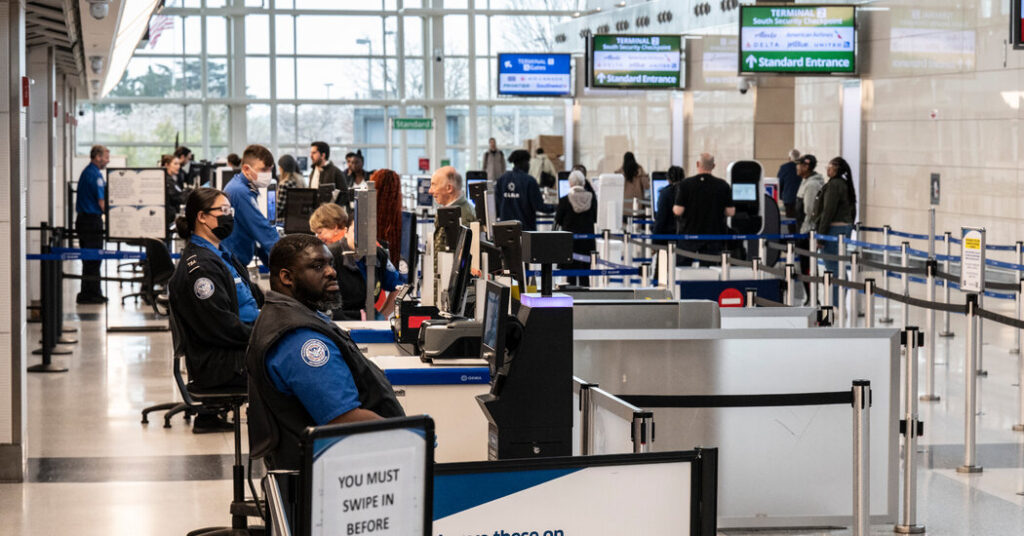
The hourslong security lines at airports eased last week after President Trump signed an order to retroactively pay Transportation Security Administration officers, who had worked more than six weeks without compensation because of the partial government shutdown. But the ordeal for both passengers and T.S.A. workers may not be over.
A wave of T.S.A. resignations and absences, driven by uncertainty over future paychecks, could lead to a staffing crisis threatening to disrupt airports further during the FIFA World Cup soccer tournament, which starts June 11.
“This is a dire situation,” Ha Nguyen McNeill, the acting T.S.A. administrator, told Congress last month. “We are facing a potential perfect storm of severe staffing shortages and an influx of millions of passengers at our airports for the World Cup games in less than 80 days.”
It is not clear when the partial government shutdown will end, as Congress went into recess until April 14 without agreeing to new funding for the Department of Homeland Security, of which the T.S.A. is a part. While Mr. Trump’s executive order will cover the next pay period in mid-April, the status of salaries after that remains in limbo.
The T.S.A. has been shut down for more than half of the 2026 fiscal year, which ends on June 30, resulting in employees working 87 days without pay. By March 27, nearly $1 billion in payroll had not been paid on time, according to the agency. With the latest shutdown coming just three months after the 43-day shutdown that began in October, many officers have been caught up in a cycle of debt, facing eviction, losing child care and having to rely on food banks.
More than 500 T.S.A. workers have resigned since the partial shutdown began in February, following 1,110 workers who stepped down during the shutdown in October and November, according to the agency.
Call-out rates peaked at nearly 12 percent nationwide in the latest shutdown, with some airports like Hartsfield-Jackson Atlanta International Airport and George Bush Intercontinental Airport in Houston reaching 40 percent.
Even after the shutdown ends, the T.S.A. will not be able to hire new officers in time for the World Cup games because of the rigorous training process, which can take between four and six months, Ms. McNeill said. Bringing back former workers will also be a challenge without the assurance of continued pay during future shutdowns.
“These government jobs used to represent stability and were attractive to younger people looking to start their lives,” said Caleb Harmon-Marshall, a former T.S.A. officer who writes a travel newsletter called Gate Access. “But now they are starting to look elsewhere because of how often these shutdowns are happening and how much impact they are having on their lives.”
Many officers have also been irked by the Trump administration’s proposal this week to cut over $1.5 billion from the T.S.A. budget, which would result in a loss of some 9,400 jobs from the agency’s work force of more than 61,000 employees.
Former agents have been reluctant to talk to the media, some saying they signed nondisclosure agreements when leaving the agency and others saying they don’t want to publicly criticize the government or agency in case they decide to return.
The T.S.A. did not respond to multiple requests for comment.
Mr. Harmon-Marshall, who keeps in close contact with former officers, believes the only way to bring them back is through the promise of uninterrupted paychecks.
“That would be a solution for the World Cup as these officers have already been trained, so you can fast-track the hiring process,” he said.
Last month, Republican Representative Nick Langworthy of New York introduced the Transportation Security Administration Pay Act of 2026, which would ensure that T.S.A. officers are paid through a transportation security fund during future shutdowns, like other essential workers. Congress is expected to debate the bill when it returns from recess.
But many workers can’t afford more missed paychecks. LaShanda Palmer, a T.S.A. officer for 24 years and president of the American Federation of Government Employees Local 333 at Philadelphia International Airport, said that retroactive paychecks will not automatically mean workers can resume their duties.
“People lost their cars, their child care, their accounts went into negative,” she said.
At the Philadelphia airport, Ms. Palmer and many of her colleagues are still working out of a sense of duty. “Everyone is doing their best, but the unknown about pay is very scary,” she said.
Johnny Jones, the secretary-treasurer of the American Federation of Government Employees T.S.A. Council 100 union, has been encouraging workers not to quit and instead to call out if they are unable to work without pay.
“This situation has created chaos, it’s destroyed people’s lives, but it’s a temporary issue that will eventually resolve,” Mr. Jones said, highlighting that shutdowns during the Trump administration have been unusually frequent. “That’s why the union is advocating for a $10,000 bonus for all employees, because they need to be made whole.”
Follow New York Times Travel on Instagram and sign up for our Travel Dispatch newsletter to get expert tips on traveling smarter and inspiration for your next vacation. Dreaming up a future getaway or just armchair traveling? Check out our 52 Places to Go in 2026.
Ceylan Yeğinsu is a travel reporter for The Times who frequently writes about the cruise industry and Europe, where she is based.
The post Is the T.S.A. Ordeal Really Over? appeared first on New York Times.