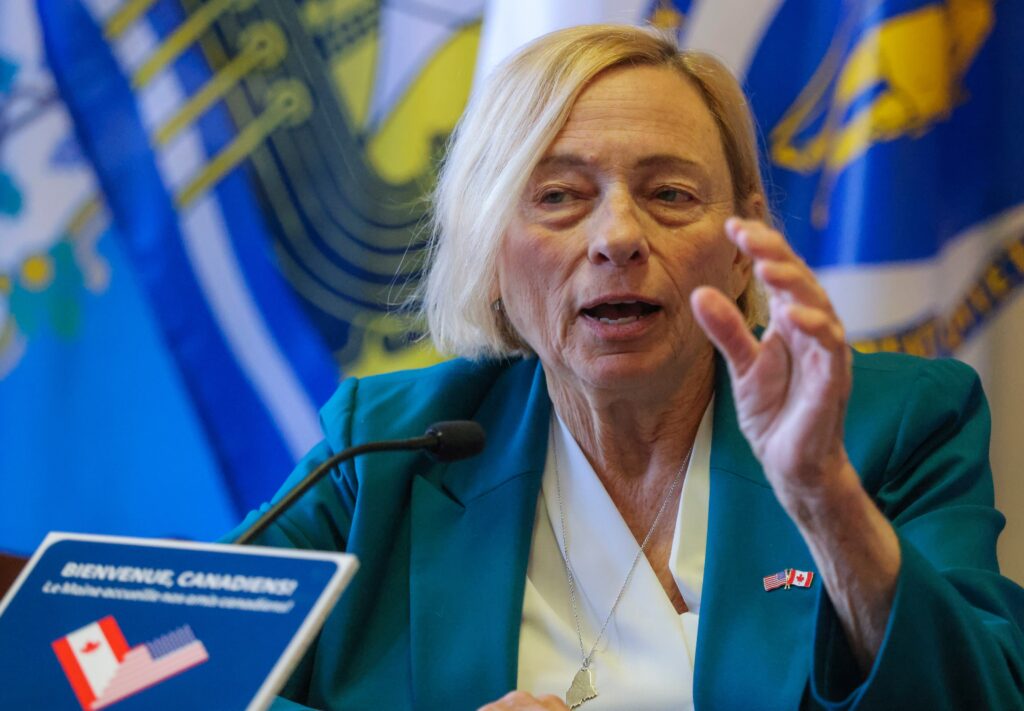
Senate Minority Leader Charles E. Schumer (D) is facing second-guessing and intense pressure to come up with a new political plan in Maine, where his top recruit to unseat Sen. Susan Collins (R) has struggled to gain traction even after launching a flurry of attacks against her upstart rival.
Gov. Janet Mills, 78, is just one of several of Schumer’s favored candidates who are struggling to catch fire in Democratic primaries from Iowa to Minnesota to Michigan, raising the prospect that he may need to rally around candidates who have criticized his leadership in blistering terms in the general election.
Mills has lagged behind her upstart liberal rival, Graham Platner, 41, in the polls since Schumer urged her to enter the race last fall. As Platner surged, Mills launched a raft of negative ads against him last month that were widely seen as her best shot at regaining a foothold in the race.
But the ads — which resurfaced Platner’s deleted Reddit comments that were dismissive of sexual assault — have not appeared to help her in recent polls, which still show her lagging far behind Platner. That leaves Schumer and Democratic groups facing a key decision: Will they aid Mills as she tries to tear down Platner ahead of the June primary, or leave her to make her case on her own, given that his lead may be insurmountable?
So far, no outside Democratic groups have come to her aid in the state on the airwaves, leaving her to run her relatively modest ad campaign against Platner on her own. Platner outraised Mills significantly in 2025 and has poured comparable amounts of money (about $500,000) into his ads rebutting her attacks as she has in prosecuting them, according to data from AdImpact. Overall, he’s outspent her by about $5 million on ads since he entered the race. (Some Democratic PACs have aired ads attacking Collins directly, but not mentioning Mills or Platner.)
Some on Mills’s team believed an outside Democratic group would come in and help the governor blanket the airwaves to take down Platner, and have been disappointed that help has yet to come.
“If you take Schumer at his word, and he was really high on Janet, then why wouldn’t they be in Maine in the beginning of the quarter? It boggles my mind,” said one person close to her campaign, who spoke on the condition of anonymity to disclose private discussions.
As of Thursday, Mills was running no TV ads at all, and her campaign declined to say whether she would re-up the attacks or switch strategies.
Chelsea Brossard, Mills’s campaign manager, told The Washington Post that the Democrat “knows how to fight and win” and will continue to do that in this Senate campaign.
“Governor Mills is ready to defeat Susan Collins, while Republicans admit they are eager to exploit Graham Platner’s abhorrent comments and never-ending controversies,” Brossard said in a statement. “We believe voters will see this contrast and our campaign will continue to spend every day focused on making this case to voters.”
Mills’s struggles are indicative of a broader Democratic rebellion against the party’s establishment, which is struggling to recapture a restive base that is angry with President Donald Trump but views the party’s older leadership as out of touch with the moment. And any failures by Schumer-backed candidates will increase pressure from a broader group of party critics who argue the leader’s time has passed.
In Michigan, Rep. Haley Stevens, a Schumer-recruited candidate, is fending off challenges from two other Democrats who have run against the Democratic establishment, including against Schumer himself. In Iowa, state Sen. Zach Wahls has worked to link state Rep. Josh Turek, his opponent in the state’s Democratic Senate primary, to the Democratic leader. “As your U.S. senator, I will not be there to work for Chuck Schumer or for Donald Trump or the billionaires or the big corporations,” Wahls said at a recent candidate forum.
Maine is central to Democrats’ plan to retake the Senate. Collins is the most vulnerable Republican senator up for reelection this year, and party operatives acknowledge they are unlikely to flip the necessary four Senate seats to take control of the chamber without winning in Maine.
The lack of outside help for Mills has left some Democrats in Maine with the impression that Schumer and other powerful Democrats are leaving her to twist in the wind as she fails to make up ground in the polls. With Platner ads airing regularly on television, Mills supporters have begun complaining to Democrats close to the governor about the lack of a response, with some wondering why Schumer recruited the governor to run if no help would be provided when she did.
Polling is notoriously difficult and unreliable in Maine, but Mills’s allies hoped to see movement in them nonetheless after she aired her anti-Platner ads. One recent poll conducted by a firm that also works for the committee that elects Senate Democrats found her lagging behind Platner by nearly 40 percentage points.
“She took some very hard swings at Platner, and he responded effectively,” said David Axelrod, the Democratic strategist and former adviser to Barack Obama. Schumer has “a decision to make as to how they want to close out this primary, and whether they invest money or time or encourage others to invest money to try to defeat the guy who’s likely to win.”
The question is growing in importance as other seats once thought to be long shots for Democrats — including in Alaska and Texas — now appear more within reach, according to polls and party operatives. A larger map will force the party to reprioritize where best to spend money.
Republicans have needled Democrats on the apparent lack of support for Mills in the ad wars, using it to paint Schumer as out of touch with the Democratic base. “Chuck Schumer is bailing out his preferred candidates across the map, but Janet Mills’ air support is nowhere to be found,” the National Republican Senatorial Committee’s regional press secretary, Samantha Cantrell, said in a statement. “As Maine’s Democrat base turns to the radical liar Graham Platner, Schumer’s dream of beating Susan Collins is slipping further out of sight.”
Operatives close to Schumer have told people in recent months that they believe Platner can’t defeat Collins in a general election, and remain wary of the plethora of deleted internet comments that include insulting police and rural Mainers, insensitive comments about Black people not tipping and more. Platner, a combat veteran, has disavowed many of the comments, saying he was suffering from untreated PTSD when he made them.
“Governor Mills is the strongest candidate to take on Susan Collins, who is increasingly vulnerable and faces record low approval ratings,” said a spokesperson for the Senate Democrats’ campaign arm.
Platner has made laps around the state, holding numerous packed town halls, while Mills has been more low-key as she juggles the governorship and the campaign trail. This week, she committed to several debates with Platner and released a policy platform.
“Mills is running like she is the incumbent, which she is definitely not,” said a Maine Democrat who is unaligned in the race, who like others spoke on the condition of anonymity to speak frankly about the state of the Mills campaign.
Some national donors have pushed back on entreaties to aid her campaign, according to one Democratic operative familiar with the conversations, who said the donors questioned whether the money would do anything given Platner’s polling advantage. And some political operatives close to Schumer are privately admitting that Platner’s lead could be insurmountable — with or without help from outside groups.
“I maxed out to her because Chuck Schumer asked me to,” said an influential Democratic donor and fundraiser. But Mills “seems to be going down the tubes.”
That’s a far cry from where Schumer thought the race would be when he pressed Mills to run last year, arguing she could be the difference between a Democratic and Republican Senate. Mills has won two races for governor and is well-known throughout the state. In January, Schumer boasted that Mills was among his top four recruits this election cycle, touting his powers of persuasion.
“You could just sit back and relax, but if we lost the Senate by one vote, you wouldn’t be happy in retirement,” Schumer told Semafor, summarizing his pitch to would-be candidates. “And it motivated them.”
Now it appears that he may have misread the moment with Mills — or the appetite of Democratic primary voters.
“She kind of got talked into this by Schumer, and it feels a little like voters are more apt to want to give her a gold watch than a Senate seat,” Axelrod said.
Adam Lee, a business owner and Democratic donor in the state who backs Mills, said Platner has capitalized on a hunger among core Democrats for a new crop of political leaders.
“Graham Platner is saying the things that people want to hear,” he said. “They look at Janet, and … they want new blood.”
Lee said Mills supporters have not written her off, even if the polls look bleak. “The people who know her and support her, we’re not ready to call this quits yet,” he said, casting doubt on suggestions she might drop out.
Schumer, who has never met Platner, has signaled a willingness to back Democrats who emerge from the heated primaries playing out across the map, even if they don’t support him. Platner has called for him to resign his leadership role.
“Anyone who knows Chuck Schumer knows his only mission is to get to 51 Democratic seats in the Senate,” said Robert Zimmerman, a Democratic National Committee member from New York. “It’s not about him or his ego.”
The post Is Chuck Schumer leaving his top candidate recruit twisting in the wind? appeared first on Washington Post.