After Taylor Swift dropped “The Life of a Showgirl” in October, fans rushed to download her songs, making it the fastest-selling album in the United States.
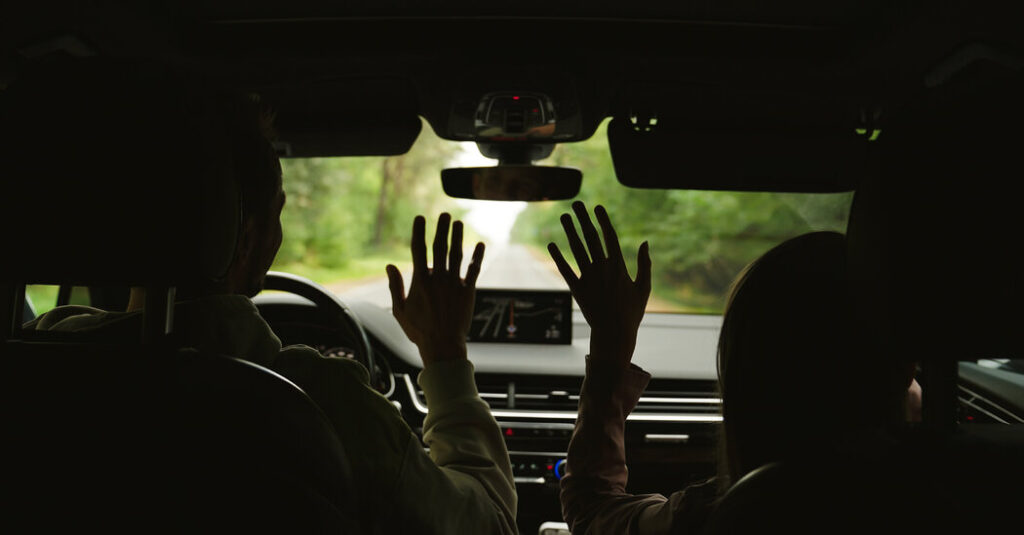
But how was their driving?
A study, published in February, has found that over the past several years, traffic fatalities in the United States increased by nearly 15 percent on the same days as the biggest album releases from artists like Ms. Swift and Bad Bunny.
Researchers from Harvard Medical School, relying on driver behavior data, found there was more smartphone use, and a lot more distractions, on those days. Their findings, “Smartphones, Online Music Streaming, and Traffic Fatalities,” was published by the National Bureau of Economic Research.
The researchers — Vishal R. Patel, Christopher M. Worsham, Michael Liu and Anupam B. Jena — wrote that data suggests that mobile device use occurs in up to 52 percent of car trips that result in a crash, fatal or otherwise.
They were frustrated though by the lack of “real-world empirical evidence” of the impact on traffic fatalities of new distractions created by smartphones, especially streaming media.
It would have been unethical to have randomized experiments involving intentionally distracted drivers, so the study authors sought another way.
They tried to find another arbitrarily timed event that might cause more drivers to use their smartphones on certain days, and then look to see what that did to traffic fatalities.
They found that album release dates were a variable.
Streaming soared on album release dates.
Music streaming surged by 40 percent on the days that the 10 most-streamed albums on Spotify — the most-used streaming service — were released in the years analyzed, 2017-22.
Streaming music is one of the most popular uses of smartphones. A media industry survey of listeners estimated that 55 percent of U.S. adults who were drivers or passengers streamed online audio in the last month.
According to the study, the 10 most-streamed albums nationwide ranged from Taylor Swift’s “Folklore” (No. 10), to the top spot, which was her “Midnights.” A stream is counted once a listener has played a track for at least 30 seconds.
Ms. Swift accounted for another top-10 slot. Drake had three albums, including one that was a collaboration with 21 Savage. Bad Bunny, Kendrick Lamar, Kanye West, and Harry Styles were the other artists on the chart.
(The release of the latest album from Ms. Swift was not included in the sample because the data only included crashes from 2017 to 2022, the latest year available at the time of the study.)
Traffic fatalities rose measurably on those dates.
The researchers overlaid the most-streamed albums data with information about each fatal crash in the United States over the same time period. Adjusting for factors like federal holidays, the researchers found 139 traffic fatalities on album release days compared with 121 on all of the 10 days before and after.
This meant there was an increase of 18.2 fatalities per release day, totaling approximately 182 fatal crashes in the United States connected to the release days of the 10 albums, according to the study.
One of the albums dropped on a Sunday, but the other nine were on Fridays. In general, Fridays have the second-most traffic fatalities, behind Saturdays, according to the National Safety Council.
Johnathon Ehsani, a professor at the Johns Hopkins Bloomberg School of Public Health, who uses policy and behavioral research to prevent motor vehicle crashes and who independently reviewed the research, described the overall findings as “fairly strong preliminary evidence” that streaming is connected to crash risk.
Referring to the approximately 40,000 fatal car crashes annually in the country, he said: “I think the bigger question here is: “How is it even acceptable? Where 120 people dying every day is the cost of getting around in this country. That’s like a plane crash or two every week. And this is adding 18 deaths.”
Album releases on Fridays don’t explain the increase.
The researchers didn’t just look at the Fridays before and after the release dates. They randomly selected 10 dates, and then an additional 10 randomly selected Fridays for comparison, and repeated the simulation 1,000 times.
The album release effect was stronger than just about every random date. Researchers then checked the same calendar dates in years when no major album was released and found no increase in fatalities.
They also did the “same date, different-year analysis” to see if those days were close to holidays or heavy travel periods that could have explained their findings. They ruled out seasonal or holiday travel as a contributing factor.
In studies done before the advent of streaming, deaths on the road were shown to be higher than usual on Tax Day, which is next Wednesday, possibly because of stress and distractions. Alcohol has been found to be a major contributing factor to a higher number of crashes on days like the Fourth of July, New Year’s Day and Super Bowl Sunday.
Distractions may be both physical and mental.
“I’d bet the physical interaction is the bigger danger, unlocking the phone, opening Spotify, scrolling through a new track list, tapping a specific song,” Dr. Patel said. “That’s eyes off the road and hands off the wheel.”
He added that simulation research showed that simply listening to unfamiliar, high-energy music could impair driving performance.
“On release day, people aren’t passively listening,” he said. “They’re actively engaged with something brand-new.”
Dr. Patel and his co-authors also learned that fatalities were significantly higher in single-occupant vehicles.
“The simplest explanation is that a passenger can handle the phone,” Dr. Patel said. “It’s like a designated driver, but for the streaming.”
The research found that the album-release effect “was more pronounced among sober drivers,” suggesting that the smartphone distraction trumped the role of alcohol. They also found that the effect was not greater during night driving.
The data also showed that fatalities were higher during clear weather, possibly because drivers felt safer using their phones then.
Technology can also be used to blunt the album-release effect.
Dr. Patel suggested that Spotify or Apple Music push a “Drive Safely” notification on major album release days.
“They already know when a major album is dropping, and they already use push notifications to promote it,” he said. “Adding a simple reminder, something like ‘New album just dropped. If you’re driving, let your passenger pick the songs’ would be a low-friction nudge in the right direction.”
Neither Spotify nor Apple commented after being told about the recommendation.
Professor Ehsani said that the technology could be used to send alerts directed to specific drivers.
“Taylor Swift fans tend to be like young and female, right?” he said. “You want these releases to be coinciding with a targeted public health prevention message. If you’re going to release a Drake album or a Kendrick Lamar album, you almost want the listeners of that audience to be the ones who receive the prevention message.”
Dr. Patel also recommended that streaming interfaces have more safety-minded features, such as larger buttons, voice-first design and fewer reasons to look at a screen.
He added that distracted driving laws were written for the texting era and have not kept pace with current trends.
Car manufacturers could design systems that help drivers enjoy their music, without taking their eyes off the road, Dr. Patel said.
“Over half of U.S. drivers now use smartphones while driving,” he said, “and that behavior has consequences.”
Adeel Hassan, a New York-based reporter for The Times, covers breaking news and other topics.
The post Is a Big Album Dropping? You Might Want to Watch the Road. appeared first on New York Times.