As President Trump turns the United States into an increasingly grumpy and unreliable partner for Britain, Prime Minister Keir Starmer is looking to diversify his friend group.
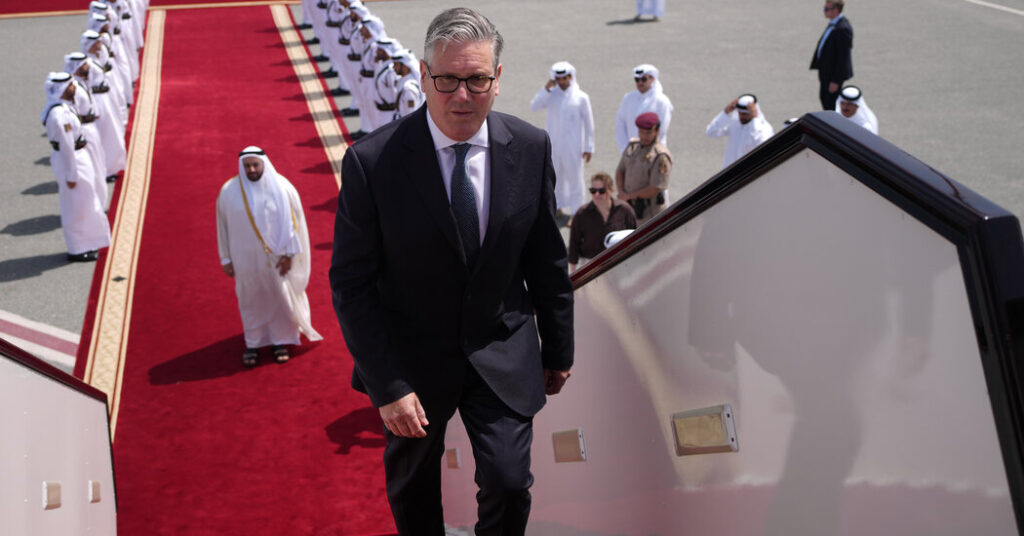
Hours after a fragile cease-fire halted the U.S. strikes on Iran this week, Mr. Starmer arrived in Saudi Arabia to begin a three-day visit to the Gulf, where he also courted leaders in the United Arab Emirates and Bahrain. It was an effort, he told ITV News, “to show that we stand with our allies.” Only toward the end of his Middle East trip did the prime minister talk with Mr. Trump.
That was no accident.
Mr. Starmer’s new approach, which follows almost a year in which he repeatedly tried to cozy up to Mr. Trump, is part of a broader strategy to move Britain closer to partners in Europe, the Middle East and elsewhere as the relationship with the United States sours.
In the six weeks since the Iran war started, the once-chummy rapport between Mr. Starmer and Mr. Trump has cratered. In the face of repeated taunts and mockery by the president, Mr. Starmer has hardened his approach, saying he will not give in to pressure from the current occupant of 1600 Pennsylvania Avenue to join the fighting in Iran.
“I’m fed up,” he acknowledged during Thursday’s interview, in a rare venting of public frustration. The prime minister, who rarely criticizes Mr. Trump by name, complained that families and businesses in Britain were unfairly subject to wild swings in their energy bills “because of the actions of Putin or Trump across the world.”
Asked about Mr. Trump’s profanity-laced social media post last week threatening to wipe out “a whole civilization,” Mr. Starmer did not hesitate to distance himself from the president.
“Let me be really clear about this,” the prime minister said, “they are not words I would use — ever use — because I come at this with our British values and principles.”
Peter Ricketts, a veteran British diplomat who served as the country’s first national security adviser, said this week that Mr. Starmer’s government needed to abandon the idea of a so-called “special relationship” between Britain and the United States, and make deeper ties with other allies around the world.
“We do have to rethink the idea that the U.S. is a reliable, trustworthy ally on which we can depend in the longer term,” Mr. Ricketts said in an interview with BBC Radio. “We’ve got to get closer to the Europeans. We’ve got to work out how we live in a world where American interest has moved away from Europe.”
He added: “I don’t think we can unsay the words that Trump has said about the fact that we have two broken aircraft carriers, old and useless. All this disparaging has to do damage.”
For his part, Mr. Starmer has made it clear that he is not giving up on closeness to the United States altogether, not least because the economic and security ties are still vital. But in recent weeks, the prime minister has highlighted the need to look beyond America.
In Bahrain, he said that Britain’s economy had struggled in the years following the Brexit vote and the subsequent deal to leave the European Union.
“That’s why, not just on defense and security but also on trade and energy, I want us to be closer to the E.U., to strengthen our economy, to make it more resilient,” he said.
That is politically difficult for Mr. Starmer, whose Labour Party pledged during the 2024 election campaign not to take major steps toward reversing Brexit or rejoining the European single market. But in his second year in office, he is increasingly testing the limits of that promise with steps to strengthen ties with the bloc.
There are other indications that Mr. Starmer’s government is trying not to rely as deeply on the United States.
On Thursday, John Healey, Britain’s secretary of defense, took the rare step of revealing a previously covert military operation to track Russian submarines caught spying in the northern Atlantic Ocean. Mr. Healey made a point of saying that the operation was a demonstration of what Britain and its allies, including Norway, can do to safeguard their waters against an aggressive Russia.
He did not mention America.
Last week, Yvette Cooper, Britain’s foreign secretary, convened a meeting of her counterparts from more than 40 countries to discuss efforts to secure the Strait of Hormuz once the fighting in the Middle East was over. The United States did not participate in the meeting or a later gathering of military planners from the same countries.
Mr. Starmer’s Middle East visit was meant to underscore a deepening alliance with Gulf leaders. While Britain did not join the attacks against Iran, its Typhoon and F-35 fighter jets have flown nightly missions over Gulf nations to help protect them from incoming missiles and drones.
It has also deployed more than 400 personnel, air defense and counter-drone units, and Wildcat and Merlin helicopters to the Middle East.
Those efforts, along with the diplomatic and military meetings organized by Britain, are part of Mr. Starmer’s attempt to take a leadership role in reopening the Strait of Hormuz, whose shipping lanes are crucial to the world economy, and to protect British interests. He said Thursday that he sees the war as a defining moment in his time as prime minister.
That kind of ambition comes with risks.
“The pressure will now be on Starmer to deliver on what he pledged — that the U.K. would step up to secure the Strait of Hormuz ‘once the fighting has ended,’” said Burcu Ozcelik, a senior research fellow at the Royal United Services Institute, a defense think tank based in London.
“We are there now,” she said, “so the question will be what is the U.K. willing to do? Washington will be watching too.”
But if Mr. Starmer is worried about what Mr. Trump will say, it’s not evident. (In fact, while the prime minister’s poll ratings in Britain remain very low, they have bumped up slightly since he began standing up to the president more.)
It was clear on Thursday that Mr. Starmer was talking about resisting Mr. Trump’s taunts about being too cowardly to join the fight against Iran.
“I make decisions on what’s in the British national interest and that is my focus,” he said. “And notwithstanding for noise and the pressure and the rhetoric, that has been my firm focus throughout this.”
Michael D. Shear is the chief U.K. correspondent for The New York Times, covering British politics and culture and diplomacy around the world.
The post ‘I’m Fed Up.’ Frustrated With Trump, Starmer Embraces Other Allies. appeared first on New York Times.