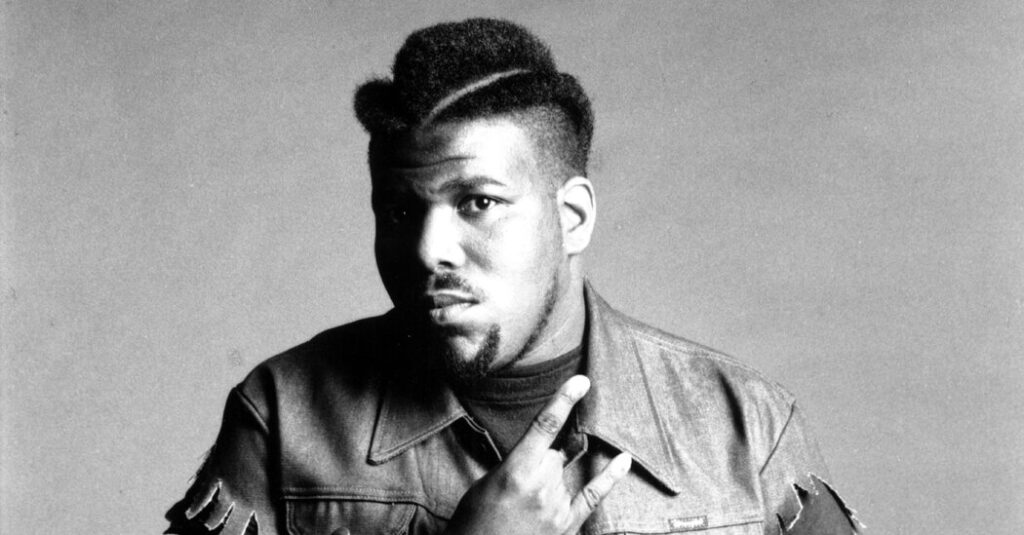
Long ago, before sneaker deals and hip-hop Super Bowl halftimes, in a place far away from the world’s business centers, an American D.J. was instrumental in creating the image and sound of a nascent culture. That culture, widely derided at first, would come to dominate the world.
The time was the 1970s, and the place was the South Bronx. The D.J. was Afrika Bambaataa. Goaded (inspired is too mild a word) by the local competition in the form of the innovator D.J. Kool Herc, Mr. Bambaataa hauled his turntables and milk crates crammed with vinyl to the block parties where a fan base had already formed for what was not yet known as hip-hop.
The beats, turntable techniques and aura of the street gatherings drew their energy from a gang called the Black Spades, which Mr. Bambaataa would recast into a loosely affiliated Pan-African movement he christened the Universal Zulu Nation.
Mr. Bambaataa, who was born Lance Taylor, died on Thursday of prostate cancer at age 68. Amid the encomiums that followed the loss of a founding father of hip-hop, fans and students of culture found themselves grappling with the problem of separating his achievements from the man himself.
In her 2023 book, “Monsters: A Fan’s Dilemma,” the essayist Claire Dederer examined a number of artists known for their misdeeds, naming Roman Polanski, Bill Cosby, John Galliano and William S. Burroughs, among many others. Mr. Bambaataa could have been among them.
His notoriety stemmed from allegations of child abuse that culminated in a lawsuit brought by an anonymous plaintiff, who accused him of sexually abusing him for four years, beginning in 1991, when Mr. Bambaataa was in his 30s and he was 12. The judge ruled in favor of the plaintiff in a default judgment, after Mr. Bambaataa did not show up in court.
Mr. Bambaataa, who denied allegations of sexual abuse, faced more than a dozen such accusations in recent years. The Universal Zulu Nation disassociated itself from him in 2016.
As news of his death circulated, the Hip-Hop Alliance, a group headed by the rapper Kurtis Blow, issued a statement that acknowledged the pivotal role Mr. Bambaataa played in helping “shape the early identity of hip-hop as a global movement rooted in peace, unity, love and having fun” and the fact that “his legacy is complex.”
Mr. Bambaataa took hip-hop from the Bronx to the Mudd Club in Manhattan — and then beyond New York, on an early hip-hop tour of Europe. He was “the generative figure, the Promethean fire-starter of the hip-hop generation,” as Jeff Chang described him in the 2005 book “Can’t Stop, Won’t Stop: A History of the Hip-Hop Generation.” Mr. Bambaataa’s death has left fans trying to reconcile their love of many foundational songs and the serious allegations against the artist who had created them.
“There’s a definite struggle between recognizing his enormous contributions as hip-hop pioneer and this great reckoning,” Monica Lynch, the president of the pioneering hip-hop label Tommy Boy Records, said.
For Ms. Lynch, as for others, the impulse remained strong to focus on his contributions to culture, including his greatest hit, “Planet Rock,” in which he joined a Kraftwerk sample to the pulse of a Roland TR-808 drum machine beneath the raps of Soulsonic Force.
And there are those intimates, like Ms. Lynch, who recalled a different Mr. Bambaataa from the unifying public figure and the man implicated in what she termed “some horrible, disturbing stuff.” Quiet, introspective, an aficionado of all musical genres, Mr. Bambaataa was foremost a vinyl geek.
His collection, already vast in the early days of his career, would eventually number over 40,000 records and would become part of an archive at Cornell University. In 2013, a selection of those records was a centerpiece of a show at Gavin Brown Projects gallery in Manhattan, an event that featured D.J. sets along with fliers, posters and ephemera from the days when hip-hop was a Bronx phenomenon.
The exhibit underscored a little celebrated dimension of Mr. Bambaataa’s contribution: his style. Inspired in equal measure by street gangs, the Afro-futurist musician Sun Ra, the funk wizard George Clinton and the Mardi Gras Indians of New Orleans, Mr. Bambaataa devised a stage persona that relied on Viking helmets, custom-tailored denims and the Afrocentric garments he adopted following a 1974 trip to Africa.
“Bam always had this sort of otherworldly planetary futuristic funk vision,” Ms. Lynch said.
That observation was echoed by Arthur Baker, the producer of some of his best known tracks. Speaking of the look shared by Mr. Bambaataa and Soulsonic Force, Mr. Baker said, “There was a stage where they were into the P-Funk, the Sun Ra look, the Zulu beads and stuff that later ended up influencing other crews, like the Native Tongues guys and Q-Tip.”
Offstage, Bambaataa favored a puffer jacket over a hoodie. To the end, his style brought to mind the cultural moment before hip-hop went global. It was a Bronx-born look, one that would become the stuff of runway shows and branded merchandise.
“In the early ’70s, mid-’70s, trends were still dictated by the local gangs,” said Pete Nice, a curator of the Universal Hip Hop Museum in the Bronx. “The Bronx was influenced by Harlem and whatever the kids gravitated toward — a certain hat or sneakers — that happened to be different enough and cheap.”
Cool, in the way that early hip-hop heroes were still cool, was a product of neighborhoods, crews and grass-roots cultures that now seem universes away from the endlessly replicated images of social media.
“The word that comes to mind is fresh,” Ms. Lynch said. “It was fresh sneakers, fresh Lee jeans, fresh T-shirts — and everything was clean. It was low-key but very conscious of what it was doing.”
Guy Trebay is a reporter for the Style section of The Times, writing about the intersections of style, culture, art and fashion.
The post ‘His Legacy Is Complex’: Grappling With Afrika Bambaataa appeared first on New York Times.