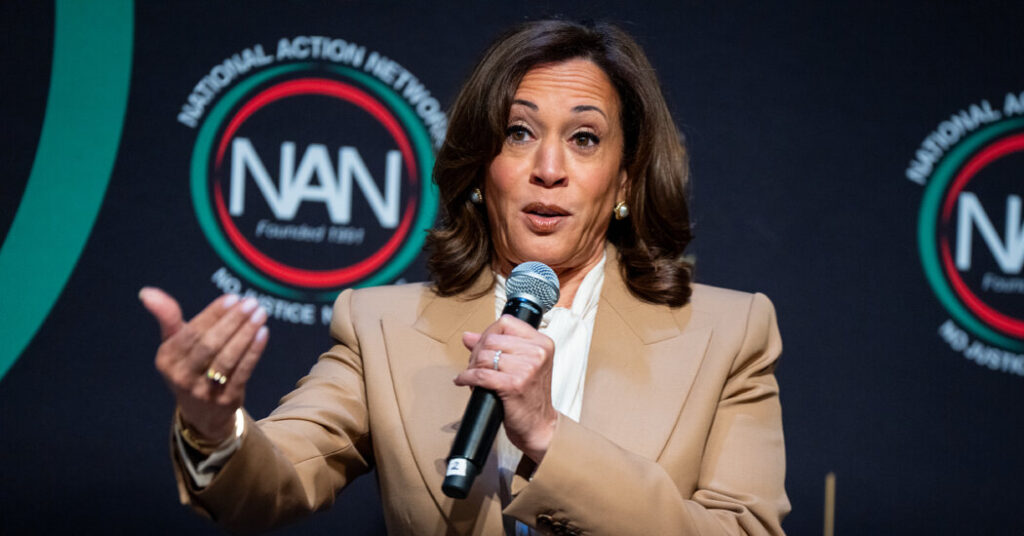
Former Vice President Kamala Harris, the 2024 Democratic nominee for president, on Friday offered some of her most detailed remarks to date about her future political ambitions, acknowledging that she was “thinking about” seeking the presidency again in 2028.
“I might,” she told the Rev. Al Sharpton at a New York City gathering of the National Action Network, a civil rights organization he founded. “I served for four years being a heartbeat away from the presidency of the United States. I spent countless hours in my West Wing office, footsteps away from the Oval Office. I spent countless hours in the Oval Office and the Situation Room. I know what the job is, and I know what it requires.”
Ms. Harris’s loss to President Trump in 2024 devastated Democrats, and many are now clamoring for a new generation of leadership. But inside a room full of Black leaders and activists, a beaming Ms. Harris — who was the first Black woman to win a major party’s nomination — received an often-raucous reception as she laced into Mr. Trump’s stewardship of the economy and international affairs.
Her appearance came as the 2028 presidential shadow primary ramped up, with more than a half-dozen potential Democratic candidates descending on Midtown Manhattan for the convention.
There, a parade of prominent governors and lawmakers highlighted their connections to Black communities, emphasized their commitments to protecting voting rights and coyly dodged questions about their presidential ambitions.
“I’m going to be more involved than ever before in 2028 because we can’t lose,” Gov. JB Pritzker of Illinois allowed on Thursday, when Mr. Sharpton pressed him on his plans.
Gov. Josh Shapiro of Pennsylvania and Gov. Wes Moore of Maryland, as well as Representative Ro Khanna of California, Senator Ruben Gallego of Arizona and former Transportation Secretary Pete Buttigieg, who ran for president in 2020 but struggled to connect with Black voters, also took part in conversations with Mr. Sharpton.
Mr. Sharpton recalled that he had lunch with Mr. Buttigieg at Sylvia’s Restaurant in Harlem as Mr. Buttigieg set out on his 2020 presidential run.
“Just so my calendar’s clear, should I be reserving a table at Sylvia’s?” Mr. Sharpton asked. “Are you going to run again?”
Mr. Buttigieg replied: “You save me a seat. I’ll be there.” His response drew cheers from the crowd, which had thinned considerably after Ms. Harris left the stage.
Gov. Andy Beshear of Kentucky, Senator Mark Kelly of Arizona and Senator Cory Booker of New Jersey are scheduled to speak on Saturday.
For decades, Black voters have been perhaps the most significant constituency in contested Democratic presidential primaries, most recently propelling Joseph R. Biden Jr. to the presidential nomination in 2020 with a decisive victory in South Carolina, his first after ignominious showings in Iowa and New Hampshire.
But — at least at this way-too-early juncture — it is not yet clear which potential 2028 candidate has the advantage with Black leaders, voters and activists nationally and in the traditional early-voting presidential primary states.
In an interview after Ms. Harris’s appearance, Mr. Sharpton said, “She sounded like she was ready.” He also said it was “fair” to say Ms. Harris would begin the race as the first choice among the crowd at the convention.
Ms. Harris has built relationships with key leaders and is a household name. Yet Ms. Harris — who is headlining a fund-raiser next week in support of the South Carolina Democratic Party and making other stops across the South — would also encounter significant challenges if she were to run again in a crowded, competitive field..
“I don’t think anyone clears the field in 2028,” said Clay Middleton, a Democratic National Committee member from South Carolina.
In some ways, the National Action Network gathering marked the first of many Democratic cattle calls to come ahead of 2028, with speakers promoting their home state records, stressing that Black voters must not be taken for granted by the party, and looking for points of connection — speaking about faith, for example — with the crowd.
“What I’m most proud of? I was raised right by my family, I was trained right by the United States Army and I serve a mighty God,” Mr. Moore said in remarks that brought many to their feet.
Speaking with reporters later, Mr. Moore, the first Black governor of Maryland, was asked about the inroads Republicans made with Black men in 2024 and how his party could reverse course.
“We need to do more than just tell Black people they’re appreciated — I think you actually need to appreciate them,” he said, encouraging his party to act with urgency on voters’ priorities.
Onstage, many criticized Mr. Trump over issues including his calls to “nationalize” elections and his handling of the war in Iran. The Friday session unfolded amid news that inflation had surged in March, as the energy shock stemming from the war rippled across the economy.
“He told the American people on Day 1 he was going to bring down prices and costs,” Ms. Harris said. “He lied.”
On Thursday, Mr. Pritzker cautioned Democrats against spending too much time discussing threats to democracy at the expense of clearly addressing pressing pocketbook issues.
“You talk to voters at the door, and you say, ‘What’s the most important issue to you?’ Five out of 100 will tell you ‘democracy,’” Mr. Pritzker said. He added, “Everybody uses this word ‘affordability,’ but we need to talk about it in very plain language. It needs to be about lowering costs for people.”
One common theme among the speakers: deflecting questions about the 2028 presidential election and insisting the focus should be on the 2026 midterms.
“I’m hungry,” Mr. Moore told the crowd. “But I’m not thirsty. And I need people to take this moment seriously.”
Katie Glueck is a Times national political reporter.
The post Harris Says She Is ‘Thinking About’ Running for President Again in 2028 appeared first on New York Times.