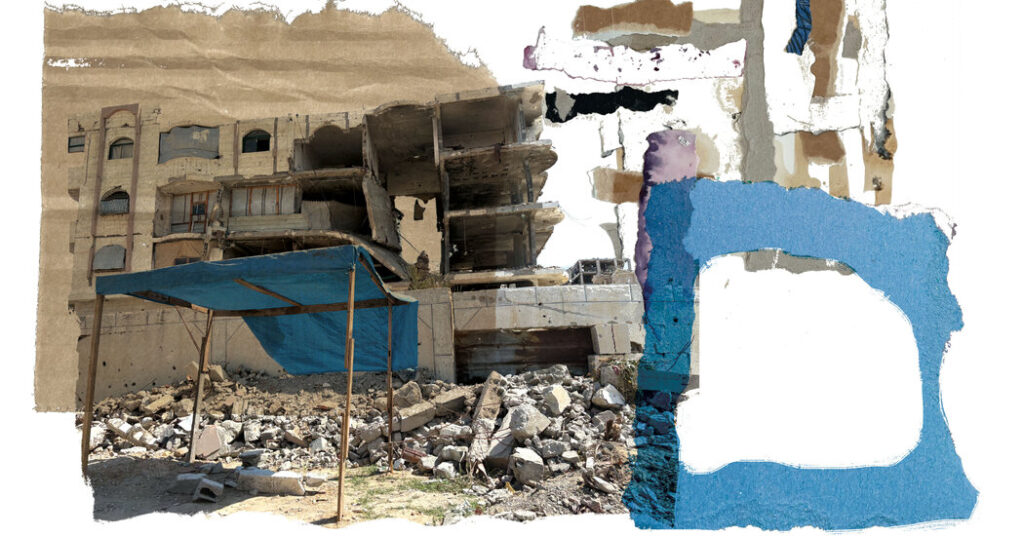
Rubble is everywhere. In Gaza, there’s more than one kind. Towers that once held dozens of families have been reduced to hills: broken slabs stacked in layers, steel bars twisted through them like exposed nerves, concrete pancaked over furniture. Sometimes, the remains of a home lean at an angle, like the Tower of Pisa. Other buildings are hollowed out from below, the lower floors erased while the upper floors hang in a crooked pause, held up by some stubborn rebar and luck. The streets narrow into corridors of debris. People walk more slowly, watching their footing, scanning for something steady before their next step.
It isn’t just the sadness of what was demolished. Seeing endless piles of concrete brings a second layer of violence — the violence of being forced to live with destruction. Rubble doesn’t just destroy the past; it erases the future. It forces your mind to stop imagining, to stop thinking, to stop dreaming about life after today.
It has been six months since the cease-fire was announced in Gaza, when the war was officially stopped. But it hasn’t stopped, not really. The Israeli airstrikes are less constant, but they still kill us — there was a drone strike that killed a man and injured a child just this week. When I talk to people abroad, they ask me if I can still hear Israeli drones at night. Once, I tried to record the buzzing as one hovered above my home, proof of the sound that has become a part of Gaza the way the sound of my own breathing is a part of me.
War, in and of itself, has become indivisible from Gaza: It’s in the landscape, in the harsh conditions that make up our days, in our bodies. Outside the strip, people speak about the future: about reconstruction, about a “new Gaza.” I’ve seen renderings that imagine it as a city like Dubai, with glittering seaside skyscrapers. But from here, it’s hard to imagine the new Gaza. The war does not feel finished. It continues to live within us. We can’t escape it.
In some places, the rubble is a grave. Amjad al-Af came to the pile of rubble next to his home last January, when the first cease-fire was announced. The 23-year-old was still injured — his leg had been crushed under concrete and some of his skin seared off from the heat of a bomb — but he wanted to use the opportunity to find his family. Or rather, the bodies of his dead family. This is how we spend cease-fires in Gaza: We clean what’s left of our destroyed homes and try to retrieve the bodies of our beloved.
Mr. al-Af’s mind drifted while we spoke, maybe to his family members in Gaza who were killed on Dec. 18, 2023. An Israeli airstrike destroyed the building where they were sheltering. “It was my father’s birthday,” he told me.
That afternoon, the family had been sitting in their garden. The area had been evacuated days earlier, but people had slowly returned to their homes. “My father told us we should get inside,” he recalled. They had heard tanks nearby. “He said we should turn on the TV and watch the news to understand what’s going on.” There were a lot of times during the war when it felt as though no one could fully comprehend what we were living through, even when we could see it with our own eyes. Airstrikes, bombshells, bullets, snipers. Famine. No water. Displacement. It’s too much for the human brain to grasp.
Mr. al-Af had just graduated with a degree in interior architecture and design when the war began, and he was hoping to continue on to a master’s degree. Before the war, his life was all about graduating and caring for his family — small ambitions that felt within reach.
While they were inside their house, explosives fell on it, whistling as they came down. His family had been prepared for evacuation: Like many in Gaza, they had a plan for where to go, which papers to take, which road, what to carry. They moved to their neighbor’s house. Mr. al-Af’s brother, father and little sister sat beside him in one room. In another room, his other sister, sister-in-law, mother and women from his neighbor’s family.
They were all there, alive for one more minute.
Then, Mr. al-Af said the room went dark. An airstrike hit.
Mr. al-Af spent about nine hours under the collapsed building, his leg pinned under rubble. During those nine hours, he couldn’t see anything, but he kept calling out names: his father’s, his mother’s, his brother’s and sisters’. No one responded.
Later on, he asked one of the neighbors who rescued him from under the rubble how many rockets had fallen on the home. The neighbor said he counted four rockets, one after the other. In Gaza we call these a “ring of fire,” a sequence of explosives, deep, penetrating missiles that make the heart pound.
Mr. al-Af refuses to let go of the rituals of life in Gaza. He was generous, almost stubbornly so when we met — insisting on serving tea, even as cooking fuel had become prohibitively expensive and such gestures were no longer simple. But our conversations often drifted back to his family members: his little sister’s giant teddy bear, his father’s way of speaking. It’s as if he is living among their ghosts.
Last January, while Mr. al-Af was picking up the rubble that was once his home, his cousins, who were also looking for their family’s bodies, called for him. They asked what his father had been wearing the night of the airstrike. “He wore navy blue pajamas with gray stripes,” he recalled.
They had found his father.
They found other bodies, too: his brother, his little sister, Celia, who was 9 when she died. Mr. al-Af said she was the light of his family’s life.
Some in Gaza would consider him lucky for being able to find the bodies of some of his family members. Others aren’t as fortunate, if you can call it that: A video recently circulated on social media showing a man using a sieve to collect the bones of his wife and five children.
When we last spoke, Mr. al-Af hadn’t found everyone yet. His mother, older sister and sister-in-law were still somewhere under the collapsed concrete.
Rubble isn’t just a grave for people in Gaza. It’s a grave for our futures.
Siham al-Hayek and I met in the house where she has been staying since the start of the war, an empty property owned by her in-laws. Living arrangements like this have become common across Gaza; families doubling and tripling up in abandoned or damaged homes while a majority remain in tents pitched everywhere: in schoolyards, in fields, by hospitals, on street medians or by the sea. There are markets, but prices are still high and goods inconsistent. You find food, but there is no refrigerator to store it in, and no power for it anyway. Some people work when they can, improvising small ways to earn or barter. Schools, for the most part, are not functioning in any regular sense; there are some educational tents where children go, but with few stationery or school supplies.
The day we met, Ms. al-Hayek had positioned four jerrycans in different corners of the room to catch rainwater leaking through the damaged ceiling.
We used to think of rain in Gaza as a blessing: It softened the air; it made the streets smell clean. During the war, it became something to fear. Families watched their tents sag and collapse. We haven’t celebrated rain since before the war. As I watched Ms. al-Hayek’s jerrycans fill drop by drop, I felt something that I’ve struggled to explain to people outside: Even the weather has changed sides here.
But Ms. al-Hayek says she considers herself lucky. She has shelter, and she has lost only material things, not people. Gratitude has become a discipline in Gaza: We have to exercise it like a muscle, even when the basic standards collapse around us. There’s a saying we would repeat during the war: money, but not children. It rhymes in Arabic: “mal” (money), but not “al-iyal” (children).
The “mal,” for Ms. al-Hayek, was the apartment she spent most of her adult life living in. Sousi Tower used to be one of Gaza’s largest and oldest high-rises. The apartment, she said, was not just a home but also a life built over years. The kitchen, especially, held her memories. It was where the family gathered, where conversations stretched for hours over coffee and tea. Her children would sit around eating sandwiches, laughing, talking — ordinary moments that now feel impossibly distant. “I had been living there almost since I got married in 2004,” she told me. “It wasn’t just a building to me. It was my sense of stability, my identity.”
In September, Sousi Tower was destroyed by Israeli missiles, all but reduced to rubble.
In the beginning, when her home was still standing, Ms. al-Hayek and her family fled when Gaza City was under an evacuation order. She heard news that Israeli snipers had taken up positions on the roof but then withdrew. Soon after, the tower was set on fire. Her apartment was burned. The area was invaded again, and an airstrike hit the tower adjacent to the one she lived in. It damaged the structure of her building.
After the airstrike next to Ms. al-Hayek’s building, part of it — the part where her apartment was — remained standing. But the stairs that led up to it collapsed. The house where she and her family had been staying was nearby, and they would walk past the tower to see how things were from time to time. Ms. al-Hayek and her family told themselves the same thing people in Gaza are forced to console themselves with in the face of such calamities: It’s OK. It’s not that bad. We can still fix it and make it livable.
Nine months later, Ms. al-Hayek was out of the house to sign up for a course that might help her get a job. The fighting and displacement were the worst they had ever been, but Ms. al-Hayek, like many others, felt she couldn’t keep her life on pause anymore. Her daughter called: “‘Mom,’ she told me, ‘Don’t come back.’” An Israeli airstrike completely destroyed what was left of Sousi Tower. “I didn’t have time for one last look,” Ms. al-Hayek told me.
When the war began, she had only five months of interest payments left on the mortgage. “We were happy,” she said. “We were sitting there dreaming, thinking we were finally done.”
When she first went back to her destroyed home, her teenage son Hamdi sweetly tried to cheer her up with jokes that the fancy sofa she never let her kids sit on and the nice glasses that she never let them use lest they break were all gone. The kids would never again have a chance to ruin them.
Now, when Ms. al-Hayek passes the rubble of Sousi Tower, she tells me her heart hurts: She can physically feel the pain in her chest. Mr. al-Af, too, said he feels the same way when he passes his neighbor’s house, where some of his family are still buried. Instead, he tries not to look at the pile at all. He tries to pass it without turning his head. To look is to be pulled back into the moment that the room went dark.
War doesn’t hand people tragedies one at a time in Gaza. They come in multiples.
That’s how I felt talking to Samaher Musleh. She was doing her laundry with a broken wash tub in her makeshift tent in Deir al-Balah, my hometown. When we first started seeing tents like hers, they were temporary, until they started organizing themselves into neighborhoods. Now they have names like Karama (“Dignity”) Camp, or Return Camp, or Hayat (“Life”) Camp. As with so many Palestinian refugee camps, what begins as temporary becomes permanent.
Ms. Musleh greeted me in her black abaya and green head scarf. Her face has an expression I’ve come to recognize everywhere in Gaza: sorrow and grief that have settled across her wrinkles and into her voice. “I used to have everything,” she said. Her neighbors would tell her she was spoiled. “I used to be surrounded by my family.”
Ms. Musleh, 49, had five children: three sons and two daughters. Her youngest, Mariam, was injured on Dec. 18, 2023. Later, as I compared my notes, I realized the date sounded familiar. Monday, Dec. 18, 2023: the same day Mr. al-Af lost his entire family. I’m not sure what to call that. A coincidence? The impact of this war is so vast that it starts to rhyme. If I asked other people what they were doing that day, there would be a bottomless well of tragedies to write about.
That day, an Israeli missile blew up near Ms. Musleh and Mariam, who was 6 years old at the time. Three pieces of shrapnel — Ms. Musleh held up three fingers as she told me — ripped through Mariam’s back. Ms. Musleh carried her daughter three miles to one hospital, then moved her to another — she had internal bleeding. It took weeks for Mariam to recover. When she was finally discharged, Ms. Musleh rejoined her family at her brother-in-law’s home. They had relocated there, believing it might be safer. But safety in Gaza is theoretical. Obeying Israel’s orders, moving from place to place, guarantees nothing. Israel started bombing the areas around them, Ms. Musleh told me: “And the shrapnel started flying again. Then the phosphorus started.” During the war, we would see plumes of the white chemical smoke over the city. When it touches the skin, it can burn down to the bone.
Her family decided to split up. Ms. Musleh took two of her sons, Jaber and Obada, and little Mariam with her. Her husband and eldest son, Nabil, stayed together at their house. She told me Nabil was studious and responsible; he had completed a degree in business administration and was even given an opportunity to travel abroad. Of her sons, Nabil was the dependable one.
After a while, Nabil left their home and decided to take shelter at a nearby school. Her youngest son, Jaber, who was 17 at the time, left for South Gaza with a friend to look for food and work. She warned him the way all mothers warn their children in Gaza, to watch out and take care of himself. He reassured her the way boys do: “‘Don’t worry,’ he told me.” Jaber was “stubborn,” she said. “Nothing will happen to me,” he told her. “Whenever you need me, call me.”
At the beginning of the war, a lot of us clung to the idea of staying together. If we were harmed, at least we’d share the same fate — no one would face it alone. But as the months dragged on, the logic of war shifted. It became harder to keep a whole family fed, warm, hidden from the bombs and moving as one unit. Under the constant airstrikes, as famine worsened, many believed that survival might require separation. If you split up, at least someone might live.
Ms. Musleh’s family made that choice, split across different shelters and family homes, trying to survive the chaos. They would call one another when they could, but the cellphone service was often cut off by the Israeli military.
One day, Nabil decided he’d check up on his father at their house. He borrowed a bicycle from another man staying at the school and rode out. He was shot, “a single bullet in the heart,” Ms. Musleh said. She heard that when one man tried to rescue him, he was shot, too. A third tried to retrieve their bodies, and he was shot as well. Ms. Musleh heard seven people were shot that day.
The shock of Nabil’s death came as another tragedy unfolded in Ms. Musleh’s life. Jaber, her youngest son, hadn’t been heard from since the day he left. He was missing: not dead, not alive, just absent — suspended somewhere between rumor and silence.
The concept of people being disappeared is new to Palestinians. I had heard of missing people from the Syrian war, but in Gaza, despite our many years of surviving war after war, we were spared from this phenomenon. Now, the conditions of war seem to swallow up people whole. Communications networks collapse for hours or days at a time. Hospitals are overwhelmed, and the injured are sometimes taken to facilities far from where their families expect them to be. When the war began, you would start seeing people post on social media that their children were missing. Then, people with disabilities went missing. And then people who weren’t children or disabled were marked as missing, too.
After Jaber stopped answering his phone, Ms. Musleh tried every channel she could find to locate him: calling relatives, chasing rumors, contacting the International Committee of the Red Cross and an Israeli human rights group. She described what he was wearing: a black sweater, black jeans. He was fair-skinned, with wide eyes and long hair.
Some people told her they had seen him in Rafah. Others said he had been killed. Someone said a body had been found. “Where? When? How?” No one knew.
The shelling in that part of Gaza was intense during that period of the war. Ms. Musleh’s family moved together after Nabil’s death, from their home to a school shelter to a refugee camp, then back to the school again. Ms. Musleh told me that one night, a quadcopter was hovering and firing above them. By morning, the gate of the school where they had been sheltering was hit. She heard a child and a young man were killed and others injured. Panic spread through the classrooms where people were sheltering, and people began to flee any way they could.
Ms. Musleh’s husband, who was staying on an upper floor with her son, insisted on staying. “‘Let’s leave,’ I told him. ‘We have no one left except for ourselves.’” But her husband insisted on staying, and he said she could leave with the kids if she wanted. She told me she felt the logic of the plan cracking. “Why am I leaving?” she thought. “Am I leaving for myself?” Then another thought followed, sharp and shameful: “My oldest is dead and my youngest is missing. For whom am I living?”
Ms. Musleh decided to stay. Not long after, the schoolyard was bombed. Obada ran upstairs to try to find his father. He came down to Ms. Musleh and told her: “My father was killed.”
“I felt death was following us,” Ms. Musleh told me.
Obada, the only son she has with her, has been posting Jaber’s name online. When Palestinian prisoners were released by the Israelis during cease-fires, he rushed toward them with the same question: Have you seen my brother?
Ms. Musleh told me about Jaber. He liked French fries, but not too crispy. He didn’t like okra. He adored spicy food. “Jaber was everyone’s friend,” she said. “He came to me twice in my dreams,” she told me.
“Every time I walk around the camp, I remember him.” She paused, then added: “Maybe his beard has grown longer.”
One afternoon some weeks ago, I was at home folding laundry — a task I’ve always disliked — trying to persuade my sister to help me with it. Music was playing from my phone when YouTube began to auto-play an old Mayada el-Hennawy song, “El Hob Elly Kan”: The love that once was. My sister told me to turn it off. She began to cry before I could understand why. I let it play anyway, listening to the lyrics more closely:
Once upon a time, love filled our home And tenderness kept us warm. Time came to visit, and stole our joy from us And our comfort And our safety
I understood why she was weeping. In Gaza, we’re living a life we no longer recognize.
Here, war has only changed form. It manifests in the smaller wars that repeat in our lives every day. Life in Gaza is lived in fragments: searching for water, charging a phone, cooking on a fire when fuel is available, checking the news, waiting. What exists now is not a return to normal life, but a warped version of it — where the mundane persists alongside the unbearable.
How will Ms. Musleh overcome her loss? How will her daughter, Mariam, live with injury, displacement? How will Mr. al-Af look at rubble without choking back tears? How will Ms. al-Hayek rebuild her future?
Hearing their stories, I think of my parents, my grandparents and other older generations, how their lives have been shaped by the Nakba, the “catastrophe” that Palestinians faced as the State of Israel was created in 1948: the displacement, the loss, the grief, the uncertainty. And above all, the memory. How that war became something they carried through the rest of their lives. I am afraid that this war will remain living within us as it did with them. Every time I recall these stories, a few of many, I try my best to move on. But there’s one question that comes back to me: not how will we survive war, but how will we learn to continue living after it?
We are alive, but there’s no going back to once upon a time. We are learning how to live in the in-between.
Ghada Abdulfattah is a Gaza-based writer and multimedia producer. She writes frequently about the stories of everyday Gazans.
The Times is committed to publishing a diversity of letters to the editor. We’d like to hear what you think about this or any of our articles. Here are some tips. And here’s our email: [email protected].
Follow the New York Times Opinion section on Facebook, Instagram, TikTok, Bluesky, WhatsApp and Threads.
The post Gaza’s Rubble Is the Grave of Our Future appeared first on New York Times.