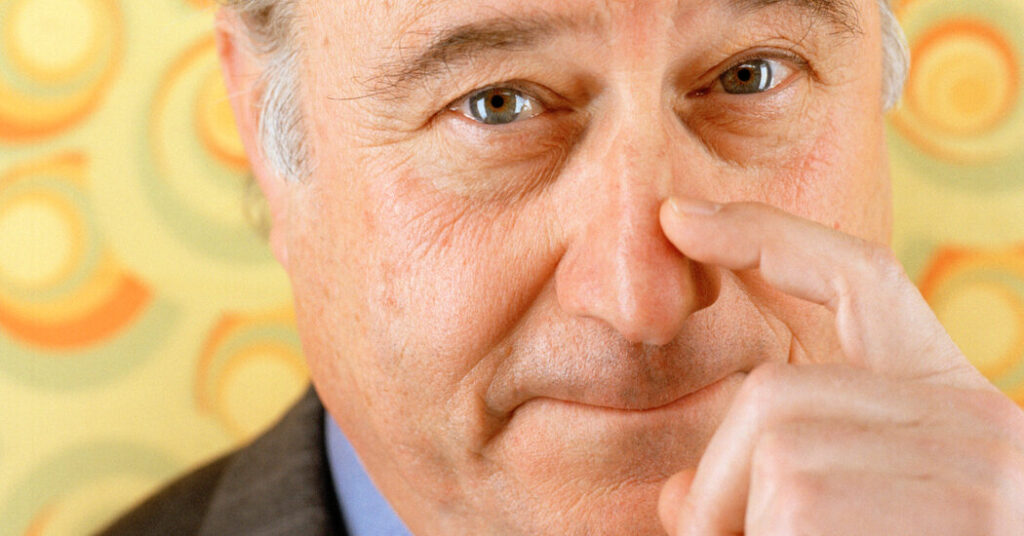
Fred Drasner, who as the stickball-playing, cab-driving, alligator-hunting consigliere to the real estate and publishing tycoon Mortimer Zuckerman ran The Daily News in New York in the 1990s, during the city’s fabled tabloid wars, died on Saturday at his home in Wellington, Fla. He was 83.
His wife, Lora Drasner, said the cause was heart failure.
Born in Brooklyn and raised in Queens, Mr. Drasner never lost his New York accent, or his verve for verbal combat.
In 1993, he and Mr. Zuckerman bought the flailing Daily News, then brought it back to profit through painful cost cutting, newsroom investments and an aggressive marketing campaign against its main rivals, The New York Post and New York Newsday. Mr. Drasner served as the newspaper’s co-publisher and oversaw its business operations.
New Yorkers of a certain age might remember him from a series of TV ads in which Mr. Drasner bragged about The Daily News as the one true hometown paper, in contrast to the newcomer New York Newsday — whose parent paper, Newsday, then owned by the Times Mirror Company, was based in the Long Island suburbs.
In one ad, he stared out across a cow field, supposedly not far from Newsday’s headquarters in quiet Melville, N.Y.
“This is the view of New York City as seen by the publisher of New York Newsday,” he told the camera. (What he didn’t note was that the Newsday offshoot, trying to establish a presence in the city, had its editorial offices in Manhattan.)
In another ad, Mr. Drasner stood in a New York street, doffed his suit jacket and challenged the Newsday publisher to a game of stickball. Then, taking a bat from a nearby teen, he knocked a ball down the street. “Two sewers,” he said to the viewer.
Mr. Drasner did more than drag his competitors. A tough-as-nails negotiator, he spent long nights and weekends persuading the newspaper’s unions to make concessions. He showed his working-class bona fides by riding in delivery trucks and hanging out at printing presses.
He pushed marketing teams into parts of the city where his competitors’ readers lived, and he filled his pages with reporting that doubled as attacks on those competitors’ owners and editors.
They pushed back, in part by attacking Mr. Drasner. The New York Post reported that while hunting in upstate New York, he had come across a pond full of snoozing ducks and proceeded to shoot them. Though he denied the report, Mr. Drasner became known in news circles as the Duckslayer.
He was the perfect foil to the urbane Mr. Zuckerman, though both were fierce businessmen at heart. Mr. Zuckerman fashioned himself an intellectual, and wrote a biweekly foreign-affairs column in the magazine U.S. News and World Report, which he bought in 1984. Not Mr. Drasner, who let his hair grow long in the back and preferred flying his own airplane to hobnobbing with other media elites.
After retiring in 2004 and moving to Florida, outside Palm Beach, he took up alligator hunting. “I’m the world’s richest 8-year-old,” he told The Washington Post in 2001.
But his rough-edged persona was belied by a deep understanding of the news business and an appreciation for what it produced. “He liked being thought of as a philistine, yet he was a lot deeper than that,” James Fallows, who worked with him as an editor at both U.S. News and World Report and The Atlantic, another Zuckerman property, said in an interview.
Mr. Drasner had been Mr. Zuckerman’s personal lawyer before Mr. Zuckerman bought U.S. News and World Report and installed him as its president and chief executive; the magazines Fast Company and The Atlantic likewise fell into Mr. Drasner’s portfolio.
Their decision to buy The Daily News for $36 million (about $82 million in today’s currency), with Mr. Drasner as a minority owner, was a major risk: The paper had lost about $100 million in the previous decade, thanks to mismanagement and a crippling six-month strike.
They hired Martin Dunn, a savvy British editor, to run the newsroom, moved their printing operation to a high-tech plant in New Jersey and added about 100 editors, reporters and critics to their rolls.
Within a year, they said they were making a profit. New York Newsday ceased publication in 1995. For the moment, The Daily News was New York’s dominant tabloid, and by then, Mr. Drasner was already looking for his next challenge.
In 1999, he and Mr. Zuckerman joined Dan Snyder, a Maryland businessman, to buy the Washington Redskins, the professional football team now known as the Commanders.
Though Mr. Zuckerman, never much of a sports fan, soon sold his shares to Mr. Snyder, Mr. Drasner stayed on and became a close adviser to Mr. Snyder, even helping him face down hard-bargaining agents over prospective players.
“I was never going to do something that wasn’t fun,” he told The Washington Post. “At the end of the day, I’m the one who’s gonna be dead. When they close the box, I don’t want to say, ‘Woulda, shoulda, coulda.’”
Fred Drasner was born on Jan. 2, 1943, in Coney Island and grew up in Far Rockaway and later Forest Hills. His father, David, was an accountant and his mother, Shirley (Kobitz) Drasner, ran the household.
Fred began working part-time jobs while in high school and in college at New York University. He bused tables at resorts in the Catskills and drove a cab around Manhattan.
He graduated with a bachelor’s degree in accounting in 1965. He received his law degree from American University in 1971 and a master’s in tax law from N.Y.U. in 1972.
At his first job as a lawyer, with the Washington-based firm Shaw Pittman Potts & Trowbridge (today Pillsbury Winthrop Shaw Pittman), Mr. Drasner stood out as a tireless worker. He made partner in just four years.
He developed a reputation for hard-edge negotiating. Before a marathon session he would eat a big late lunch, then push talks deep into the night, never getting up from his seat, until he wore his hungry opponents down.
Mr. Drasner’s first two marriages, to Judith Ordover and Cynthia Coulson, ended in divorce. He married Lora Weynands in 2004.
Along with his wife, he is survived by a daughter from his first marriage, Johanna Haban; a daughter from his second marriage, Amanda Drasner; and his brother, Kenneth.
Mr. Drasner first encountered Mr. Zuckerman when Mr. Zuckerman hired Shaw Pittman to handle a legal dispute. The tycoon was so impressed with Mr. Drasner that he hired him as his personal lawyer.
The two clashed repeatedly through their decades-long working relationship, tension that they batted away as creative differences whenever rumors of it dribbled into public.
“We’ve worked together for 25 years,” Mr. Zuckerman told The Times in 1998. “How can we not get along?”
But as The Daily News faced renewed financial challenges in the late 1990s, the distance between the two widened. Among other problems, Mr. Zuckerman publicly fumed about the amount of time his confidante was spending on football.
“When he’s on the ground, he’s very good — as good a businessman as I’ve ever seen — but you have to be on the ground,” he told The Washington Post in 2001. “Would I have preferred it if Fred were devoted full time? Of course.”
Mr. Zuckerman replaced Mr. Drasner with Ira Ellenthal as head of his magazines in 1998. Mr. Drasner stepped down as co-publisher of The Daily News in 2004. (Mr. Zuckerman sold the newspaper in 2017.)
Mr. Drasner bought a boat, and he and his wife spent three years sailing around the world. His late-in-life adventuring was no surprise to those who knew him as a peripatetic spirit.
“I like the action, I don’t like the maintenance,” he told The Washington Post. “Once it’s about meetings and people skills, that I leave to others. I don’t like business as usual.”
Clay Risen is a Times reporter on the Obituaries desk.
The post Fred Drasner, a Feisty Leader of The Daily News, Is Dead at 83 appeared first on New York Times.