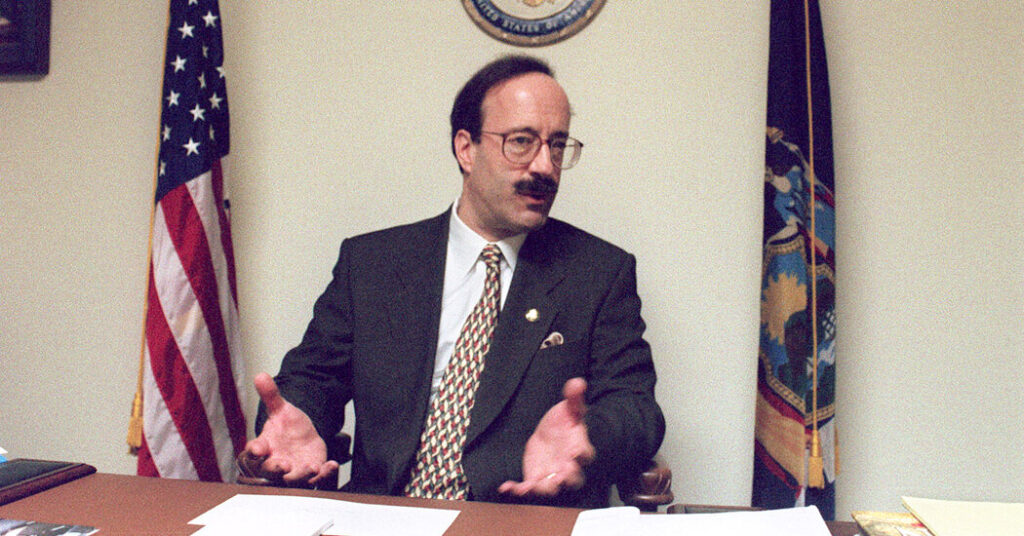
Eliot Engel, a 16-term Democratic congressman from the Bronx who rose to chair the House Foreign Affairs Committee but whose political fortunes were undone in 2020 when a live microphone caught him making an ill-advised comment in the aftermath of the killing of George Floyd, died on Friday in a hospital in the Bronx. He was 79.
His death was announced in a statement from his family which did not provide the cause.
As an insurgent former New York State assemblyman, Mr. Engel was first elected to the House of Representatives in 1988 after toppling Representative Mario Biaggi, a 10-term incumbent and a fixture of New York politics, in the Democratic primary. Mr. Biaggi had resigned his seat after being charged in a corruption scandal, but his name had remained on the ballot because nominating petitions had already been filed.
Once he took office, Mr. Engel championed liberal causes, supporting the Affordable Care Act while endorsing an even broader single-payer health care system; backing legislation to improve maternity care and combat tuberculosis; and seeking to reduce the nation’s dependence on imported oil.
After Democrats took control of the House in the 2018 midterm elections, Mr. Engel was elevated to the chairmanship of the Foreign Affairs Committee. He had been the committee’s ranking minority member since 2013 and a fervent supporter of Israel, embracing Jerusalem as its undivided capital.
But having been re-elected 16 times to represent the Bronx and southern Westchester County — variously in the 16th, 17th and 19th Districts as redistricting maps changed — Mr. Engel’s political fortunes ran out in 2020.
Stung by criticism that he had shunned his home state during the Covid-19 pandemic, remaining mostly in Washington, he lost the Democratic nomination in 2020 in the 16th District to Jamaal Bowman, a Yonkers school principal who had outflanked him from the left, 55 percent to 40 percent.
He did not help himself during the primary campaign when he appeared at a news conference in the Bronx with other local officials in early June to address unrest in the aftermath of the killing of Mr. Floyd, the Black man suffocated by a white police officer during an arrest the previous month in Minneapolis.
When the Bronx borough president, Rubén Díaz Jr., said that there was not enough time for Mr. Engel and other elected officials to speak, Mr. Engel incautiously responded into an open microphone, “If I didn’t have a primary, I wouldn’t care,” repeating, “If I didn’t have a primary, I wouldn’t care.” His comment cost him support from fellow Democrats.
What he meant, he said later, was that “in the context of running for re-election, I thought it was important for people to know where I stand. That’s why I asked to speak. Of course I care deeply about what’s happening in this country; that’s what I wanted to convey. I love the Bronx.”
In a city represented by a dozen members of Congress competing for attention, Mr. Engel managed to stand apart.
Physically, he was distinguished by his Groucho Marx mustache. Politically, he nimbly juggled alliances both with party reformers and the Democratic establishment.
Beginning in 1989, he guaranteed himself maximum visibility every January when the State of the Union address was televised live, by showing up early to snare an aisle seat in the House chamber so that his constituents could see him greeting the president.
“It’s an honor to shake the hand of the president of the United States, no matter who it is,” Mr. Engel once explained.
After 29 years, he ended that tradition in 2017, when he drew the line at exchanging pleasantries with his fellow New Yorker, President Trump.
“I will listen to what he has to say today,” Mr. Engel said, “but I will not greet him and shake his hand.” He cited concerns about Mr. Trump’s hard-line policies on immigration and reports of Russian interference in the 2016 election.
Eliot Lance Engel was born on Feb. 18, 1947, in the Bronx, a grandson of Jewish immigrants from Ukraine. His father, Philip, was an ironworker. His mother, Sylvia (Bleend) Engel, kept the home.
Raised since he was 12 in Eastchester Homes, a middle-income housing project in the northeast Bronx, he developed an affinity for politics during John F. Kennedy’s presidential campaign in 1960.
He graduated with a bachelor’s degree in history from Lehman College of the City University of New York in 1969, earned a master’s degree in school counseling there in 1973 and a law degree from New York Law School in 1987.
He taught and served as a guidance counselor in the city’s public schools from 1969 to 1977, when he ran in a special election for the State Assembly. The incumbent, Alan Hochberg, a Democrat, had been convicted of trying to bribe a potential rival and had resigned.
Running as the Liberal Party nominee, Mr. Engel won by 103 votes, a margin of about 1 percent, defeating the Democratic and Republican candidates to become the first New York assemblyman elected solely on the Liberal line.
Serving in the state legislature from 1977 to 1988, Mr. Engel chaired the Committee on Alcoholism and Substance Abuse and the subcommittee on the Mitchell-Lama subsidized housing program.
He is survived by his wife, Patricia (Ennis) Engel; a daughter, Julia; two sons, Jonathan and Philip; three grandchildren; and a sister, Dori Kaplan.
Mr. Engel’s defeat in 2020 left Jerrold Nadler of Manhattan as the only remaining Jewish member of New York City’s congressional delegation. Mr. Nadler announced last year that he would not seek re-election in 2026.
Sam Roberts is an obituaries reporter for The Times, writing mini-biographies about the lives of remarkable people.
The post Eliot Engel, a 16-Term Bronx Liberal in Congress, Dies at 79 appeared first on New York Times.