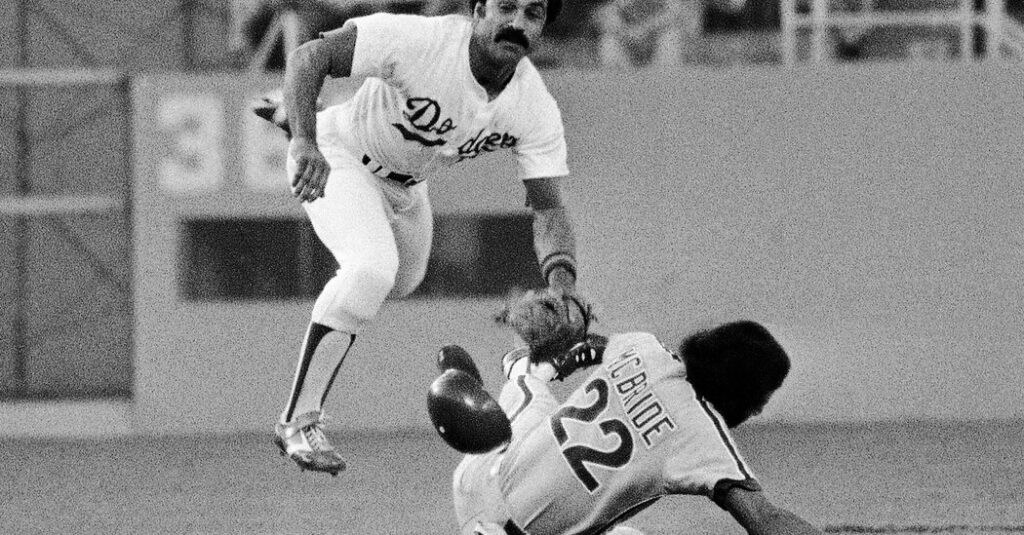
Davey Lopes, an All-Star second baseman for the Los Angeles Dodgers who was one of the most successful base stealers in baseball history, died on Wednesday in Providence, R.I., near where he grew up. He was 80.
A spokesman for the Dodgers said his death, in a hospital, was from Alzheimer’s disease and Parkinson’s disease. One of his sisters had been caring for him. He had previously lived in San Diego.
In 1973, his first full season with the Dodgers, Lopes became a pillar of the team’s dynamic infield, alongside Steve Garvey at first base, Bill Russell at shortstop and Ron Cey at third. They started a record 833 games together over 8½ seasons.
“He was the catalyst to the engine, and it was 700 horsepower with the four of us,” Garvey told reporters after Lopes’s death.
There were still plenty of hungry base thieves in Major League Baseball at that time, including Lou Brock, Rickey Henderson, Joe Morgan, Bill North, Omar Moreno and Willie Wilson. Lopes followed in the sprinting footsteps of another Dodger, the shortstop Maury Wills, who stole a record 104 bases in 1962.
In 1975, a year after Brock broke Wills’s single-season record with 118 steals — which Henderson then eclipsed with 130 in 1982 — Lopes led baseball with 77 stolen bases, including 38 consecutive successful attempts without being caught, an M.L.B. record at the time. The next year, his 63 steals led the National League. He stole five bases in a game in 1974.
“Good base stealers have an attitude,” he told MLB.com in 2016, when he was a coach for the Washington Nationals. “They like to run. You can actually control the game if you are good out there. The good base stealer intimidates. If the catcher threw me out, I would say, ‘What did I do wrong?’ I would never wonder what he did right.”
Lopes saw base stealing as an integral part of taking charge of the basepaths.
“A running team puts a lot of pressure on the other side,” he told The Los Angeles Times in 1976. “You pressure the catcher, obviously. But in addition, you put a lot of heat on the infield. One of the guys in the middle has to be moving, and that opens up another hole to hit through. And very often, the pitcher eases up a little.”
He proposed that aggressive base running was more fun than a home run.
“Home runs are dramatic, but how many do you see?” he said. “Besides, the moment the ball is hit, it’s all over.”
He added: “There’s more excitement when you’re running the bases. It begins to build when you get on first and keeps building until you either steal second or get thrown out. Everybody in the park knows you’re going to go.”
Lopes continued to steal until he neared the end of his career. As a part-time player with the Chicago Cubs in 1985, when he was 40, he stole 47 bases.
Overall, in 16 years with the Dodgers, the Oakland A’s, the Cubs and the Houston Astros, Lopes stole 557 bases, which ranks 26th all-time. (He stole 20 more bases in postseason games.) He was thrown out 114 times, giving him a success rate of 83 percent, better than the nearly 81 percent achieved by Henderson, the career stolen-base leader, with 1,406.
“He’s the best there is at stealing,” Johnny Bench, the Hall of Fame catcher with the Cincinnati Reds, told a Dodgers publication in 1976. “Lopes not only has the knowledge and speed, but also the quick acceleration. He has everything.”
David Earl Lopes was born on May 3, 1945, in East Providence, R.I., and grew up in South Providence. He was one of 10 children raised by his mother, Mary, a domestic worker. His father, who was from Cape Verde, an island country off the coast of West Africa, left the family when Davey was a toddler. The family was said to be impoverished, subsisting on his mother’s earnings and welfare payments.
Davey found an outlet in sports. A local coach, Mike Sarkesian, mentored him and later recruited him to two colleges at which Sarkesian was hired as athletic director: Iowa Wesleyan University in Mount Pleasant, Iowa, and then Washburn University in Topeka, Kan.
While at Washburn, in 1967, Lopes batted .380, with nine home runs, and earned all-conference honors. He was also a starting guard on the school’s basketball team.
Although he was drafted by the San Francisco Giants in 1967, Lopes decided to stay at Washburn another year. The Dodgers drafted him in 1968. He graduated from Washburn in 1969 with a bachelor’s degree in education.
After five seasons in the Dodgers’ minor league system, Lopes was called up to the majors late in the 1972 season and became a regular in 1973. Through his final season with the Dodgers, in 1981, he played in four World Series, winning one, against the Yankees in 1981. He was chosen for four All-Star Games and won one Gold Glove Award.
Lopes was not big — 5-foot-9 and 170 pounds — but he was strong enough to hit 155 home runs in his career, including 28 in 1979.
He had his best statistical day at Wrigley Field in Chicago in August 1974. A week before the game, Red Adams, a Dodgers coach, advised him that manager Walter Alston wanted him to walk and bunt more.
“The first time up — bang — a home run,” Lopes said in an interview with Ross Porter, a former Dodgers announcer, for the book “The Ross Porter Chronicles, Volume 1: The Dodger Years” (2025, with Mike Kunert). “Second time up — bang — a home run. And Red Adams comes up and says: ‘Davey, forget what Walt said. Just keep swinging.’ So I hit another one.”
After the 1981 season, the Dodgers were prepared to make Steve Sax their starting second baseman and traded Lopes to Oakland, where he was Henderson’s teammate. Lopes was sent to the Cubs in 1984, then to Houston in 1986. His final stolen base came as a pinch runner in the eighth inning of an Astros-Cubs game in August 1987. He stole second off the reliever Lee Smith.
Retiring after that season, he spent the next two decades coaching for the Dodgers, the Texas Rangers, the Baltimore Orioles, the San Diego Padres, the Philadelphia Phillies and the Nationals. He also managed the Milwaukee Brewers to losing records in 2000 and 2001 before being fired early in the 2002 season.
Information on his survivors was not immediately available.
Dusty Baker, who played with Lopes on the Dodgers and managed the Nationals when Lopes was one of his coaches, said in a phone interview that, as a base runner, Lopes “had good instincts and good anticipation.”
“He knew the pitchers’ idiosyncrasies and where you could get a hell of a jump,” Baker added.
Lopes passed his knowledge on to other players, but, as Baker recalled, “He would tell guys something, and they’d get a good jump, but they’d stop, because they couldn’t believe how right he was. Sometimes they stole the base, and sometimes they got caught.”
Richard Sandomir, an obituaries reporter, has been writing for The Times for more than three decades.
The post Davey Lopes, Base-Stealing Maestro, Is Dead at 80 appeared first on New York Times.