The Bureau of Economic Analysis released gross domestic product numbers for the states and D.C. on Thursday. In the fourth quarter of 2025, the D.C. economy fared worse than during the depths of the Great Recession.
Inflation-adjusted economic output contracted by 8.3 percent on an annualized basis compared with the third quarter. In contrast, during the first three months of 2009, the city’s economy contracted by 4.3 percent.
A big part of the explanation for the last three months of 2025 is the 43-day federal government shutdown that dragged on from Oct. 1 to Nov. 12, combined with the reduction in the size of the federal workforce under President Donald Trump.
But D.C.’s economic underperformance predates Trump’s second inauguration. The city’s economy contracted in three out of four quarters in 2022, even as the U.S. economy grew in three out of four quarters that year.
Downtown has been much slower to recover from covid than most other major U.S. cities, partly because of overly permissive policies on remote work.
In only three of the 16 quarters since the start of 2022 has the D.C. economy outperformed the national average. In the 16 quarters before the pandemic, from 2016 to 2019, D.C. outperformed in nine of them.
Between January 2025 and January 2026, D.C. lost workers in every sector except construction. The unemployment rate of 6.7 percent this January was 1.3 percentage points higher than any state and 2.4 percentage points above the national average.
Federal employment will always play an outsize role in a capital city’s economy, but it cannot be the only driver of growth. Attracting more private investment and development in the District must be the top priority for all city leaders.
That doesn’t mean bribing businesses with taxpayer money to relocate here. Even if corporate welfare worked as a long-term growth strategy, D.C. doesn’t have the budget for it.
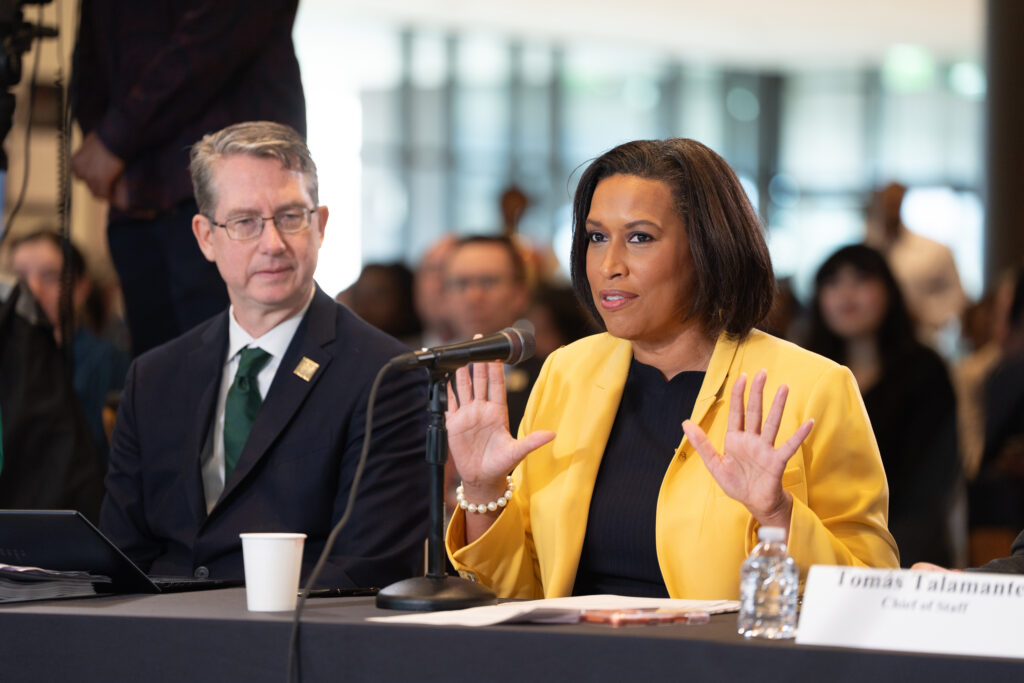
Outgoing Mayor Muriel E. Bowser’s final $21.2 billion budget, released on Friday, proposes $469 million in necessary cuts. The Democrat is right to call for putting off employee raises, as well as paid medical leave, early childhood pay, workforce development and affordable housing programs that aren’t producing good results.
Cutting significant bloat from the city’s budget will be important for whoever succeeds Bowser as mayor. Increasing the city’s already substantial tax burden, as the socialist mayoral candidate Janeese Lewis George proposes to do, wouldn’t just hold back future growth but risks pushing D.C. into a fiscal death spiral.
The city has a spending problem, not a revenue problem: The municipal government took in 62 percent more money last year than it did in 2015.
D.C. still has plenty going for it that private businesses desire. Three regional airports provide national and global connectivity. A heavy concentration of top universities, plus satellite campuses for universities from around America, produce 100,000 college graduates a year. The city’s unique neighborhoods and walkable lifestyle are attractive to many employees.
The city has sometimes been described as having a “recession-proof economy” due to federal employment not following the business cycle. But federal employment as a share of the city’s workforce has been declining since the end of 2020. It’s now about seven percentage points lower than its peak in 2010. Regardless of Trump’s actions, relying on the federal government for economic growth is not where the city’s future lies.
The post D.C.’s economy shrank by 8.3 percent in the fourth quarter appeared first on Washington Post.